| Question | Short Answer |
|---|---|
| Why is Agave murpheyi called Hohokam agave? | Modern populations occur near Hohokam archaeological sites and descend largely from pre-Columbian agricultural plantings. |
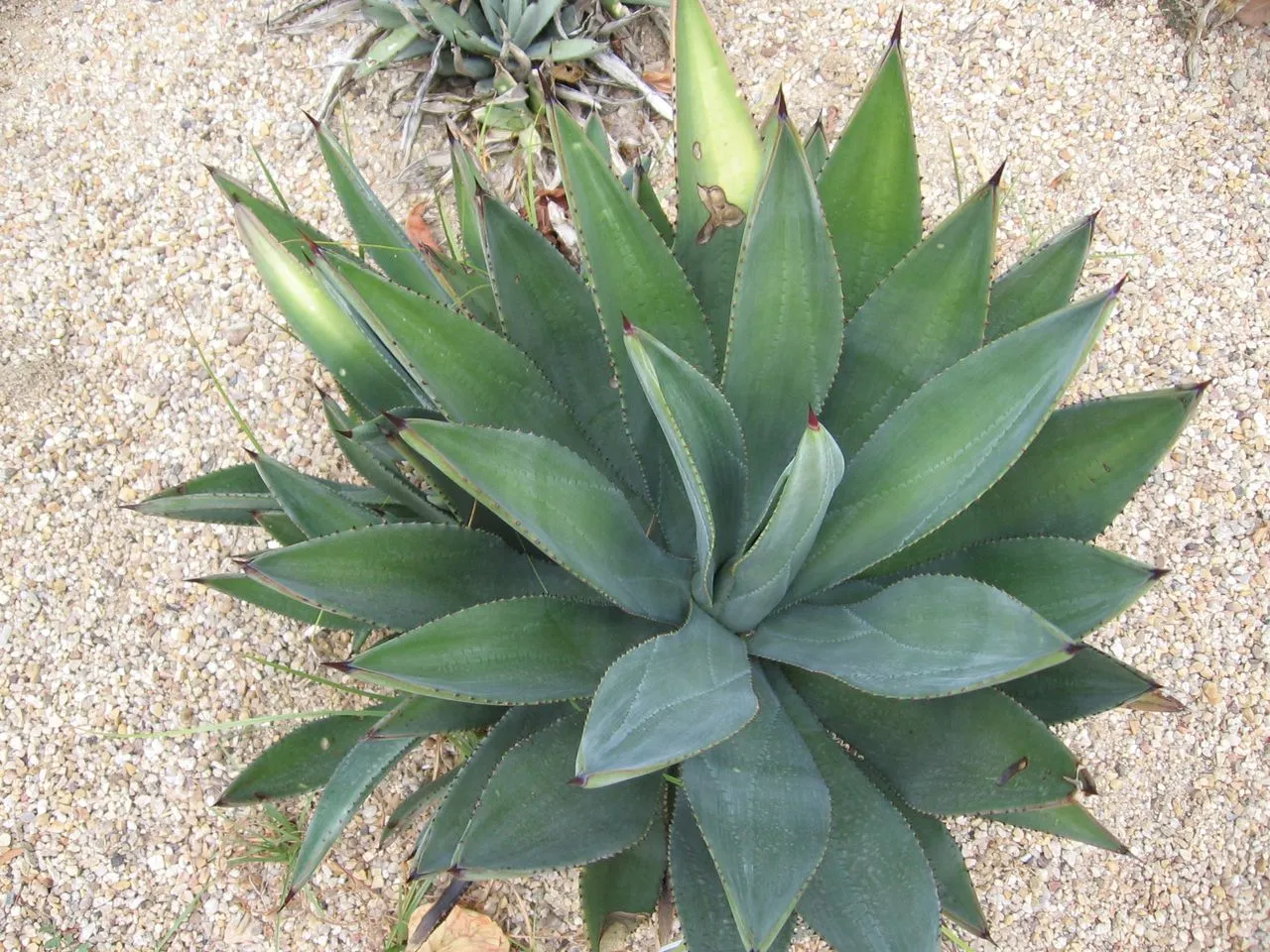
| How do you identify Agave murpheyi? | Look for 80 cm to 120 cm rosettes, glaucous leaves with faint pale bud-imprint banding, small brown teeth, and prolific bulbils after flowering. |
| How cold-hardy is Agave murpheyi? | It survives about −9 °C to −12 °C when dry, placing it around USDA zone 8. |
| What is the best propagation method? | Both offsets and bulbils are reliable. |
Agave murpheyi F. Gibson (Hohokam agave, Murphey's agave) is one of a handful of agaves that exist in cultivation largely as relicts of pre-Columbian agriculture. It occurs wild only in scattered populations in central and southern Arizona and adjacent Sonora, almost all of them adjacent to known Hohokam archaeological sites dating from roughly 600 to 1450 CE. Archaeobotanical work by Wendy Hodgson and colleagues at the Desert Botanical Garden has established that the species was selectively propagated and planted by the Hohokam as a food and fibre crop, and that most modern "wild" populations represent the descendants of those plantings.
Taxonomically A. murpheyi sits in the subgenus Agave, group Ditepalae, alongside A. palmeri and A. chrysantha.
Part of the Complete Agave Guide.
Identification
- Leaves. Lanceolate, 50 cm to 90 cm long and 8 cm to 12 cm wide, green to glaucous blue-green, often bearing faint paler cross-banding or "bud-imprint" marks from the way the leaves lay against each other in the central spike. Margins carry small, irregularly spaced brown teeth 2 mm to 5 mm long and a dark terminal spine 2 cm to 3 cm long.
- Rosette. Solitary to clumping, 80 cm to 120 cm across at maturity. Produces numerous basal offsets and often forms dense colonial stands.
- Inflorescence. Paniculate, 3 m to 5 m tall, with 8 to 14 lateral branches carrying greenish-yellow flowers tinged pink to purple in bud. Bulbils form prolifically on the scape after flowering, a trait that made the species particularly valuable to the Hohokam as a propagation route.
The bud-imprint marking is the most useful field character. Few other agaves in the Ditepalae group carry it as consistently.
Cultivation
Cultivation largely follows the pillar defaults. Species-specific notes:
- Cold tolerance. Moderate. Survives to about −9 °C to −12 °C with minimal damage when dry, placing it firmly in USDA zone 8. Less hardy than A. parryi but more than A. americana.
- Substrate. Tolerates poor, rocky soils exceptionally well, reflecting its habitat on dry bajadas and alluvial slopes. In heavy clay or waterlogged soils it fails quickly.
- Flowering age. Earlier than many large agaves, typically 10 to 15 years in cultivation. Look for emerging spikes in late winter to early spring; the inflorescence develops through spring and flowers by early summer.
Like most borderlands species, it resents summer watering when already wet. Water deeply and then allow to dry fully.
Propagation
Both offsets and bulbils are reliable. Offsets are produced throughout the plant's life rather than only at maturity, so any adequately sized rosette will yield pups on request. Sever, callus, and pot as per the pillar.
Bulbil yield from a single flowering rosette can be several hundred plantlets. This is the species to choose if you need a large clonal planting for restoration or landscape use. Bulbils root within 4 to 6 weeks of being pressed into mineral substrate.
Notes
The cultural history of A. murpheyi is the main reason to grow it. Roasted agave hearts, mescal in the pre-distillation sense, were a staple food of the Hohokam and the species was chosen for cultivation partly because of its prolific bulbil production, the pre-Columbian equivalent of cloned seedstock. The surviving wild populations are protected as cultural resources in several Arizona state parks and on federal lands; collection from the wild is prohibited. Nursery-sourced plants are descended from long-standing horticultural lines and are the only legitimate route to cultivation.
Identification is sometimes confused with A. palmeri, which shares the habitat range. A. murpheyi has the pale leaf banding; A. palmeri does not. For the biology of monocarpy and what happens when a bulbil-producing species flowers, see Agave death-bloom explained.
See also: Agave palmeri, Agave parryi, Agave parviflora.
Frequently Asked Questions
Why is Agave murpheyi called Hohokam agave?
Modern populations occur near Hohokam archaeological sites and descend largely from pre-Columbian agricultural plantings.
How do you identify Agave murpheyi?
Look for 80 cm to 120 cm rosettes, glaucous leaves with faint pale bud-imprint banding, small brown teeth, and prolific bulbils after flowering.
How cold-hardy is Agave murpheyi?
It survives about −9 °C to −12 °C when dry, placing it around USDA zone 8. It is less hardy than A. parryi.
What is the best propagation method?
Both offsets and bulbils are reliable. A single flowering rosette can produce several hundred bulbils, useful for clonal planting.