| Question | Short Answer |
|---|---|
| Is Agave montana a desert agave? | No. |
| How cold-hardy is Agave montana? | Established plants with dry roots can take brief drops around −12 °C, with some reports near −15 °C under excellent drainage. |
| How large does Agave montana get? | It usually reaches about 1 m wide in a container and up to 1.5 m wide in open ground. |
| How is Agave montana propagated? | Seed is the cleanest species-level method. |
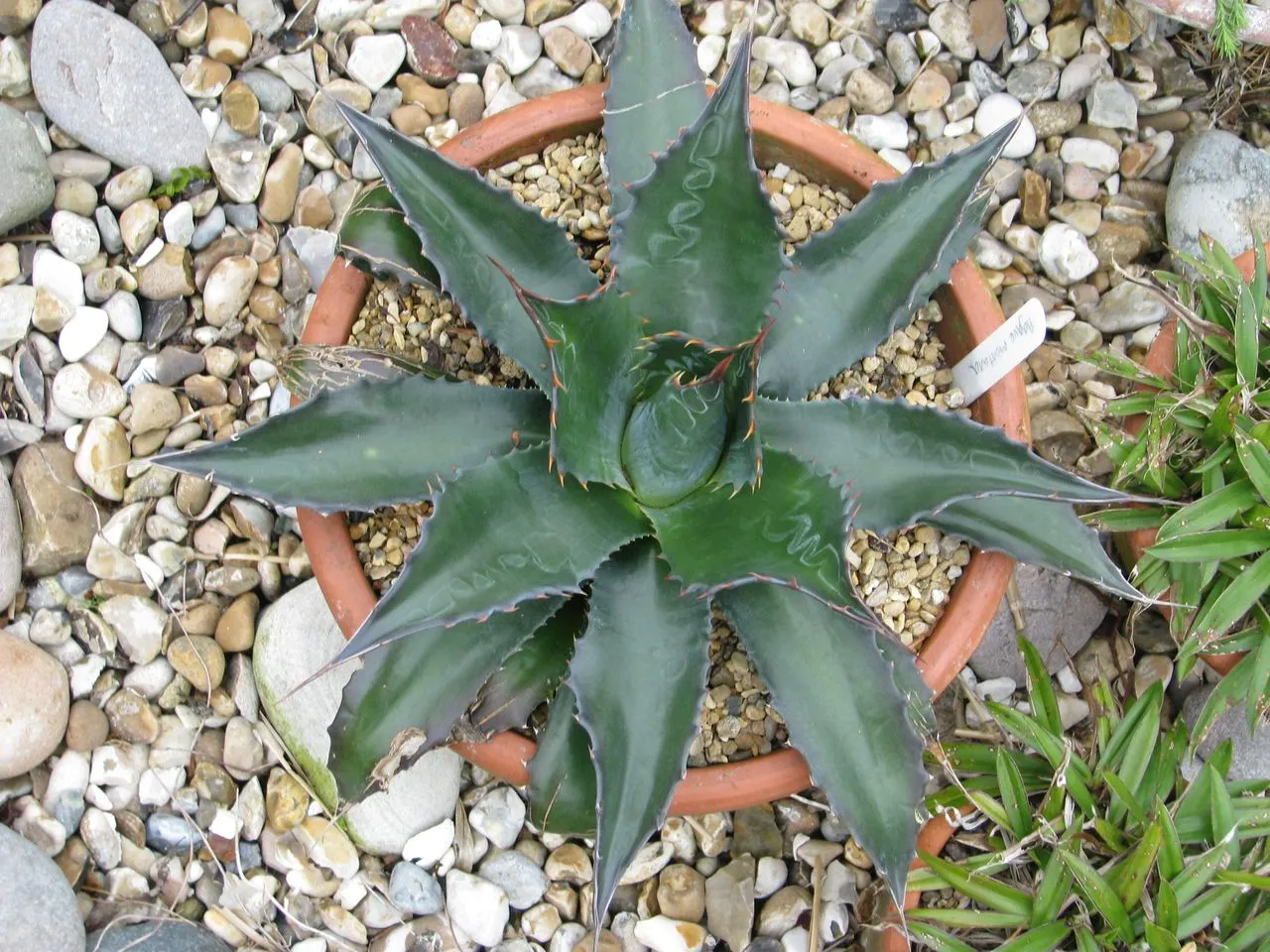
Agave montana, the mountain agave, was described by Tomás Villarreal Quintanilla in 1996 from the high mountains of northeastern Mexico. Its natural range lies mainly in Tamaulipas and Nuevo León, where rosettes grow at roughly 2,200-2,800 m in cool oak-pine cloud forest. The plant is best known for a broad, dark green rosette 1-1.5 m across, strong pale bud-imprints on the leaves, and a brown-black terminal spine that gives each leaf a firm hooked finish.
In habitat, A. montana is not a desert agave in the usual sense. It grows among oaks, pines, limestone outcrops, leaf litter, and seasonal mist, often on slopes where water drains away fast after rain. Nights are cool for much of the year. Winter cold is real, but so is air movement, mineral soil, and a root zone that does not stay saturated. That combination explains both the species' value in cold gardens and the mistake that kills it in cultivation: treating hardiness as permission for wet winter compost.
Part of the Complete Agave Guide.
Identification
A mature A. montana forms a solitary to rarely offsetting rosette, usually 1 m wide in a container and up to about 1.5 m wide in open ground. The outline is dense and symmetrical, more rounded than the open, architectural silhouette of many dryland agaves. Leaves are broad, thick, and dark green, commonly 50-75 cm long on mature plants, with a slightly concave upper surface and a stiff texture that resists folding.
The bud-imprints are the feature most growers notice first. As each new leaf develops pressed against its neighbours in the central spear, the marginal teeth and leaf edges emboss pale markings onto the surface. On A. montana these imprints can look chalky, broad, and deliberate, especially on plants grown in strong light with restrained feeding. They remain visible as the leaf ages, creating a layered pattern across the rosette.
The marginal teeth are not as showy as those of some agaves, but they are functional and sharp. They tend to be brown to grey-brown, set along the leaf edge at regular intervals. The terminal spine is stronger: brown-black, commonly about 2-3 cm long, and aligned with the leaf tip rather than twisting sideways. Handle the plant as you would a small barrel cactus. The leaves look smooth at a glance, but the tip can puncture skin or catch clothing.
Flowering is monocarpic. A rosette grows for many years, produces a tall flowering panicle, then dies after seed set. For this species, the panicle typically reaches about 4-6 m, with branching in the upper portion and yellowish to greenish flowers. Plants in containers may take decades to reach that stage, and a flowering event is not a routine annual feature. If offsets have formed at the base, they may continue after the main rosette collapses, but many plants remain solitary.
The two comparisons worth keeping in mind are A. parryi and A. gentryi. A. parryi is usually smaller, often bluer or greyer, and similarly cold tolerant when dry, which is why both species appear in hardy succulent plantings. A. montana is greener, larger, and more forest-derived in its preferences. A. gentryi is the frequent trade confusion. It can share a broad green rosette and bold leaf markings, but it is often larger and more variable, with a different overall leaf posture. If a plant labelled A. montana grows quickly into a loose, very large rosette, check it against A. gentryi before trusting the name.
Cultivation
Give A. montana strong light without assuming it needs the hottest exposure in the garden. Outdoors in temperate climates, full sun to light afternoon shade is ideal. In hot inland regions, morning sun plus high bright shade after 14:00 keeps leaves cleaner and reduces summer stress. Indoors, it needs the brightest position available, preferably an unobstructed south-facing window or a grow light strong enough to prevent the central leaves from lengthening. A plant that receives too little light becomes open, soft, and dull green, with weaker bud-imprints.
Water deeply during active growth, then wait for the root zone to dry well before watering again. In a 20-25 cm terracotta pot in warm weather, that may mean every 10-18 days. In a larger plastic container or cool coastal climate, it may be closer to every 3-4 weeks. Use leaf firmness as a secondary cue: a thirsty A. montana loses some pressure in the lower leaves, while an overwatered one stays heavy but stops producing compact central growth. If you use a moisture probe, wait until the top 5 cm reads dry and the deeper root zone is no longer wet.
The substrate should be mineral and open, but not sterile scree. A useful container mix is 60-70% mineral material, such as pumice, lava rock, coarse grit, or expanded shale, with 30-40% loam-based, low-peat organic matter. The small organic fraction suits a cloud-forest species that naturally grows with leaf litter nearby; the mineral fraction prevents the winter root problems that kill hardy agaves in pots. For outdoor planting, choose a raised bed, slope, crevice, or mound where water leaves the crown and root zone quickly.
Temperature tolerance deserves more than a label. A. montana is one of the agaves that can be trialled in USDA zone 7 gardens, provided the site is dry, drained, and not exposed to repeated freeze-thaw saturation. Established plants with dry roots can take brief drops to roughly -12 °C, and some growers report survival near -15 °C under excellent drainage and overhead protection. Those numbers do not mean a potted plant in wet compost can freeze solid for a week. Cold hardiness in this species is a dry-root hardiness. Below about -5 °C, the difference between a sloped mineral bed and a water-holding nursery mix is the difference between cosmetic marking and basal rot.
In containers, start young plants in a pot only 2-4 cm wider than the root ball. Shift up gradually until the rosette needs a heavy 25-35 cm pot for balance. Terracotta is useful in humid climates because it dries the wall of the root ball faster; plastic can work in hot dry regions if the mix is coarse. Always keep the crown slightly above the substrate surface. Buried lower leaves trap damp debris and invite rot at the base.
Fertiliser should be modest. A low-nitrogen feed at one-quarter to one-half label strength, once in spring and once in early summer, is enough for most container plants. Heavy feeding produces lush, less hardy leaves and softens the crisp rosette geometry. If the plant is in open ground with a little mineral soil and leaf mould, it may need no added feed.
Propagation
Seed is the cleanest way to propagate A. montana as a species. Use fresh seed if available, because germination falls with age. Sow on a fine mineral mix with a small amount of sifted organic matter, keep it evenly damp but not sealed in stagnant air, and hold temperatures around 20-24 °C. Germination commonly begins in 10-21 days. Seedlings are slower than many soft succulents; expect strap-like juvenile leaves for the first year and a recognisable small agave rosette after 18-30 months.
Offset division is possible only when the plant provides material. A. montana is not a dependable offset factory, and many rosettes remain solitary for years. If a basal shoot appears, wait until it has several leaves and its own roots, usually at 8-12 cm across or larger. Remove it during warm active growth, dusting off old damp substrate rather than washing roots in cool weather. Let any wound dry for several days, then pot into barely moist mineral mix. A rooted offset may settle within 4-8 weeks; an unrooted one is much slower and more likely to desiccate.
Do not remove the central spear or cut the crown to force pups unless the plant is already damaged beyond display value. That technique may produce shoots in some agaves, but it also destroys the natural form and opens a large wound on a plant whose main virtue is a long-lived solitary rosette.
Notes
The species' cloud-forest origin makes it slightly more tolerant of summer moisture and filtered light than hard desert agaves, but it is not a shade plant. The best cultivated specimens I have seen were grown hard: bright light, mineral soil, steady air movement, and winter dryness. Their leaves were shorter, wider, and more heavily imprinted than plants grown with generous fertiliser and frequent irrigation.
Watch for scale insects along the leaf bases and for snails in outdoor plantings. The tight rosette can hide both. Old leaf bases should not be peeled away aggressively; they protect the stem and often detach only after they are fully dry. If you must clean debris from the crown, use long tweezers rather than fingers, and remember the terminal spine is doing exactly what it evolved to do.
A. montana is a good candidate for growers who like the hardy agaves but want a greener, montane look than A. parryi. It asks for accuracy rather than pampering: cold is acceptable, wet cold is not. Match that distinction, and the plant becomes one of the more useful large agaves for cool-climate collections.
See also
- Complete Agave Guide - genus-level cultivation, morphology, and propagation.
- Agave parryi - smaller, often bluer, and similarly dry-cold tolerant.
- Agave victoriae-reginae - compact, geometric, and slower in containers.
- Agave winter damage — dry-root frost tolerance and what wet cold does to hardy species in containers.
Quick answer: how to care for Agave montana
Agave montana wants bright light, gritty soil, and careful watering. It can handle some cold better than many tender succulents, but winter wet is the real problem. In a pot, use fast drainage and let the mix dry before watering again.
Pot and soil setup for Agave montana
As an Amazon Associate, we earn from qualifying purchases, at no extra cost to you. Choose a heavy pot with a drainage hole so the rosette does not tip as it grows. A terracotta cactus pot with drainage helps the mix dry faster, especially indoors or on a covered patio.
How much sun does it need?
Give it bright light outdoors and the brightest window you can manage indoors. Move it into stronger sun gradually if it has been grown in shade, or the leaves can scorch.
Winter moisture is the usual failure point
Cold alone is not always what kills Agave montana. Cold, wet soil around the crown and roots is much worse. Keep the crown open, avoid water sitting in the rosette, and shelter potted plants from long winter rain.
Agave montana FAQ
Can Agave montana grow indoors?
Yes, but it needs very bright light and a pot that dries quickly. A dim room will make it weak and more likely to rot after watering.
How often should you water Agave montana?
Water when the mix is dry, then wait. In winter, water much less often, especially if the plant is cool or getting weak light.
Frequently Asked Questions
Is Agave montana a desert agave?
No. It comes from cool oak-pine cloud forest with limestone outcrops, seasonal mist, and fast drainage.
How cold-hardy is Agave montana?
Established plants with dry roots can take brief drops around −12 °C, with some reports near −15 °C under excellent drainage.
How large does Agave montana get?
It usually reaches about 1 m wide in a container and up to 1.5 m wide in open ground.
How is Agave montana propagated?
Seed is the cleanest species-level method. Offsets are possible only when the plant produces them, because many rosettes remain solitary.