| Question | Short Answer |
|---|---|
| How big does Agave isthmensis get? | Mature rosettes are usually 25 cm to 40 cm wide and 20 cm to 30 cm tall, making it a genuine dwarf agave. |
| How do you identify Agave isthmensis? | Look for a compact glaucous rosette, broad triangular leaves, pale raised bud markings, and bold red-brown marginal teeth. |
| How cold-hardy is Agave isthmensis? | A dry, settled plant can survive brief drops to about −4 °C. |
| How do you propagate Agave isthmensis? | Offsets are easiest because the species suckers freely. |
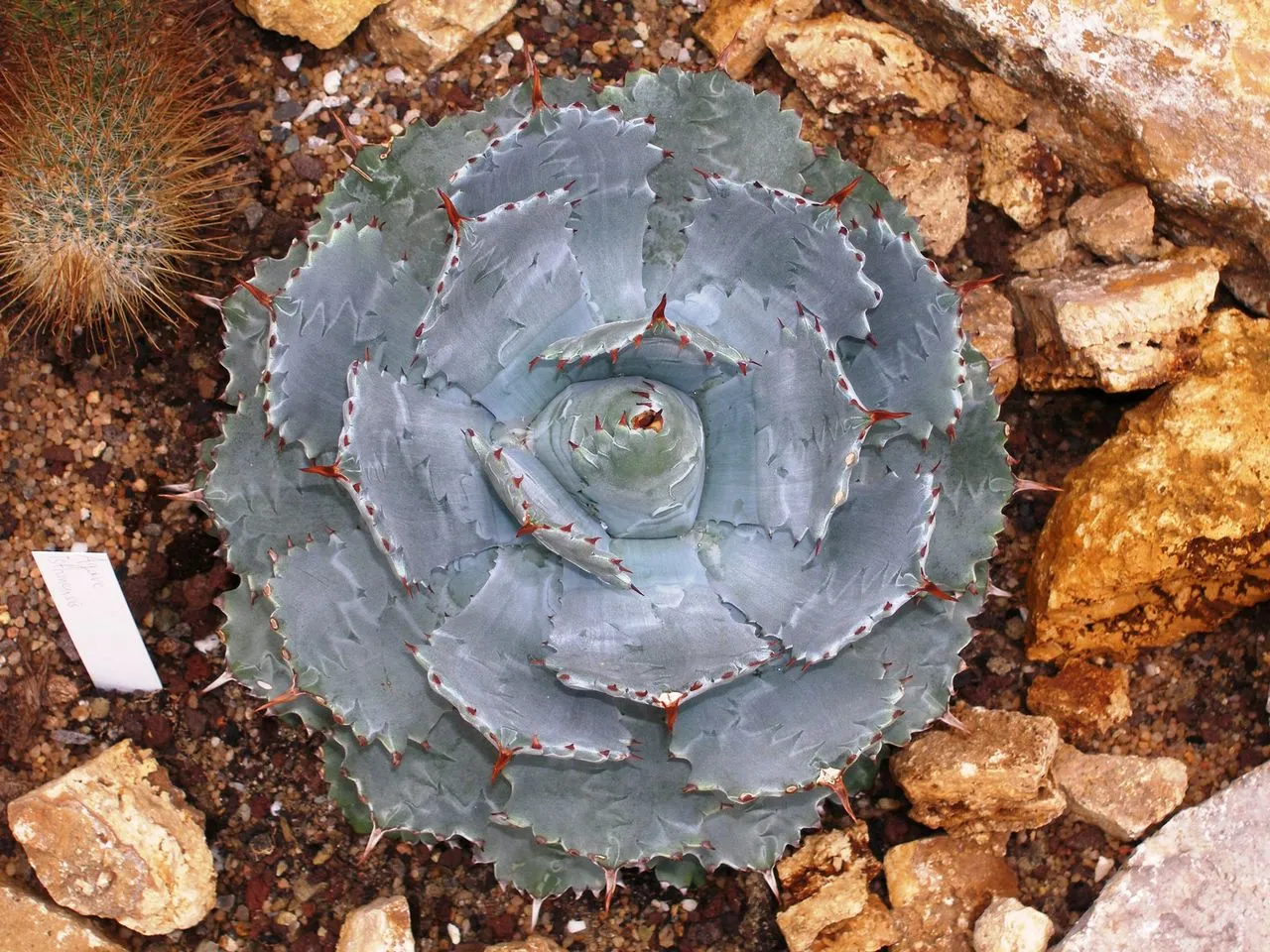
Agave isthmensis A.García-Mend. & F.Palma, the dwarf butterfly agave, was formally described in 1995 by Abisai García-Mendoza and Felipe Palma from material collected on the Pacific side of the Isthmus of Tehuantepec. The species is endemic to a narrow corridor of southern Oaxaca, Mexico, where rosettes grow on volcanic and limestone slopes between roughly 600 and 1,200 m. The defining features are a compact rosette no more than 40 cm across, broad triangular blue-green to glaucous leaves carrying strikingly imprinted pale bud-markings on their inner surfaces, and bold red-brown marginal teeth that catch sunlight along the leaf edge.
In habitat, A. isthmensis belongs to seasonally dry tropical scrub and low deciduous forest on weathered volcanic ash and uplifted limestone, where soil is shallow, drainage is rapid, and the canopy above is open enough that direct sun reaches the rosette for most of the day. Wild populations are local and patchy, often clinging to rocky outcrops and slope ledges where larger competing vegetation cannot establish. The Isthmus of Tehuantepec is one of the more floristically distinctive zones in southern Mexico, a narrow neck of land between Pacific and Gulf drainages, and several agaves restricted to it are conservation priorities. IUCN assesses A. isthmensis as Vulnerable, driven by a small extent of occurrence, ongoing habitat conversion, and direct collection pressure on a plant whose compact size makes it portable. As with other narrow-range endemics, sourcing nursery-propagated stock rather than wild-collected material matters here.
Part of the Complete Agave Guide.
Identification
A mature A. isthmensis forms a tight, dome-shaped rosette typically 25 to 40 cm wide and 20 to 30 cm tall. The leaves are broad, thick, and decidedly triangular in profile, 12 to 18 cm long and 5 to 8 cm wide near the base, narrowing in a clean taper toward a rigid terminal spine. Colour is blue-green to glaucous, often with a fine waxy bloom that intensifies under strong light. The rosette is dense rather than open: leaf count on a healthy adult sits in the 30 to 60 range, layered into a compact ball that holds its shape from any angle.
Two leaf details settle the ID. First, the inner surfaces of the leaves carry pale bud-markings, the imprint pattern left where one leaf pressed against the next while still tightly furled in the central spear. The pattern is strongly raised on a clean specimen, reading as ghostly white lines and chevrons against the blue-green ground. Brushing a fingertip along an inner leaf face picks up the relief. Second, the marginal teeth are bold and red-brown, set on a continuous horny edge that runs the full length of the leaf. Light striking the leaf at low angles catches the teeth as a row of small dark hooks against the pale margin, and this combination of red-brown teeth on glaucous blue is what gives the "butterfly" common name traction in trade: the leaves read as patterned wings when the rosette is viewed from above.
Flowering is monocarpic and rare in cultivation. After eight to fifteen years, an individual rosette sends up an unbranched panicle 2 to 3 m tall, carrying yellow-green tubular flowers along the upper portion. Because A. isthmensis suckers freely from the base, the plant carries on even when the central rosette dies after fruiting, and a settled clump simply reorganises itself around the surviving offsets.
Three lookalikes account for most trade confusion. Agave victoriae-reginae is the closest superficial match for the bud-impressed leaf surface but is much larger (mature rosettes 40 to 70 cm across), carries no marginal teeth at all, and shows white pencilled lines along the leaf margin rather than red-brown teeth. Agave potatorum shares the broad triangular leaf shape and glaucous tone, but is solitary rather than offsetting, larger at maturity, and lacks the imprinted bud markings. Agave parviflora sits in the same dwarf size class but carries narrow leaves with white filiferous threads peeling from the margin, no broad triangular blade at all, and white pencilling instead of teeth. If the plant in front of you is small, dome-shaped, with broad triangular leaves and red-brown teeth set against a glaucous bud-imprinted surface, you have A. isthmensis.
Cultivation
Light should be bright and largely direct. Outdoors in temperate or Mediterranean climates, six to eight hours of direct sun keep the rosette tight and the glaucous bloom strong. Indoors, the plant accepts a bright unobstructed south or southwest window, or a strong horticultural grow light at close range; in lower light, the leaves stretch, the rosette opens, and the bud-imprint pattern thins as the new leaves come through with less pressure between them. The dwarf size and tight habit make A. isthmensis one of the more tolerant agaves of indoor culture, though it does need real light. The broader principles of light, watering, and substrate for new growers are covered in the beginner's guide.
Substrate should be mineral and pH-tolerant. A practical container mix is 70 to 80% mineral material, with pumice, lava rock, coarse granite grit, and crushed limestone as good components, and 20 to 30% loam-based compost. The dual volcanic-and-limestone habitat means the species is not fussy about pH; both acidic-leaning and alkaline mineral mixes work, and a slightly more limestone-weighted blend can help in regions with soft, acidic tap water. Avoid peat-heavy mixes, which hold water inside the dense central rosette and invite crown rot before the surface above gives any clue.
Water deeply during active growth, then let the upper half of the substrate dry before watering again. In a 12 to 15 cm terracotta pot in warm weather, that interval is typically 10 to 18 days. The thick triangular leaves hold water visibly: lower leaves should stay firm to the touch, and any softening at the base ring is a signal to water deeply. In winter, especially below 10 °C, keep the root zone almost dry; the plant has no useful tolerance for cold wet substrate.
Frost tolerance is moderate but real. A settled plant with a bone-dry root ball survives brief drops to about -4 °C without lasting damage. Below that, leaf tips brown, the central spear can blacken, and prolonged wet cold is lethal. In winter-rain climates, container plants belong under glass, on a bright unheated windowsill, or beneath a deep eave. Open-ground plantings need a south-facing slope or a raised mineral bed where rainwater leaves the crown immediately. The compact size means a single plant moves easily under cover for the worst of any winter spell.
Pots can stay modest. A. isthmensis has a fibrous root system that does not demand depth, and a slightly snug pot encourages a tighter rosette form and faster offset production. Terracotta is helpful in temperate or coastal climates because the porous wall accelerates drying after watering. Feed lightly: a low-nitrogen fertiliser at one-quarter to one-half label strength, once in spring and once in early summer, is enough. Heavier feeding produces longer, paler leaves and softens the dense ball habit that gives the species its visual appeal as a small-collection plant.
Propagation
Offsets are the practical method here. A. isthmensis suckers freely, often producing a ring of pups around the parent within two to three years of being potted on. Wait until a pup carries six to eight leaves and has its own roots, then sever the connecting stolon cleanly with a sharp blade. Let the wound dry for five to ten days in shade, pot into dry mineral mix, and wait another week before watering. Rooted offsets resume growth within four to eight weeks in warm conditions and reach a recognisable rosette within twelve to eighteen months. Yields from a single mature clump are generous enough that a windowsill grower can build a small group of clones from one purchased plant.
Seed works for maintaining genetic diversity but is less common in collections because flowering events are infrequent. Fresh seed germinates in 14 to 28 days at 22 to 26 °C on a fine mineral surface with light coverage. Seedlings sit as small green triangles for the first year and gradually thicken into the broad triangular adult leaf over three to four years. Use seed when you specifically want a non-clonal population for breeding work or display variation.
Detached leaves do not root, as is generally true across the genus, so do not waste material trying.
Notes
The two practical risks for A. isthmensis in cultivation are crown rot and slow loss of the bud-imprint pattern under low light. Crown rot follows from peat-heavy substrate, oversized pots, or winter watering that continues out of habit; the dense ball-shape canopy hides the early signs until the central spear collapses and the rosette begins to lean. The light problem is subtler: a plant that reads tight and well-marked under summer sun can quietly thin and stretch over a winter on an east-facing windowsill, and the new spring leaves come through with weaker bud impressions and a duller glaucous bloom.
Mealybugs occasionally settle deep in the rosette where the leaf bases hide them; check by parting outer leaves with a soft probe rather than fingers, and inspect with a hand lens. Scale appears occasionally on plants kept in still indoor air. The agave snout weevil rarely concerns A. isthmensis at typical container size, the small adult plants offering little reward for an insect that targets large landscape agaves.
Trade circulation is heavy on selections and crossings. Cultivars marketed as 'Ohi Raijin', 'Kichiokan', and various variegated forms are widely propagated in East Asian collections under the broader name A. isthmensis or as A. potatorum 'Kichiokan' (the two species hybridise readily and are often confused at the cultivar level). For a typical species plant, the diagnostics in the Identification section above should resolve any label question. For genus-level cultivation, hardiness, flowering, and propagation context that frames this species against its dwarf and bud-printed siblings, see the Complete Agave Guide.
See also
- Complete Agave Guide - genus-level cultivation, flowering, hardiness, and propagation.
- Agave victoriae-reginae - larger bud-printed cousin with white-pencilled margins and no marginal teeth.
- Agave parviflora - dwarf agave with white filaments rather than red-brown teeth.
- Agave macroacantha — another compact container species with bold marginal teeth and a prominent black terminal spine.
Frequently Asked Questions
How big does Agave isthmensis get?
Mature rosettes are usually 25 cm to 40 cm wide and 20 cm to 30 cm tall, making it a genuine dwarf agave.
How do you identify Agave isthmensis?
Look for a compact glaucous rosette, broad triangular leaves, pale raised bud markings, and bold red-brown marginal teeth.
How cold-hardy is Agave isthmensis?
A dry, settled plant can survive brief drops to about −4 °C. Cold wet substrate is the greater danger.
How do you propagate Agave isthmensis?
Offsets are easiest because the species suckers freely. Remove rooted pups with six to eight leaves, callus, and pot dry.