| Question | Short Answer |
|---|---|
| Why is Agave macroacantha called black-spined agave? | Its small marginal teeth and 2 cm to 4 cm terminal spine are dark brown to black, standing out strongly against pale blue-grey leaves. |
| How big does Agave macroacantha get? | Mature rosettes usually remain 60 cm to 90 cm across, so the species is more manageable in containers than large landscape agaves. |
| How cold-hardy is Agave macroacantha? | Dry plants tolerate brief drops to about −7 °C. |
| How do you propagate Agave macroacantha? | Divide offsets once they are 8 cm to 12 cm across and rooted. |
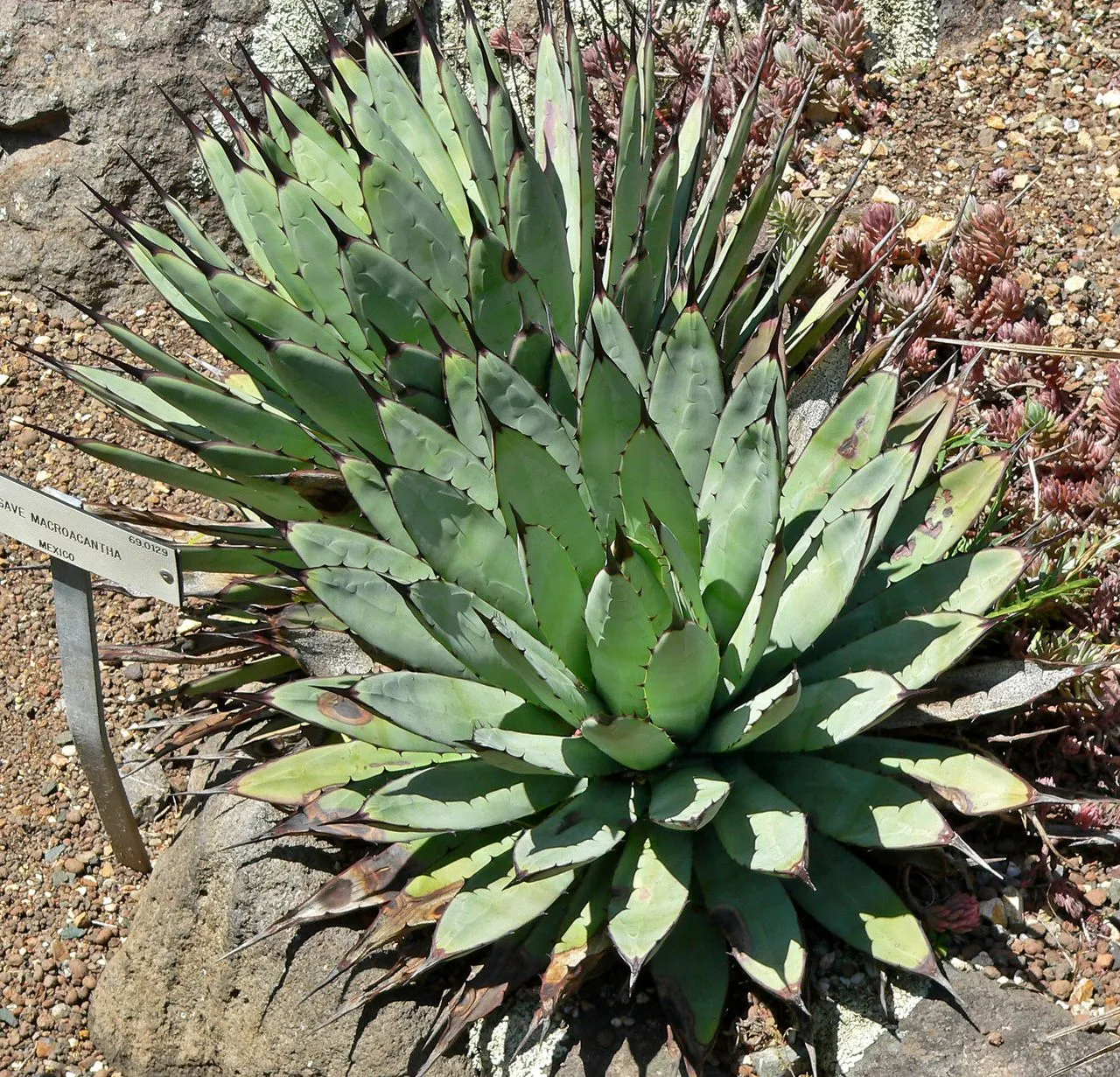
Agave macroacantha Salm-Dyck (1859), the black-spined agave, is a compact southern Mexican species recognised for the strongest spine-to-leaf contrast in the genus: blue-grey to glaucous leaves edged and tipped in dark brown to black. It is endemic to arid scrub and rocky slopes in Oaxaca and Puebla, including the Tehuacán Valley, mostly between 800 m and 1,900 m elevation. Mature rosettes usually remain 60 cm to 90 cm across, which makes the species far more usable in containers than the large landscape agaves that dominate public plantings.
The habitat explains the plant's temperament. A. macroacantha grows in bright, dry, seasonal country where mineral soils drain quickly and rainfall arrives in pulses rather than as steady background moisture. It is not a rainforest-tolerant houseplant, but it is also not difficult if you give it hard light, air around the crown, and a root zone that dries thoroughly. In cultivation it is one of the easier small agaves, especially for growers who can keep it dry during cold weather.
Part of the Complete Agave Guide.
Identification
A single rosette of A. macroacantha is symmetrical, low, and dense, with 80 or more narrow leaves radiating from a tight centre. The leaves are usually 25 cm to 40 cm long and 3 cm to 5 cm wide, widest around the lower third, then tapering to a hard terminal spine. Colour varies with light and clone. In strong sun the surface is blue-grey or powdery glaucous; under softer light it can shift toward grey-green. Avoid handling the leaves if you value that powdery bloom, because rubbed wax does not regenerate on the same tissue.
The spines are the plant's signature. Marginal teeth are small, closely spaced, and dark, often appearing almost inked against the pale leaf surface. The terminal spine is longer and more emphatic, commonly 2 cm to 4 cm, black to very dark brown, and sharply rigid. That contrast separates the species at a glance from many compact agaves that carry pale grey or horn-coloured teeth.
The rosette offsets freely. A plant bought as a single head often forms a ring of pups by its third or fourth year in good light, and an older specimen becomes a colony of clustered rosettes rather than a solitary sculpture. This is useful horticulturally because the species is monocarpic at the rosette level: a flowering rosette dies after setting seed or exhausting the inflorescence, while the surrounding offsets continue the plant.
Flowering is uncommon in small containers but not mysterious when it happens. Mature rosettes produce a tall, branched inflorescence that can reach several metres, with greenish to yellow flowers typical of the genus. The flowering rosette should be left in place until it has fully declined if you want maximum energy transfer to adjacent pups.
Distinguishing from lookalikes. Agave victoriae-reginae is the common retail comparison because both are compact, architectural, and container-friendly. A. victoriae-reginae has shorter, broader, darker leaves marked with crisp white lines and usually forms a tighter, more geometric ball. A. macroacantha has narrower blue-grey leaves, visible marginal teeth along most of the leaf, and a more open rosette. Agave parryi can also appear blue and compact, but it has broader spoon-shaped leaves, a heavier bud imprint pattern, and a much larger pale terminal spine rather than a slim black one.
Cultivation
Light. Give A. macroacantha 5 to 7 hours of direct sun daily if you want the compact form and the best blue-grey colour. Outdoors, full morning sun with some late afternoon exposure is enough in hot climates. In northern Europe or cool coastal districts, full south-facing sun is appropriate. Indoors, a south-facing window is the minimum, and even then growth will be slower and greener than outdoors. If a plant has been grown under shade cloth or in a shop interior, acclimate it over 10 to 14 days before putting it into summer sun, since old leaves can scorch before the wax layer thickens.
Substrate. Use a sharply mineral mix: 60% to 70% pumice, lava grit, expanded shale, or coarse grit; 20% coarse sand; and no more than 10% to 20% loam-based compost. The Tehuacán Valley and neighbouring arid scrub habitats favour quick drainage and mineral contact around the roots. Peat-rich succulent compost keeps the crown too wet after watering and tends to collapse into a dense layer after repeated drying.
Watering. During active growth, water deeply only when the whole pot is dry to the base. In a 20 cm terracotta pot in warm weather, that is often every 10 to 16 days; in a plastic pot or a cooler greenhouse it may be closer to every 3 weeks. A moisture probe reading below 10% at the lower third of the pot is a better cue than a calendar. Leaves that are slightly less rigid near the base can also signal that the plant is ready, but do not wait for severe wrinkling in a young plant, because small rosettes have less stored water.
From mid-autumn, reduce watering sharply. Below 7 °C, keep the root zone dry. The species can tolerate brief drops to about -7 °C when dry, but wet cold is a different event physiologically: roots remain oxygen-starved, tissue repair slows, and rot can enter through the lower stem. In climates with winter rain, container specimens should be moved under glass, beneath a roof overhang, or into an unheated but bright porch before the first hard frosts.
Temperature. Best growth occurs between 18 °C and 32 °C. Sustained heat above 38 °C can pause growth, especially in a black plastic pot where root temperatures climb beyond air temperature. The plant usually resumes once nights cool and water becomes available. Cold tolerance is respectable for a Mexican agave of this size, but it should not be treated like high-elevation A. parryi. Dryness is the difference between a clean winter and a collapsed crown.
Container growing. This is one of the better agaves for long-term pot culture because the rosette stays under 90 cm and the offsets can be managed without losing the plant's architecture. Start a young plant in a 15 cm to 18 cm terracotta pot. A mature single rosette or small clump suits a 25 cm to 30 cm pot that is at least as deep as it is wide. Terracotta is preferable in humid climates because it shortens the wet phase after watering. Repot when offsets press against the rim or when water runs down the inside of a root-bound pot without wetting the core.
Propagation
Offsets. Division of pups is the reliable method. Wait until an offset is 8 cm to 12 cm across and has its own roots, then remove the plant from the pot and cut the connecting rhizome with a clean blade. Do not twist pups away from the parent, since that often tears the base and leaves a larger wound. Let the cut surface dry for 5 to 7 days in shade, pot into dry mineral substrate, and wait another 5 to 7 days before the first light watering. At 20 °C to 26 °C, rooted offsets usually resume growth within 4 to 6 weeks.
Because A. macroacantha clumps prolifically, you do not need to divide every pup. A colony of five to seven heads in a broad terracotta bowl is often more attractive and more stable than a single rosette repeatedly stripped clean. Remove offsets when they distort the main rosette, crowd the pot rim, or are needed as insurance before an old head flowers.
Seed. Seed propagation is possible but slower and less predictable for named or selected forms. Fresh seed germinates in 10 to 21 days at 22 °C to 28 °C on sterile mineral media with light surface coverage. Seedlings are narrow and grasslike at first, then begin showing glaucous rosette character in the second or third year. Expect 5 to 7 years before a seedling becomes a convincing display plant in a 15 cm pot.
Named variegated clones should be propagated by offsets, not seed. Seedlings will not reliably preserve the central yellow stripe of 'Mediopicta' or the marginal variegation sold as 'Variegata'.
Notes
The plant is often sold under the common name black-spined agave, and in this case the name is genuinely useful. Check the terminal spine before buying: it should be dark, slender, and conspicuous against the leaf. Plants with pale grey spines, broad chalky leaves, and a larger rosette may be compact forms of A. parryi or another blue agave rather than true A. macroacantha.
Several variegated cultivars circulate in specialist trade. 'Mediopicta' usually refers to a central pale yellow to cream stripe with green or blue-green margins; 'Variegata' is used less consistently, sometimes for marginal variegation and sometimes for broader irregular striping. Variegated plants grow more slowly because less leaf area is photosynthetic, and they scorch faster in sudden full sun. Give them the same drainage but slightly gentler light, usually 3 to 5 hours of direct morning sun rather than all-day exposure.
The main pest to watch for is agave snout weevil in regions where it is established. Small species are not immune, although large soft-cored agaves are attacked more often. Sudden loosening of the rosette, sour smell at the base, or collapse from the centre should be treated as serious. Full identification and treatment steps are in the agave snout weevil guide. Mealybugs can also hide between tight leaves and around offset bases; inspect the inner crown with a torch before wintering plants indoors.
Sap may irritate skin and is unsafe for pets that chew foliage. The black terminal spines are also functional, not decorative. Place container plants where people will not brush past them at thigh or eye level, especially when a clump has produced outward-facing pups.
See also
- The Complete Agave Guide
- Agave victoriae-reginae, another compact container species with a tighter geometric rosette and white leaf markings
- Agave parryi, a broader blue agave with much greater cold tolerance when dry
- Agave victoriae-reginae — compact container alternative with a tighter geometric rosette and no marginal teeth.
- Agave isthmensis — dwarf species with bold bud imprints and red-brown teeth in the same size class.
Frequently Asked Questions
Why is Agave macroacantha called black-spined agave?
Its small marginal teeth and 2 cm to 4 cm terminal spine are dark brown to black, standing out strongly against pale blue-grey leaves.
How big does Agave macroacantha get?
Mature rosettes usually remain 60 cm to 90 cm across, so the species is more manageable in containers than large landscape agaves.
How cold-hardy is Agave macroacantha?
Dry plants tolerate brief drops to about −7 °C. Wet cold is dangerous because oxygen-starved roots and slow repair invite rot.
How do you propagate Agave macroacantha?
Divide offsets once they are 8 cm to 12 cm across and rooted. Seed works, but seedlings need 5 to 7 years for display size.