| Question | Short Answer |
|---|---|
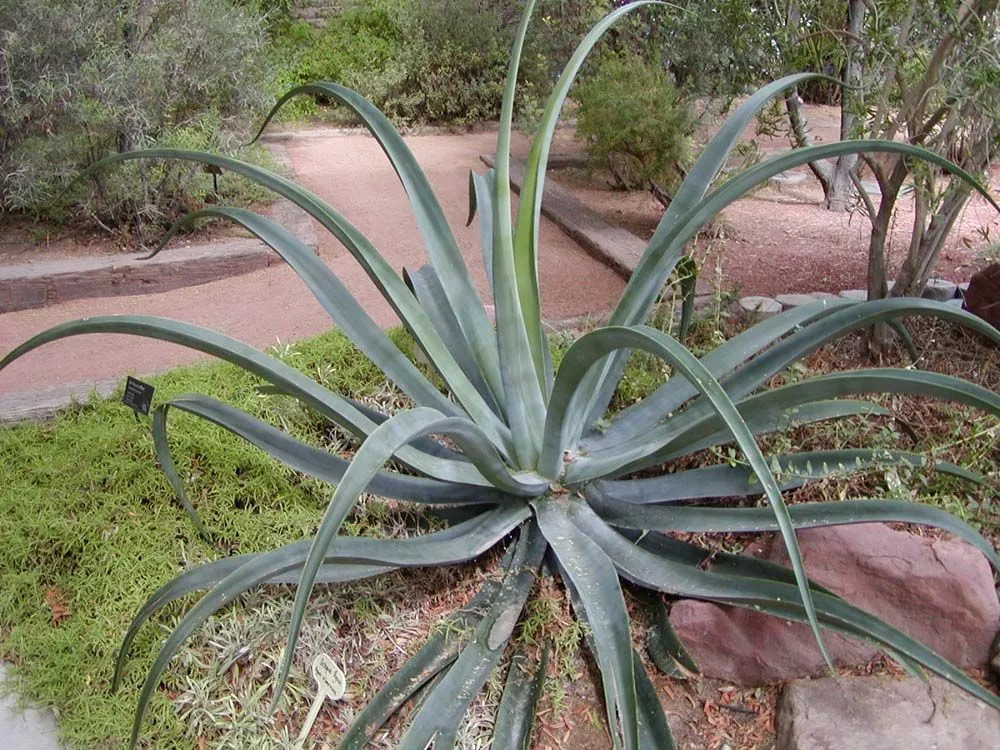
| Why is Agave vilmoriniana called octopus agave? | Its long, narrow, flexible leaves arch and droop away from the central crown, giving a tentacular outline. |
| Is Agave vilmoriniana spineless? | Yes. |
| How cold-hardy is Agave vilmoriniana? | It survives brief dry exposure to about −5 °C to −7 °C, but wet winter soil near freezing rots the crown quickly. |
| How do you propagate Agave vilmoriniana? | Bulbils are the defining method. |
Agave vilmoriniana A. Berger (octopus agave) is the large, sprawling, spineless agave that looks unlike anything else in the genus. The long arching leaves curving away from a central crown give the plant its common name and account for much of its ornamental appeal. It is native to cliff faces and steep rocky slopes in the Sierra Madre Occidental of northwestern Mexico, principally in Sonora, Chihuahua, Sinaloa, and Durango, at elevations between 600 m and 1,800 m. The species was named for the French botanist and horticulturist Maurice de Vilmorin.
Taxonomically it belongs to the subgenus Littaea, group Amolae, characterised by cliff-dwelling habit, unarmed leaf margins, and prolific bulbil production.
Part of the Complete Agave Guide.
Identification
- Leaves. Narrowly lanceolate to almost linear, 80 cm to 130 cm long and 7 cm to 10 cm wide at the base, tapering to a soft non-stabbing terminal point. Light yellow-green to glaucous olive, with a pliable texture and a distinctly arching to drooping posture. Margins are smooth, without teeth.
- Rosette. Solitary, 1.5 m to 2.5 m across at full extension, with leaves spreading widely and radiating outward in all directions. Non-clumping; offsets at the base are rare.
- Inflorescence. Spicate, unbranched, 3 m to 5 m tall, carrying yellow tubular flowers along the upper two thirds of the scape. Flowering age in cultivation is typically 10 to 15 years.
The cliff-dwelling habit of the wild plants produces a characteristic gravity-sculpted form where the leaves curve downward from a vertical rock face; container-grown plants in level orientation produce a more symmetric, outward-radiating rosette.
Cultivation
Cultivation follows the pillar defaults with a few species-specific notes:
- Cold tolerance. Moderate. Survives brief exposures to −5 °C to −7 °C when dry but is damaged in colder prolonged cold. Reliable in USDA zone 9 and warmer. The crown rots quickly in wet winter soil at any temperature near freezing.
- Space. This is a large plant. A mature specimen fills a circle 2 m or more across, and the arching leaves cannot be compressed or pruned without losing the diagnostic form. Plan the planting site accordingly.
- Light. Full sun to bright filtered light. The arching form is most pronounced in full-sun grown plants; shade-grown specimens are looser and less architecturally striking.
- Substrate. The cliff-dwelling origin means the species tolerates very shallow, rocky, sharply drained substrates. In level ground, amend heavily with grit.
Unlike most agaves, the spineless leaves make this a genuinely pedestrian-safe plant for poolside or walkway plantings.
Propagation
Bulbils are the defining propagation route for A. vilmoriniana and the reason it is prolifically distributed in the ornamental trade. A single flowering rosette produces hundreds of aerial plantlets along the scape after the flowers drop, many with pre-formed aerial roots. Detach once the bulbil reaches 3 cm to 5 cm, press the base into mineral substrate, and keep barely moist. Rooting is typically complete in 4 to 8 weeks.
Offset production at the base is rare and unreliable, so bulbils are effectively the only clonal route. Seed germinates readily if you can find two compatible plants flowering simultaneously, but this is unusual outside dedicated collections.
Notes
The species has a long history of use in traditional Mexican crafts. The leaves are rich in saponins, and sections of leaf were historically used as soap, the natural lather being produced when the crushed tissue contacts water. This property is reflected in the species's alternate Spanish name amole.
Taxonomic confusion is most common with A. attenuata, another spineless large agave. A. vilmoriniana has narrower, distinctly arching leaves and a cliff-dwelling habit; A. attenuata has broader leaves and develops an upright aerial trunk. Mature plants are easily distinguished; young seedlings less so.
If you want an agave that will reliably give you more agaves, this is the species to grow. One flowering rosette yields enough bulbils to carpet a garden. For the biology of monocarpy and why the parent rosette dies after bulbil production, see Agave death-bloom explained.
See also: Agave attenuata, Agave murpheyi, Agave parviflora.
Frequently Asked Questions
Why is Agave vilmoriniana called octopus agave?
Its long, narrow, flexible leaves arch and droop away from the central crown, giving a tentacular outline.
Is Agave vilmoriniana spineless?
Yes. The leaf margins are smooth and the terminal point is soft rather than stabbing, making it pedestrian-safe compared with armed agaves.
How cold-hardy is Agave vilmoriniana?
It survives brief dry exposure to about −5 °C to −7 °C, but wet winter soil near freezing rots the crown quickly.
How do you propagate Agave vilmoriniana?
Bulbils are the defining method. A flowering rosette can produce hundreds of aerial plantlets that root in 4 to 8 weeks.