| Question | Short Answer |
|---|---|
| Does Agave bracteosa die after flowering? | Usually no. |
| Is Agave bracteosa safe near paths? | Physically, yes. |
| How big does squid agave get? | A mature rosette is usually 40 cm to 50 cm across and about 30 cm to 40 cm tall at the centre. |
| How cold-hardy is Agave bracteosa? | It tolerates brief exposure to about −9 °C when completely dry. |
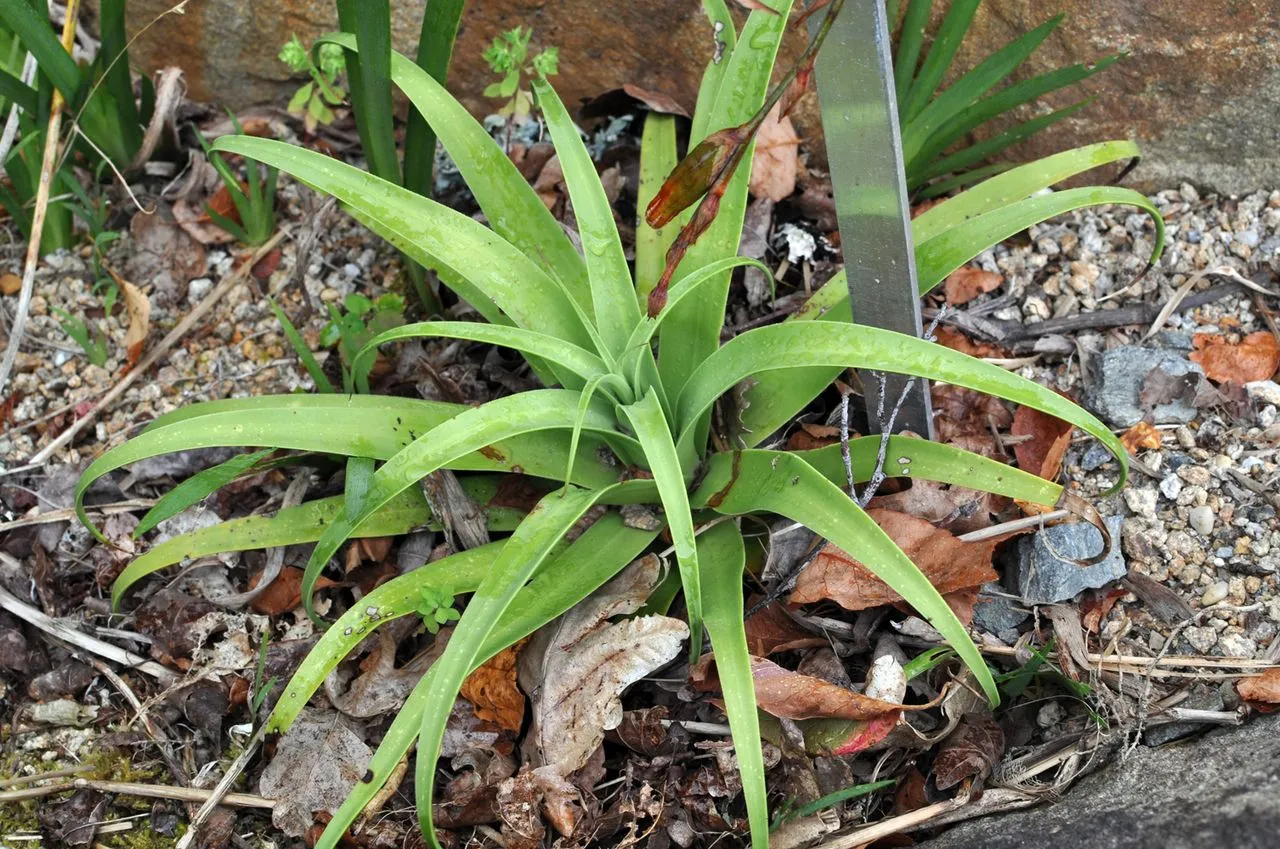
Agave bracteosa S.Watson ex Engelm. (1885), known as the squid agave or spider agave, is one of the smallest and most distinctive species in the genus. The common name earns its keep: 30 to 50 narrow, glossy, bright-green leaves arc outward from a tight central crown, each one curving back at the tip, giving the whole rosette the appearance of something marine rather than desert-born. It is native exclusively to north-eastern Mexico, growing on limestone cliffs and canyon walls in the states of Coahuila, Nuevo León, and Tamaulipas, mostly at elevations between 800 m and 1,800 m in the Sierra Madre Oriental.
Two characters separate it from every other agave in common cultivation. First, the leaves carry no terminal spine and no marginal teeth whatsoever. Second, the rosette does not die after flowering. These are unusual enough in the genus that they tend to surprise growers encountering A. bracteosa for the first time.
Part of the Complete Agave Guide.
Identification
A mature rosette measures 40 cm to 50 cm in diameter and reaches roughly 30 cm to 40 cm at the centre. Individual leaves are 30 cm to 45 cm long and 2 cm to 3 cm wide at the base, narrowing gradually to a soft, blunt, flexible tip. Press a fingertip firmly against any leaf tip: it gives without resistance. The margins are equally smooth; there are no teeth, ridges, or filaments along the entire length.
Leaf colour is a consistent mid to bright green with a distinct sheen. This separates the species immediately from Agave attenuata, which is glaucous grey-green and three to four times larger, and from Agave victoriae-reginae, which is dark green with bold white margin lines and a hard terminal spine. The slightly keeled underside of each leaf, combined with the outward-arching posture that curves back downward near the tip, produces the tentacular effect the squid name describes.
The plant is clumping. Basal offsets form freely once the primary rosette matures, typically at 4 to 6 years from a rooted pup. A container specimen of 8 years or more will usually carry several satellite rosettes around the central plant.
Inflorescence is a slender erect spike, 1.5 m to 2 m tall, carrying densely packed creamy-white to pale yellow flowers. It lacks the drama of A. attenuata's arching three-metre raceme, but it is not modest in flower count. The spike emerges from an otherwise unremarkable rosette, which is part of what makes the polycarpic habit important to know in advance: growers who have not been told expect the plant to die once the spike appears.
Distinguishing from lookalikes. Agave geminiflora presents the greatest identification risk. Both species produce a rosette of narrow, recurving leaves, and both are sometimes sold as safe or spineless agaves. A. geminiflora is neither: it carries a stiff terminal spine capable of drawing blood, and its margins peel fine white filaments. The leaves are also darker and narrower. Agave attenuata is occasionally grouped with A. bracteosa in retail under broad "soft agave" labelling, but the size difference alone settles it: A. attenuata at maturity is three to four times wider, grey-green rather than bright green, and develops a visible aerial trunk.
Cultivation
Light. In the Sierra Madre Oriental, cliff faces and canyon walls give A. bracteosa several hours of direct sun at low angles while blocking overhead midday exposure. In cultivation, this translates to a plant that performs well with 3 to 5 hours of direct sun daily and tolerates bright indirect light better than any other commonly grown agave. An east- or west-facing outdoor position is close to optimal. In cool or overcast climates, a south-facing aspect is fine. In hot, dry climates where summer temperatures exceed 38 °C, unbroken midday exposure will bleach the leaf tips to pale straw; this damage is cosmetic but permanent on leaves that persist for years.
That shade tolerance is the species' most useful cultivation trait. It opens positions that are off-limits for most agaves: a covered terrace, a bright room without south-facing exposure, or a courtyard corner where direct sun falls for only part of the day. Growth slows in lower light, averaging 2 to 3 new leaves per year rather than 4 to 5 in a sunnier spot, but the plant stays healthy and compact.
Substrate. As for the genus in general: 60% pumice or lava grit, 25% coarse sharp sand, and 15% peat-free loam-based compost. A. bracteosa originates from calcareous substrate, so a slightly alkaline pH of 7.0 to 7.5 suits it. Avoid peat-based mixes; their moisture retention works against crown drying between waterings, and their acidity runs counter to the species' limestone origins.
Watering. Water thoroughly when the substrate is fully dry to the base of the pot. In active summer growth, that is typically every 10 to 14 days under warm conditions; you can water when the substrate drops below 12 to 15% on a moisture probe rather than waiting for near-zero readings, reflecting the higher summer rainfall of the canyon habitat compared with open desert. From mid-autumn, extend intervals progressively. Below 7 °C, withhold water entirely.
Temperature. A. bracteosa tolerates brief exposure to approximately -9 °C when the roots are completely dry, placing it in USDA zone 7 hardiness. This is considerably hardier than A. attenuata (damaged below -2 °C) but well short of cold-continental species like Agave parryi or A. montana. Wet cold is the real danger: a moist root zone at -3 °C will rot the plant when that same temperature on dry roots causes no damage. Container plants are most at risk because the root zone is more exposed than in-ground planting; move pots under cover before sustained overnight temperatures fall below -5 °C.
Container growing. The compact rosette and absence of hazardous spines make A. bracteosa one of the best agaves for long-term pot cultivation. A 20 cm to 25 cm wide terracotta pot, 25 cm deep, is appropriate for a single mature rosette; terracotta's porosity supports the dry-wet cycle the roots need. As offset rosettes accumulate, re-pot the whole clump up one pot size rather than attempting to detach every pup.
Propagation
Offsets. Pup division is the primary route. Wait until a satellite rosette has formed its own visible root system, roughly when it reaches 12 cm to 15 cm in diameter. Sever the stolon connection with a clean, sterile blade, keeping the cut surface away from the parent's roots. Callus for 5 to 7 days in dry shade, then pot up in mineral substrate and withhold water for a further week. Rooting is typically complete within 3 to 5 weeks at temperatures above 18 °C.
Bulbils. Flowering can be followed by bulbil production on the old spike. Because the parent rosette survives and continues growing, the plant's investment in bulbil production is less absolute than in monocarpic species expending their final reserves; bulbils are not always abundant. When they form, detach them at 2 cm to 3 cm, allow two days to callus, and press the base into barely moist pumice. Expect rooting in 4 to 6 weeks above 20 °C.
Seed. Fresh seed germinates in 10 to 20 days on a sterile pumice surface at 22 °C to 26 °C. Seedlings are slow, reaching identifiable rosette character in 2 to 3 years and flowering size in 8 to 12 years. As with the genus generally, A. bracteosa is self-incompatible; two genetically distinct plants in flower simultaneously are required for viable seed.
Notes
The common story about agaves runs like this: they take years to mature, they die after flowering once, and they are physically dangerous. A. bracteosa is a useful counter-example to all three parts of that account.
On physical safety: the leaves are genuinely soft. The rounded, flexible tips will not puncture skin; the smooth margins cannot catch or scratch. Positioning the plant beside a frequently used path, in a pot on a terrace with children nearby, or indoors near foot traffic is reasonable in a way it is not with Agave americana, A. ferox, or most other species in the genus. The comparison to A. attenuata is apt, with the added advantage that A. bracteosa stays far smaller and handles cooler winters.
On monocarpy: it does not apply here. The rosette that sends up a flowering spike this season will still be growing next season. In good cultivation conditions, the same rosette can flower more than once over a long life. Combined with the clumping habit, a well-established container planting becomes self-renewing. Growers who have lost an A. americana or A. victoriae-reginae to monocarpic flowering, and who have come to accept that every agave eventually ends this way, tend to be genuinely surprised the first time a A. bracteosa spike comes and goes without ending the plant.
Trade confusion. Plants labelled "spineless agave" in retail are frequently A. attenuata regardless of the tag. Confirming A. bracteosa is straightforward: run a finger along the leaf margin from base to tip. The result should be entirely smooth. Any trace of resistance, prickling, or thread-like filaments indicates a different species. A. geminiflora is the most common mislabelling, and it matters because that species has a functional terminal spine.
Pet safety. Agave sap contains calcium oxalate crystals and steroidal saponins that cause gastric irritation and contact reactions in cats and dogs. The softer leaves of A. bracteosa reduce the risk of physical puncture injury to animals but do not change the chemical risk. Keep the plant out of reach of pets that chew foliage.
See also
- The Complete Agave Guide
- Agave attenuata, foxtail agave; the other widely grown spineless species, considerably larger and more cold-sensitive, with an arching inflorescence
- Agave victoriae-reginae, Queen Victoria agave; small geometric rosette also suited to long-term container cultivation
- Agave geminiflora — another narrow-leaved species sometimes confused with squid agave in retail.
Frequently Asked Questions
Does Agave bracteosa die after flowering?
Usually no. It is polycarpic, so the rosette can flower and continue growing, unlike the monocarpic pattern typical of Agave.
Is Agave bracteosa safe near paths?
Physically, yes. The leaves have no terminal spine or marginal teeth, although the sap can still irritate pets or people who chew or cut it.
How big does squid agave get?
A mature rosette is usually 40 cm to 50 cm across and about 30 cm to 40 cm tall at the centre.
How cold-hardy is Agave bracteosa?
It tolerates brief exposure to about −9 °C when completely dry. Wet cold is the serious danger, especially for container plants.