| Question | Short Answer |
|---|---|
| What is the main identification point? | The Identification section separates Aloe humilis by plant habit, leaf form, marginal teeth or surface markings, flowers, and lookalikes named in the article. |
| How should this aloe be watered? | Follow the Cultivation section rather than a fixed calendar. |
| How is it propagated? | Use the Propagation section. |
| What should buyers watch for? | Check the Notes and lookalike sections. |
Aloe humilis (L.) Mill., the spider aloe, is one of the earliest aloes to enter the Linnaean system: Carl Linnaeus published the basionym in Species Plantarum in 1753, and Philip Miller transferred it to its current combination in The Gardeners Dictionary a few years later. The species is a South African endemic of the Eastern Cape and the Karoo fringes of the Western Cape, growing on rocky shale and dolerite slopes between roughly 100 and 1,300 m. It is a true dwarf at 10 to 15 cm tall, stemless or very short-stemmed, with dense rosettes of incurved blue-green to grey-green leaves covered in raised white tubercles on both surfaces. The radiating pattern of those pale tubercles against a dark leaf is the source of the common name.
Habitat is dry, open, and seasonally cool. Karoo and Eastern Cape inland slopes carry winter rainfall in the west and summer rainfall further east, and the species sits across that gradient on shallow, free-draining mineral soils with strong sun exposure. Temperatures swing widely: hot dry summers above 30°C and frosty winter nights down to a few degrees below zero on inland slopes. A. humilis is currently assessed as Least Concern on the South African National Red List, in contrast to several of its narrow-range relatives, and it remains locally common in undisturbed veld. CITES Appendix II covers all aloes (except A. vera), so international trade in cultivated material requires permits even where the species itself is not threatened.
Part of the Complete Aloe Guide.
Identification
A. humilis is a small plant by the standards of the genus. A solitary mature rosette is rarely taller than 15 cm and rarely wider than 10 to 12 cm across, with 20 to 30 leaves stacked tightly in a flattened-globose habit. The leaves themselves are short and sharply incurved, 8 to 15 cm long, lanceolate, and the curl is pronounced enough that the rosette closes inward over the centre when the plant is stressed by drought or strong sun. Colour ranges from a steely blue-green in shaded plants to a paler grey-green flushed with red-brown along the margins in full exposure.
The diagnostic character is the surface tuberculation. Both faces of the leaf carry small raised white tubercles, scattered fairly evenly but tending to align in irregular radiating rows from the base of the leaf toward the tip. The marginal teeth are larger, white, triangular, and sit on a strongly toothed pale cartilaginous rim that runs the full length of the leaf edge. A hand lens makes the surface texture obvious: it is rough to the touch in a way that very few other dwarf aloes are.
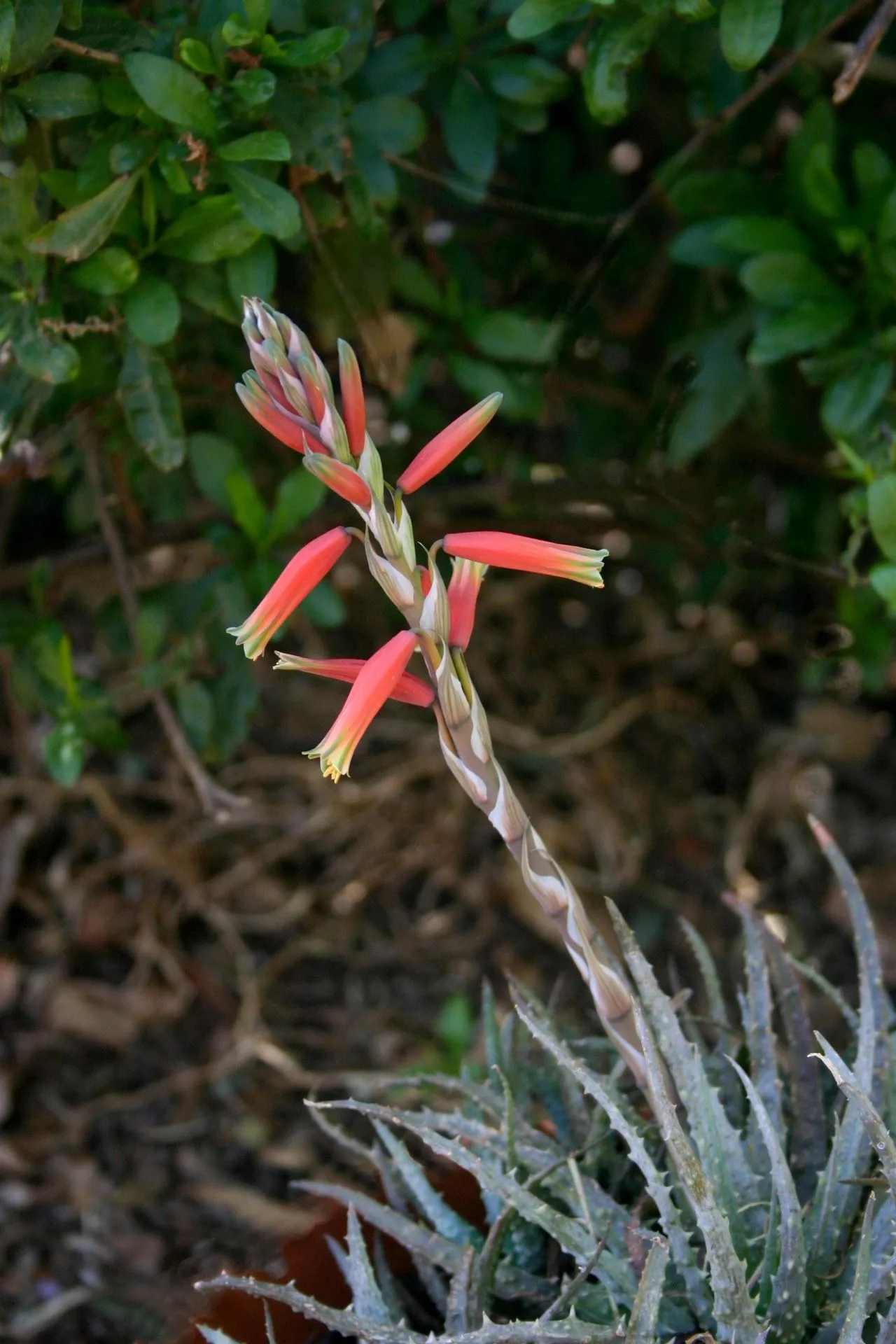
The species is a prolific clumper. A single rosette throws abundant basal offsets that root almost immediately, and an established plant in the ground builds a low spreading mat 30 to 60 cm across within a few seasons. Inflorescences appear in spring, September to November in habitat (corresponding to March to May in the northern hemisphere), as simple unbranched racemes 30 to 40 cm tall carrying tubular orange-red flowers. A branched candelabra panicle would point to a different aloe; A. humilis raceme is always single.
Three lookalikes recur in trade and in older literature. Aristaloe aristata (formerly Aloe aristata) is the most commonly substituted plant: its leaves are narrower, taper to a fine white aristate hair-tip, and carry small white markings that on close inspection are flat or slightly papillate rather than the raised round tubercles of A. humilis. The needle-tip is the quickest separator. Aloe brevifolia shares the dwarf clumping habit and the Cape origin, but its leaves are smooth on both surfaces, with no tubercles at all, and its marginal teeth are smaller and paler against broader, fleshier blue-green leaves. Gonialoe variegata (formerly Aloe variegata, the partridge-breast aloe) is unmistakable on close look despite a similar size: its leaves are arranged in three distinct vertical ranks rather than a spiral rosette, and the surface markings are pale transverse bands of soft white speckling, never the raised tubercles of A. humilis. If the pattern looks painted on, it is G. variegata; if it feels rough, it is A. humilis.
Cultivation
Light. Give full sun in the open garden once acclimated. Strong light keeps the rosette tight, deepens the blue-grey leaf colour, and brings out the contrast of the white tubercles against the leaf face. In a south-facing window, 6 to 8 hours of direct light is the working minimum; less than that produces visibly elongated leaves with reduced tuberculation and a paler, flatter rosette. North of about 45° latitude, a supplemental grow light through the dim months prevents the etiolation that ruins the species' main visual character.
Water. Treat A. humilis as a cool-season grower with a hot-summer slowdown across most of its range. In a 12 to 15 cm terracotta pot with a mineral mix, water deeply when the top 2 to 3 cm of substrate has fully dried, then drain freely. From autumn through spring that may mean every 7 to 12 days; in midsummer above 28°C, intervals stretch to 3 weeks or longer, and a quietly dormant plant tolerates prolonged drought without leaf loss. Wet roots at low temperatures are the most common failure mode, especially on stagnant winter substrate where rot enters at the base of the rosette.
Substrate. A mineral-dominant mix of about 70 percent inorganic to 30 percent organic suits this species well. A practical recipe is 40 percent pumice, 20 percent coarse perlite or lava grit at 3 to 6 mm, 10 percent quartz or granite grit, and 30 percent sifted loam-based compost. The clumping habit roots shallow but spreads laterally, so a wide rather than deep pot, with a 1 to 2 cm mineral top dressing, keeps the leaf bases dry where new offsets emerge.
Temperature. Frost tolerance is moderate but real. An established, bone-dry plant takes brief exposure to about -3°C without significant cosmetic damage, and inland Karoo populations regularly endure light overnight frosts. Survival to about -5°C is reported in well-drained Mediterranean and Californian gardens with quick-draining mineral soils. Wet cold is the failure mode; -1°C with damp roots damages tissue more than -4°C with a dry root ball. Above 35°C in dry conditions, the rosette closes inward and growth halts; the plant tolerates this for short periods but needs cooler nights to recover condition.
Container. A wide shallow stoneware or terracotta pan suits the spreading mat better than an upright cylinder. A starter rosette fits a 10 cm pan; a clumped colony of 8 to 12 rosettes wants 20 to 25 cm of width with strong drainage. Repot every 2 to 3 years into fresh mineral substrate and split the colony at the same time. The cultural baselines outlined in the beginner's guide apply directly here; A. humilis is forgiving once drainage is right.
Feeding is light. A quarter-strength balanced cactus fertiliser once or twice in the cool active growing season is enough. Heavier feeding produces softer leaves with reduced tuberculation, which defeats the point of growing the species.
Propagation
A. humilis is one of the easiest aloes to propagate vegetatively. Basal offsets emerge in quantity from the parent rosette and root almost as soon as they touch substrate. To divide a clump, lift the colony in cool weather (autumn or early spring), tease the offsets apart with finger pressure or a clean knife, let any cut surfaces callus for 3 to 5 days in dry shade, and pot the divisions individually into a sharply drained mineral mix. New roots usually appear within 2 to 4 weeks, and a 90 percent or higher take rate is normal in a home setup.
Single-leaf cuttings do not work for this species, as for the genus generally; aloes do not regenerate from leaf tissue. Seed is viable but slower and rarely necessary given the prolific offsetting. Fresh seed germinates at 18 to 24°C on a sterile mineral surface with a thin grit dressing, in bright shade with constant air movement. Germination starts within 2 to 4 weeks and a 60 to 75 percent rate is realistic from fresh, properly stored seed. Seedlings reach division-sized rosettes in about 18 to 24 months. Hand-pollination between unrelated clones produces better seed set than self-pollination of a single clone.
Notes
Hybrids and trade material. A. humilis has been one of the most heavily used parents in dwarf-aloe hybridisation since the nineteenth century, and a great deal of nursery stock sold under the species name is in fact a hybrid involving A. aristata (now Aristaloe aristata), A. brevifolia, or A. variegata (now Gonialoe variegata). Pure A. humilis has the dense raised white tubercles on both leaf surfaces, the strongly incurved leaves, and the prolific basal offsetting. If the leaves carry a fine hair-tip, suspect Aristaloe parentage; if the leaf surface is smooth, suspect A. brevifolia or one of its hybrids.
Pests. Mealybug occasionally hides between the tightly packed lower leaves of an established colony, especially under glass with poor airflow. The incurved leaf habit makes chemical access into the rosette interior poor once colonies settle deep in the leaf axils, so a hand-lens inspection before winter is the most useful precaution. Aloe mite is rarely reported on this species, but any distorted cauliflower-like growth at a rosette centre should be removed and the affected rosette destroyed away from the rest of the collection.
Pet and child safety. The marginal teeth are sharp enough to scratch on contact and the leaf tips are firm. The species is not seriously hazardous, but it is not a sensible plant at face height where children or cats brush past it. The aloe-typical sap chemistry should not be eaten.
See also
- The Complete Aloe Guide: genus-level cultivation principles and how dwarf tubercled species fit alongside the larger arborescent aloes.
- Beginner's Guide to Succulents: light, water, and substrate fundamentals to settle before reading species-specific notes.
- Aloe brevifolia — another dwarf clumping Cape aloe, compared in the identification section.
Frequently Asked Questions
What is the main identification point?
The Identification section separates Aloe humilis by plant habit, leaf form, marginal teeth or surface markings, flowers, and lookalikes named in the article.
How should this aloe be watered?
Follow the Cultivation section rather than a fixed calendar. The article gives drying depth, seasonal growth rhythm, and the wet-cold risk for this plant.
How is it propagated?
Use the Propagation section. The article states whether offsets, stem cuttings, or seed are practical, and notes that single-leaf cuttings do not work for aloes.
What should buyers watch for?
Check the Notes and lookalike sections. The article flags trade confusion, hybrid material, or conservation sourcing where those issues apply.