Spots on aloe leaves have at least four distinct causes, and the treatment for each is different. Acting without a correct diagnosis — spraying a fungicide on bruising, or dismissing a spreading fungal infection as natural variation — delays resolution and can worsen the problem. The first step is always to examine spot morphology, distribution, and the history of the plant before reaching for any product.
Part of the Complete Aloe Guide.
Natural white and pale green markings
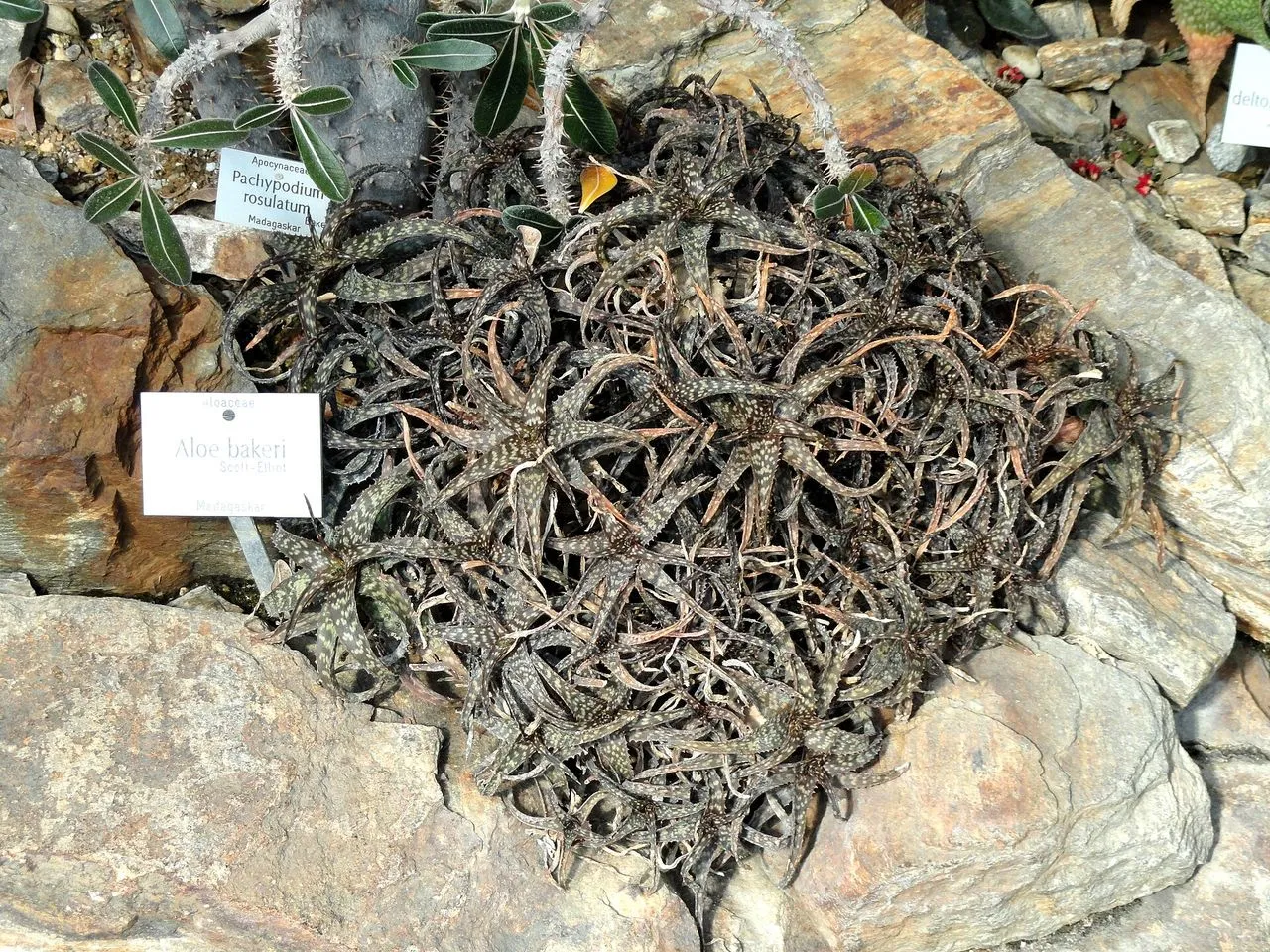
Many Aloe vera plants carry natural white, cream, or pale green spots or banding on their leaves. In A. vera, these appear as irregular whitish blotches arranged roughly in horizontal bands, more pronounced on young plants and often fading as leaves mature. In related species such as Aloe variegata and in close relatives Gasteria and Haworthia, spotted or striped markings are a defining species character rather than pathology.
Natural markings do not progress or enlarge over time, do not spread from leaf to leaf, have uniform soft edges rather than the irregular or water-soaked margin of a lesion, and are not associated with any change in leaf texture. The surrounding tissue remains firm, and new central growth carries the same pattern in the same positions relative to the leaf anatomy. They require no response. If markings on a plant that has had them for years suddenly appear to have changed character — becoming raised, sunken, or water-soaked at the edges — re-examine them against the criteria for the other causes below.
Anthraquinone bruising from impact
Aloe vera leaves are gel-filled and bruise readily when compressed, bent, or struck. When the parenchyma cells in the inner leaf are ruptured — by a fall, rough handling, pressing against a pot rim, transit packaging, or a sharp knock — the released latex and inner gel oxidise on contact with air. Aloin and related anthraquinones in the latex oxidise first to a yellow-orange colour, then to brown or reddish-brown within 24 to 72 hours of the injury. The resulting spot has a distinctive profile:
- Irregular in outline, following the contour of the impact rather than growing as a circular lesion
- Confined to the point of contact and not spreading in any direction after the initial 24 to 48 hours
- No yellow or pale green halo at the edges
- Firm surrounding tissue with only the directly ruptured cells collapsed
- Typically appearing within 24 hours of a specific handling or transport event the grower can usually identify
Bruising requires no treatment. The oxidised anthraquinone layer that forms over the ruptured cells acts as a self-repairing sealant. Keep the area dry, avoid cutting into it, and allow it to dry down to a stable brown scar over 3 to 7 days. The scar will not re-green but will remain stable indefinitely without progressing. For the distinction between bruising and true rot when the entire plant softens rather than a single contact point, see Aloe Vera Soft and Mushy.
Fungal leaf spot
Fungal leaf spots are the most clinically significant spotting problem in cultivated aloes. They are strongly associated with overhead watering, water left on the leaf surface, high humidity, poor airflow between pots, and temperatures below 18°C — conditions that allow spores to germinate and penetrate leaf tissue through stomata and minor surface wounds. The pathogens most commonly involved belong to genera including Alternaria, Fusarium, Phoma, and Helminthosporium, though the treatment approach is the same regardless of the specific pathogen. Diagnostic features:
- Spots are circular to oval, typically 2 to 15 mm in diameter at maturity
- Colour is brown to dark brown at the centre, often with a pale or water-soaked margin at the active growing edge
- Many spots are ringed by a yellow or light green halo as the pathogen releases toxic metabolites that bleach surrounding tissue
- Multiple spots appear simultaneously across the leaf surface or on several leaves at once
- Spots enlarge over 3 to 7 days and may coalesce into irregular patches in warm, humid, airless conditions
- The centre of an established spot is often sunken or slightly dry relative to the surrounding leaf, with a darker raised border at the outer edge
A single isolated spot on an otherwise healthy plant kept in dry, well-ventilated conditions may have been caused by a single water droplet acting as a magnifying lens in direct sun, producing a localised heat scar that will not spread. Multiple new spots appearing within the same week, or spots appearing on several different leaves simultaneously, indicate active fungal disease requiring intervention. The comprehensive identification guide comparing leaf spot diseases across succulent genera is at Fungal Leaf Spot.
Treat by removing heavily infected leaves cleanly at the base with sterile scissors or secateurs, dropping them directly into a bag without contact with other leaves. Reduce humidity by improving airflow: a minimum of 30 cm of clear air space between pots significantly reduces inter-plant spore transfer, and a small fan running at low speed in a greenhouse or indoor collection has a marked effect. Stop all overhead or misting-style watering immediately and switch to bottom watering or careful substrate-only watering at pot level. Apply a copper-based fungicide or sulphur-based contact product at label rate once per week for three consecutive weeks. This will not reverse existing lesions but significantly reduces the viable spore load on and around the plant. Do not apply sulphur to plants in temperatures above 27°C or in direct sun on the application day.
Scale insects misidentified as spots
Armoured scale insects — particularly species in Diaspis and related armoured-scale genera — attach to the leaf surface and construct a hard circular to oval waxy shell over their bodies. When first attached, individual scales appear as small pale-brown or grey circular spots, typically 1 to 3 mm across, fixed flush to the leaf surface. The waxy shell cannot be wiped off with a cloth or fingertip but can be levered away with a fingernail, at which point the pale soft insect body becomes visible underneath. Under a 10× loupe the shell has a slightly layered, concentric structure and a texture clearly distinct from the aloe leaf surface.
Scale insect marks do not have the yellow halo of fungal lesions, do not produce depression in the surrounding tissue, and are not distributed in the irregular or clustered pattern of bruising. As the population grows, new scale attachment points appear and the spots increase in number over weeks. Feeding-scale populations large enough to reduce plant vigour cause generalised yellowing and leaf dieback rather than discrete spots alone. The treatment protocol — physical removal followed by horticultural oil to catch mobile crawlers — is covered in Aloe Mealybugs, which includes the armoured-scale protocol alongside the mealybug treatment framework. Unlike mealybugs, armoured scales require two sequential steps: mechanical removal of each shell and a follow-up oil spray to intercept the first-instar crawlers that the shell protects from contact.
Cold water marks and hard water deposits
In hard-water areas, cold water splashed onto warm aloe leaf surfaces, or water droplets left on the leaf in direct sun, produce white or chalky tan circular marks. Hard-water deposits are calcium and magnesium carbonate that precipitate from the water film as it evaporates. They have a slightly raised, chalky, or dusty texture and are restricted to areas where water pooled. They do not enlarge after drying, have no halo or sunken centre, and are not biological.
Cold water on a warm leaf can also produce minor local cell damage — a small translucent or slightly sunken pale spot appearing within 24 to 48 hours at the contact point. This represents localised thermal shock to surface cells rather than disease, and it does not spread. Remove hard water deposits by wiping with a damp cloth or a cloth dampened in a 5% solution of white vinegar. Do not rub actively growing lesions of any kind, which could break the surface further.
How to identify the cause
| Spot characteristics | Texture | Spread over time | Likely cause |
|---|---|---|---|
| White or cream blotches, present since the plant was young | Firm, flush with surface | No spread | Natural pigmentation marking |
| Irregular brown patch after handling or transport | Brown, dry-sealing over 24–72 hours | No spread | Anthraquinone bruising from impact |
| Circular, brown with yellow halo, appearing on multiple leaves | Slightly sunken at centre | Spreads over days | Fungal leaf spot |
| Hard circular raised shells, removable with a fingernail | Waxy, hard, distinct texture | Population grows gradually | Armoured scale insects |
| White or chalky circular deposit, no biological margin | Chalky, slightly raised | No spread | Hard water or cold-water splash deposit |
When spots are multiplying, darkening, or merging within the same week, treat as fungal until proven otherwise. Static spots that match the bruising or natural-marking profile can be observed without intervention.
Risk and severity
Natural markings and bruising carry no risk to the plant. A single fungal spot on an otherwise healthy aloe kept in good ventilated conditions is low risk, provided the cause — typically an episode of overhead watering or water sitting on the leaf — is corrected. Multiple spreading fungal lesions on a plant in poor airflow is moderate risk: the infection will not kill the plant quickly, but left untreated through a humid season it will disfigure the affected leaves, weaken the outer tissue, and can spread through an entire collection via water splash. See the severity and management hierarchy in Fungal Leaf Spot.
Scale infestation at high population density reduces photosynthetic capacity and plant vigour, and can cause leaf yellowing and dieback in a sustained heavy infestation. Early-stage scale — a handful of individual shells on one or two leaves — is cosmetic only and straightforward to treat. The main risk with scale is that infestations are easy to miss during routine inspection because the shells closely resemble the leaf surface.
Solutions
For bruising
Leave the scar undisturbed. Do not apply any treatment to the oxidised surface — it is already sealed. Ensure the area remains dry and away from direct water contact. If the bruised leaf subsequently begins to smell or collapse, which indicates secondary bacterial or fungal entry through the wound, remove the entire leaf at the base with a sterile blade.
For fungal spots
Remove the most affected leaves at the base. Improve airflow by spacing pots at least 30 cm apart and removing obstructions from the growing space. Stop all overhead watering and misting. Apply copper-based or sulphur-based fungicide once weekly for three weeks. Monitor new central growth: clean, unmarked new leaves confirm the treatment has controlled the infection.
For scale insects
Work systematically across every leaf, levering off each visible shell with a fingernail or firm brush. Follow immediately with a horticultural oil spray at label rate, applied to all leaf surfaces including undersides and the axils where the leaf meets the stem. Repeat the oil treatment at 10 to 14 days to intercept crawlers that were not yet fixed when the first application was made. Monitor monthly for new attachment points for the following two growing seasons.
For hard water deposits
Wipe with a cloth dampened in water or diluted white vinegar. This is cosmetic only and has no effect on plant health. Prevent recurrence by watering at substrate level rather than overhead.
Prevention
Grow aloes with adequate spacing between pots, avoid overhead watering and misting at all times, and maintain airflow in any enclosed growing space. Inspect new arrivals carefully for scale, mealybug, and any existing lesions before placing them near established plants. Quarantine new acquisitions for a minimum of 4 weeks. Inspect established plants once a month in summer when both scale and fungal conditions are active. Keep leaf surfaces dry during cool or wet periods, which is when fungal pathogens are most effectively able to germinate and infect. See Aloe Leaves Turning Brown for how spot-related damage overlaps with the broader pattern of sunburn, cold injury, and rot when multiple causes interact.
See also
- Fungal Leaf Spot — pathogen identification, fungicide selection, and cross-genus comparison for leaf spot diseases.
- Aloe Mealybugs — scale and mealybug treatment protocol for aloe collections, including armoured-scale removal steps.
- Aloe Leaves Turning Brown — how spot-based damage overlaps with sunburn, cold injury, and rot patterns across the whole leaf.
- Aloe vera — species profile with the natural spotting pattern of standard A. vera to compare against disease signs.
Frequently Asked Questions
Why does my aloe have brown spots that look like bruises?
Aloe leaves bruise when the gel-filled parenchyma cells are ruptured by impact, bending, or pressing. The damaged cells release anthraquinones including aloin, which oxidise from yellow to brown within 24 to 72 hours. These spots are confined to the point of impact, do not spread, and do not indicate disease.
Are the natural white spots on Aloe vera a problem?
No. Many Aloe vera plants have whitish or pale green spots arranged roughly in horizontal bands across the leaf surface — these are natural pigmentation markings and are especially prominent on young plants. They are not fungal lesions, do not spread, and often fade as the leaves mature.
What do fungal leaf spots look like on aloe?
Fungal leaf spots are typically circular to oval, 2 to 15 mm across, brown to dark brown with a slightly sunken or water-soaked appearance, and often ringed by a yellow or pale green halo. They spread over days to weeks and may merge into larger lesions in humid conditions with poor airflow.
Can aloe spots spread to other plants?
Fungal spores spread to adjacent plants by water splash, shared tools, and airflow. Bruising and natural markings cannot spread. Isolate an aloe with actively spreading fungal spots and treat before returning it to a collection.