| Question | Short Answer |
|---|---|
| What is the main identification point? | The Identification section separates Aloe nobilis by plant habit, leaf form, marginal teeth or surface markings, flowers, and lookalikes named in the article. |
| How should this aloe be watered? | Follow the Cultivation section rather than a fixed calendar. |
| How is it propagated? | Use the Propagation section. |
| What should buyers watch for? | Check the Notes and lookalike sections. |
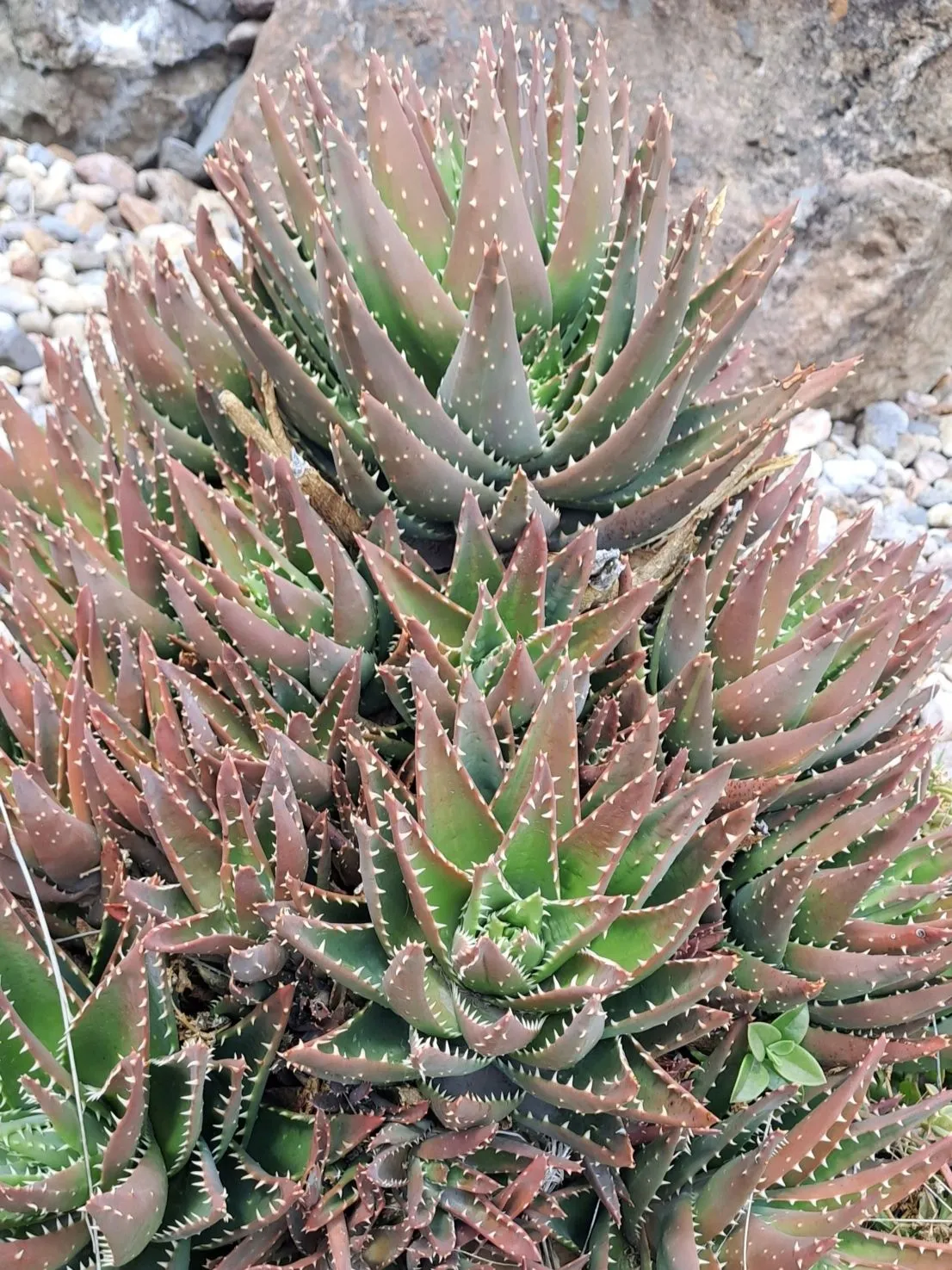
Aloe × nobilis Haw., the gold tooth aloe, was described by the English botanist Adrian Hardy Haworth around 1804 from material long circulating in European collections under various names. It is not a wild species but a horticultural hybrid, treated by modern authorities as the cross Aloe brevifolia × Aloe mitriformis (the second parent now widely synonymised with Aloe perfoliata). The plant has been in cultivation since at least the late 18th century and is among the most propagated aloes in trade, owing to dense low clumps of triangular bright green leaves edged with strikingly golden-yellow marginal teeth that flush red-orange under sun stress.
Because A. nobilis is a garden cross, it has no native range of its own. Its parents come from the Western Cape of South Africa: A. brevifolia from shale-clay Renosterveld slopes north and east of Cape Town, A. mitriformis sensu lato from sandstone outcrops in the Cederberg and Kogelberg. The hybrid combines the dense low rosettes and stoloniferous spread of the first parent with the longer ascending stems and bolder marginal armament of the second. Cultivated material is uniform enough to suggest most plants in trade descend from a small handful of original clones rather than repeated re-crossings, but the hybrid does arise spontaneously in mixed plantings where both parents flower together. As a hybrid, A. nobilis has no IUCN status of its own; the genus is listed on CITES Appendix II for international trade, which applies to all aloes except A. vera.
Part of the Complete Aloe Guide.
Identification
A. nobilis is a stem-forming clumping aloe. Mature stems reach 30 to 50 cm tall, lean or sprawl as they extend, and root readily where they touch substrate, so a single starter rosette becomes a wide spreading mat over three or four growing seasons. Each stem carries a tight terminal rosette 12 to 20 cm across, built of broadly triangular leaves 8 to 12 cm long arranged in close overlapping spirals. The leaves are firm, slightly recurved, bright green to bronze-green at the base, and they stack densely enough to hide most of the stem from view.
The diagnostic feature is the marginal teeth. They are bright golden-yellow, triangular, regularly spaced 5 to 8 mm apart along the leaf edge, and prominent enough to read clearly from across a courtyard. Under moderate light the teeth contrast against a green leaf face. Under strong direct sun, the teeth deepen to red-orange and the leaf surface flushes from green through bronze to a deep coral-orange across the upper face, with the brightest colour holding on the youngest exposed leaves. This stress colour is the hybrid's main horticultural draw and the reason it appears so consistently in dry-garden plantings across Mediterranean and southern Californian landscapes.
Inflorescences appear in summer on healthy outdoor plants. The raceme is simple and unbranched, 30 to 50 cm tall, carrying coral-red tubular flowers from a single axis. A branched candelabra panicle would point to Aloe striata or Aloe ferox, not nobilis.
Three lookalikes regularly cause confusion. A. brevifolia, one parent, is shorter overall (rosettes rarely above 25 cm tall), is stemless or very short-stemmed, builds a flatter mat, has fewer larger pale teeth on a blue-green leaf face, and never produces the deep coral stress flush. Aloe juvenna builds taller leaning stems but its teeth are pure white rather than yellow, smaller and more numerous along the edge, and scattered teeth often appear on the upper leaf face near the base; the leaf face is mid-green to bronze, not coral. A. mitriformis grown as the species rather than the hybrid produces longer climbing stems above 60 cm, broader leaves, and far fewer marginal teeth (often only a sparse row of widely spaced ones) that are whitish rather than yellow.
Cultivation
Light. Give full direct sun in the open garden once acclimated; this hybrid exists in trade because of its colour response, and the colour does not develop without strong light. In a south-facing window, 6 to 8 hours of direct sun is the working minimum, and the flush rarely reaches full intensity behind glass even at that level. Outdoors at low latitudes, full unscreened summer sun produces the deep coral stress that is the plant's selling point, with no reported burn risk on hardened tissue. An etiolated plant stretches its internodes within weeks, loses the tight rosette, and reverts to a plain mid-green that no later sun will restore short of the rosette renewing through new growth.
Water. Treat A. nobilis as a warm-season grower with a winter slowdown. In a 14 to 18 cm terracotta pot with a mineral mix, water deeply when the top 2 to 3 cm of substrate has fully dried, then drain freely. From late spring through early autumn that may mean every 7 to 10 days; in cool winters above 5 °C, intervals stretch to 3 weeks or longer. Stress colour intensifies under controlled water deficit at high light, but a chronically thirsty plant produces small soft rosettes that lose the dense overlapping habit. The hybrid resents stagnant moisture at the leaf bases of clumped stems, where damp axils combined with poor airflow are the most common failure point in collection plants.
Substrate. A mineral-dominant mix of about 70 percent inorganic to 30 percent organic suits this hybrid. A practical recipe is 40 percent pumice, 20 percent coarse perlite or lava grit at 3 to 6 mm, 10 percent quartz or granite grit, and 30 percent sifted loam-based compost. The clumping stem habit produces a shallow, laterally spreading root mass, so a wide rather than deep pot, with a 1 to 2 cm mineral top dressing of grit, keeps the lower stem and offset bases dry where they are most vulnerable to rot.
Temperature. Cold tolerance is moderate but not deep. A bone-dry established plant takes brief exposure to about -3 °C without lasting damage, with leaf-tip discolouration as the first visible mark. Below that, the hybrid is not reliable in unprotected ground; reports of survival to about -5 °C exist from inland Mediterranean and Californian gardens with sharply drained soils and dry winter cold, but wet cold is the failure mode. -1 °C with damp roots damages tissue more than -4 °C with a dry root ball. Above 35 °C in dry summer heat, growth pauses, the rosettes tighten, and the coral colour intensifies further.
Container. Use a wide stoneware or terracotta pot, 14 to 18 cm for a single-stem starter and 22 to 30 cm for a clumped colony of 6 to 10 stems. Repot every 2 to 3 years into fresh mineral substrate, refresh the top dressing annually, and lift any leaning stems back into vertical orientation at the same time. The cultural baselines outlined in the beginner's guide apply directly here; A. nobilis is one of the more forgiving aloes once drainage and light are correct.
Feeding is light. A quarter-strength balanced cactus fertiliser once or twice through the warm growing season is enough. Heavier feeding produces soft, pale, widely spaced leaves that flop on weak stems, lose the golden tooth contrast, and fail to colour up even in full sun.
Propagation
A. nobilis is among the easiest aloes to propagate vegetatively and is effectively self-multiplying once established. Stoloniferous offsets that have already self-rooted at the base of the parent clump can be lifted, separated with a clean knife, and potted directly without a callus phase. These establish almost immediately and reach a presentable rosette within one growing season. A 95 percent or higher take rate is normal in a home setup.
Stem cuttings strike with similar reliability. Take a cutting 10 to 15 cm long with at least one rosette at the apex, strip the lower 2 cm of leaves, let the cut surface callus for 5 to 7 days in dry shade, and pot into a sharply drained mineral mix. Roots usually appear within 3 to 5 weeks at 20 to 26 °C.
Single-leaf cuttings do not work for this hybrid, as for the genus generally; aloes do not regenerate from leaf tissue. Seed is a special case for A. nobilis: because the plant is itself a hybrid, seedlings from selfed flowers segregate variably and rarely match the parent in colour or habit. If colour and form are the goal, take cuttings or offsets from a known good clone and ignore the seed route unless deliberate further crossing is the aim.
Notes
Hybrid status and naming. Most botanical authorities now write the plant as Aloe × nobilis with the multiplication sign to mark the hybrid origin. The trade rarely bothers, and labels typically read "Aloe nobilis" or "Aloe x nobilis" without the proper symbol. Either is recognisable; the underlying plant is the same. Several variegated selections circulate, the most common being a cream-margined sport sold as 'Variegata', which is slower-growing and more prone to scorching in unscreened sun than the type clone.
Pests. Mealybug occasionally settles deep in the leaf axils of established clumps, where chemical access is poor and a hand-lens inspection before winter is the most useful precaution. Aloe mite is rarely reported on this hybrid but, as for any aloe, distorted cauliflower-like growth at a stem apex should be removed and the affected stem destroyed away from the rest of the collection.
Pet and child safety. The golden teeth are sharp on contact and the leaf tips are firm. The hybrid is not seriously hazardous, but it is not a sensible plant at face height where children or cats brush past it. The aloe-typical sap chemistry should not be eaten.
See also
- The Complete Aloe Guide: genus-level cultivation principles and how horticultural hybrids fit alongside the wild species in mixed collections.
- Beginner's Guide to Succulents: light, water, and substrate fundamentals to settle before reading species-specific notes.
- Aloe brevifolia — one of the two parent species, compared in the identification and notes sections.
Frequently Asked Questions
What is the main identification point?
The Identification section separates Aloe nobilis by plant habit, leaf form, marginal teeth or surface markings, flowers, and lookalikes named in the article.
How should this aloe be watered?
Follow the Cultivation section rather than a fixed calendar. The article gives drying depth, seasonal growth rhythm, and the wet-cold risk for this plant.
How is it propagated?
Use the Propagation section. The article states whether offsets, stem cuttings, or seed are practical, and notes that single-leaf cuttings do not work for aloes.
What should buyers watch for?
Check the Notes and lookalike sections. The article flags trade confusion, hybrid material, or conservation sourcing where those issues apply.