Quick Answer
The short answer: Crassula has leaves in opposite pairs (decussate), creating a four-column stack. Sedum has leaves in a spiral or alternating pattern, creating a looser look.
Best first step: Look at the stem - if leaves come in pairs at 90° to each other, it's Crassula. If they spiral around the stem, it's Sedum.
Avoid: Relying on flower color alone (Crassula can have yellow too) - always check leaf arrangement first.
A reader sends a photograph of a low, branching succulent and asks whether it is a Crassula or a Sedum. The two genera sit side by side in the family Crassulaceae, share the family name in everyday plant talk, and overlap broadly in cultivation requirements. They diverge in one feature that does most of the identification work even at a distance: leaf arrangement. Crassula puts its leaves in decussate pairs, opposite each other and rotated 90 degrees from the pair below, producing a strict geometric stack. Sedum, with a few exceptions, puts its leaves in a spiral or simple alternate arrangement, producing the looser, less ordered look most beginners associate with stonecrops. If you can see the leaves on the stem clearly, you almost certainly have a name. Here is the rest of the picture.
Both genera are old, large, and widely distributed. Crassula contains around 200 species, the centre of diversity in southern Africa (mainly the Cape provinces and Karoo), with smaller representations in East Africa, Madagascar, and a handful of cosmopolitan weedy aquatic species. Sedum sensu lato has been split heavily by recent phylogenetic work, but in horticultural use it still spans 400 to 500 species across the northern hemisphere, with major centres in Mexico (the source of S. nussbaumerianum, S. rubrotinctum, S. burrito, S. clavatum, and S. morganianum) and in Europe and the Mediterranean (S. acre, S. album, S. rupestre, S. spurium). The two lineages converged on succulent leaves and CAM photosynthesis long ago, which is why the field separators below matter more than first impressions of leaf colour or pot size.
At a glance
| Character | Crassula | Sedum |
|---|---|---|
| Leaf arrangement | Decussate (opposite pairs at 90°), strict | Spiral or alternate (occasionally irregular decussate) |
| Leaf form | Thick, triangular or rounded, often pressed against stem | Variable; obovate or cylindrical, less stem-pressed |
| Stem habit | Upright woody stems in shrubby species | Trailing, mat-forming, or pendulous in many species |
| Inflorescence | Dense terminal heads or panicles | Branched cymes, often flat-topped |
| Flower colour | White, cream, pink (rarely yellow) | Usually yellow; sometimes pink or white |
| Flower count per cluster | Many, packed | Few to many, more open |
| Native centre | Southern Africa | Mexico, Mediterranean, temperate Asia |
| Growth rate | Slow, architectural | Faster, freely propagating |
| Typical use | Specimen, bonsai, structural pot | Groundcover, hanging basket, mat |
Key separators in the field
1. Leaf arrangement. Look at the stem from the side. Crassula leaves emerge in opposite pairs, with each successive pair rotated 90 degrees from the pair below. The result is a strict four-rank stack, called decussate phyllotaxy. In C. tetragona, C. perforata, C. muscosa, C. rupestris, and C. capitella, this geometry is so regular that the stem looks almost printed. In C. ovata and C. arborescens the pairs are still opposite, just spaced further apart on woody stems. Sedum mostly produces leaves in a continuous spiral, with a single leaf at each node, set at a fraction of a turn from the previous one. S. nussbaumerianum, S. pachyphyllum, S. clavatum, and S. morganianum all show this pattern clearly. A few sedums (S. spathulifolium, S. dasyphyllum) carry leaves that look almost decussate near the rosette tip, but the order is irregular, the pairs are not perfectly aligned, and the stem reverts to clear spiral arrangement further down. If the leaf stack reads as a hard four-column geometry, it is a Crassula; if it reads as a continuous spiral, it is a Sedum.
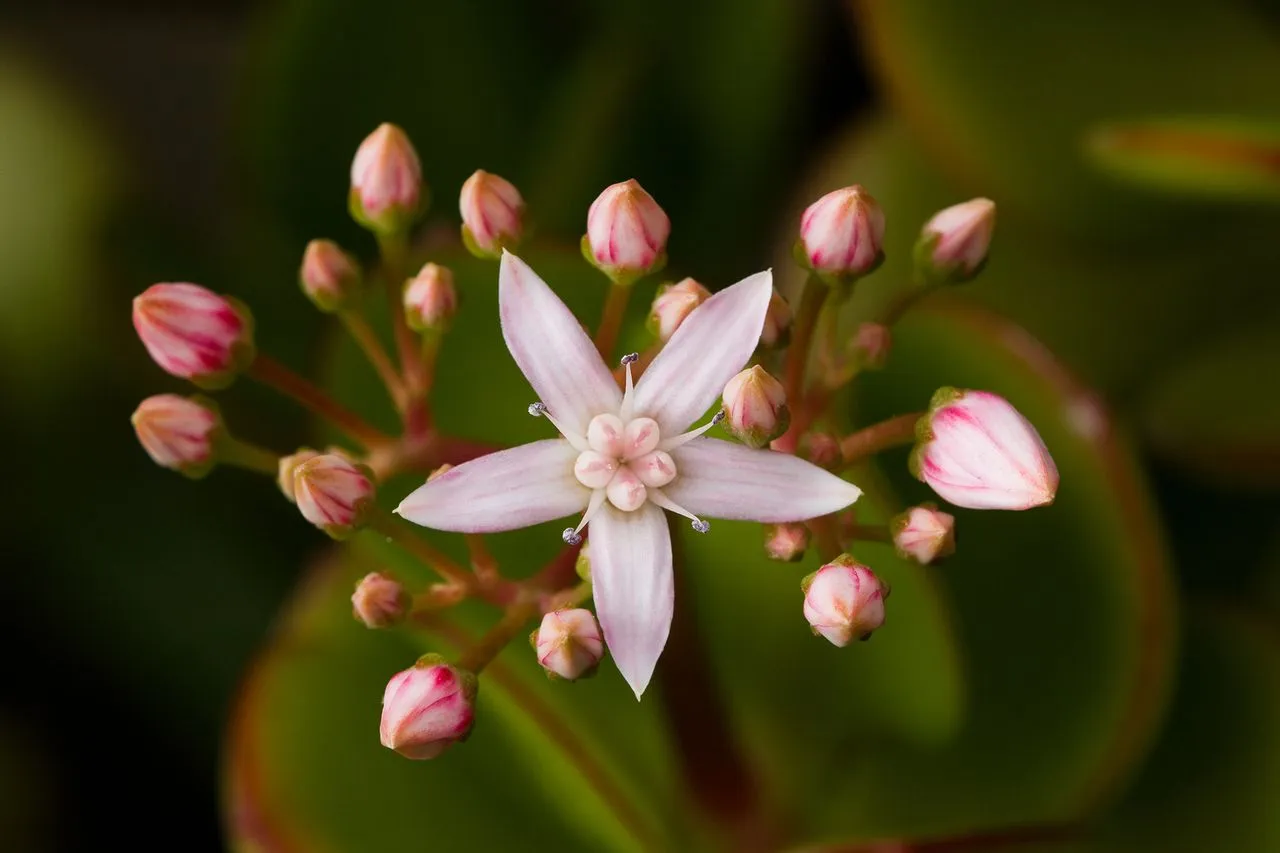
2. Flower structure. Crassula flowers are five-petalled stars 4 to 12 mm across, packed into dense terminal heads, corymbs, or short panicles, almost always white, cream, or pale pink (the major exception is the yellow-flowered C. mesembryanthemoides). The cluster sits at the very top of a stem and reads as a compact spherical or flat dome of small flowers, often producing a faint sweet scent. Sedum flowers are also five-petalled stars in most species, of similar size, but they sit on branched cymes that fan out flat or slightly domed above the foliage, with the individual flowers spaced far enough apart to be counted by eye. Colour is usually a clear bright yellow (S. acre, S. rupestre, S. nussbaumerianum, S. kamtschaticum), with pink or white in a minority of species (S. spurium, S. album, S. spectabile in its old genus sense, now Hylotelephium). A dense terminal head of small white stars on a stack of opposite leaves is Crassula; a flat-topped spray of yellow stars over a mat of spirally arranged leaves is Sedum.
3. Leaf form. Crassula leaves are typically thick and triangular, ovate, or rounded-fleshy, often pressed against the stem at a steep angle so the rows of leaves stack with little visible internode (C. perforata, C. capitella, C. rupestris) or held close to horizontal in glossy oval pads (C. ovata, C. arborescens). The leaf base is broad relative to the stem diameter, and many species carry a faint marginal line of cilia or a coloured leaf edge. Sedum leaves are more variable, but two profiles dominate cultivation: obovate to spatulate (S. nussbaumerianum, S. clavatum, S. pachyphyllum) and finger-cylindrical (S. burrito, S. morganianum, S. rubrotinctum, S. mexicanum). The leaf base in most sedums is narrow relative to the stem, the leaf often tapers to a clear stalk-like attachment, and the leaf rarely lies pressed against the stem the way Crassula leaves do.
4. Stem habit. Most large Crassula species in cultivation grow as upright shrubs or small trees with woody, branching stems and a clear architectural form. C. ovata reaches 1 to 2 m as a thick-stemmed shrub, C. arborescens the same, and C. tetragona a stiff vertical column 30 to 50 cm tall. Trailing or mat-forming Crassula exists (C. multicava, C. sarmentosa, C. pellucida subsp. marginalis), but in the trade the shrubby habit is more common. Sedum is the opposite: a large fraction of cultivated species are pendulous (S. burrito, S. morganianum), creeping mats (S. acre, S. album, S. spurium, S. rupestre), or low cushions (S. dasyphyllum, S. hispanicum). Upright, semi-woody sedums exist (S. nussbaumerianum makes 30 cm stems, S. praealtum makes 1 m), but the trailing or mat-forming habit signals the genus more often than not. A trailing succulent draped over the side of a hanging basket with finger-cylindrical leaves is almost always Sedum; a stiff upright shrub with paired oval leaves on woody stems is almost always Crassula.
5. Growth rate and propagation. Sedum is faster-growing than most Crassula in equivalent conditions. A leaf cutting of S. rubrotinctum or S. nussbaumerianum roots in 7 to 14 days at 20 to 25 °C and is a viable young plant within four to six weeks; S. acre and S. album colonise a tray of mineral grit from a sprinkle of detached leaves in one growing season. Crassula cuttings root reliably too, but more slowly: C. ovata leaf cuttings take four to eight weeks to throw a first root, and twelve weeks to a plant ready for repotting. A tray that turned over in eight weeks is almost always Sedum; an architectural paired-leaf shrub priced higher is almost always Crassula.
Edge cases and look-alikes
A handful of species deliberately blur the rule and trip beginners.
Crassula muscosa (the watch-chain or rattail crassula) and C. perforata (string of buttons) carry their decussate leaves so tightly stacked that the column reads as a single squarish stem of foliage rather than as discrete leaves. From two paces away this looks like a thread-leaf Sedum such as S. mexicanum at first glance. Rotate the stem in your hand and the strict four-rank geometry becomes obvious immediately. The leaves are not in a spiral, they are in a column.
Sedum clavatum (and similar Mexican rosette sedums S. lucidum, S. furfuraceum) forms compact pruinose blue-green rosettes at stem tips that look very Crassula-like, even superficially echeveroid. The give-away is the underlying spiral phyllotaxy: bend a rosette gently aside and the leaves below the apical cluster are clearly arranged on a continuous helix, not in opposite pairs. The flower, when it appears, is the classic flat yellow Sedum cyme.
Sedum dasyphyllum and S. hirsutum carry their leaves in apparent opposite pairs near the growth tips, and beginners sometimes call them crassulas. Examination of an older internode lower down the stem usually shows a clear spiral. These are Sedum with locally regular leaf placement, not true decussate species.
Crassula multicava and C. sarmentosa are sprawling, fleshier, mat-tending crassulas that do not match the upright-shrub stereotype. The decussate pairs and the dense head of small white-pink star flowers settle the genus regardless of habit.
Several Crassulaceae outside both genera are sometimes folded into the question. Sedum morganianum, the burro's tail, is sometimes split into Sedum sensu stricto or kept under that name even in current floras; for field purposes treat it as a Sedum. Hylotelephium (the genus into which Sedum spectabile and S. telephium have been moved by recent taxonomy) carries broad flat leaves and dense pink umbel-like terminal heads, and reads as something distinct from both groups discussed here. Graptopetalum and Pachyphytum form pruinose rosettes that some shoppers mistake for either genus, but their flowers are open star-shaped with petals partly free, and the leaves are arranged in clear basal rosettes rather than along extended stems.
When the two get confused in trade
Mislabelling at retail is real but more limited than in the Aloe/Haworthia or Echeveria/Sempervivum trade. There is no widespread "Sedum nussbaumerianum" sold as "Crassula nussbaumerianum" or vice versa: the species names stay attached to their genera. The confusion turns up at cultivar level instead.
Crassula 'Buddha's Temple' (a hybrid of C. perfoliata var. minor and C. pyramidalis) carries its leaves so tightly fused into a square stacked column that retailers occasionally label it as "Sedum 'Buddha's Temple'" or simply "tower succulent". The phyllotaxy is unmistakable on inspection: four-rank decussate, leaves clasping the stem completely. Treat it as a Crassula in cultivation: bright filtered light, drier substrate at the base than most sedums tolerate, and slow growth.
Sedum lineare 'Variegatum' (the cream-and-green needle sedum) is sometimes sold as "Crassula 'Variegata'" or "miniature jade" in mixed-tray plantings. The narrow needle leaves are not paired but spirally arranged, and a mature stem shows the classic Sedum multi-rank helix on close inspection. Cultivation differs from a true variegated jade: S. lineare 'Variegatum' is faster growing, hardier (it tolerates light frost briefly, where C. ovata damages below 0 °C), and prefers more steady moisture in the growing season.
Sedum praealtum is shrubbier than most cultivated sedums and has been sold as "miniature jade plant" in chain stores often enough to count as a recurring confusion. S. praealtum leaves alternate up the stem in a spiral; true C. ovata leaves are opposite and stem-clasping. Yellow stars in a flat panicle is S. praealtum, dense white-pink terminal heads is C. ovata.
The reliable rule at the point of purchase is the leaf-stack test. Hold the stem at eye level and rotate it. Four hard rows of paired leaves means Crassula. A continuous helix of single leaves means Sedum.
Cultivation principles for both groups are covered in the beginner's guide. The compressed version: most Crassula want bright filtered to direct light, a fully mineral fast-draining substrate, careful watering in winter (particularly the South African summer-dry species), and frost protection below 0 °C; most Sedum want full sun, gritty mineral substrate, more frequent water in active growth, and a wider tolerance of brief frost in the temperate species. Knowing which genus you have at the point of purchase removes most of the guesswork from the first growing season.
See also
- Beginner's Guide to Succulents: light, water, and substrate fundamentals shared across both genera.
- The Complete Crassula Guide: genus-level cultivation across the southern African shrubby and stacked-leaf species.
- The Complete Sedum Guide: cultivation principles across Mexican, Mediterranean, and temperate stonecrops.
- Succulent soil and substrate: substrate choices for the different growth rates and drainage needs of Crassula and Sedum
FAQ
Does Crassula or Sedum grow faster?
Sedum is generally faster-growing - a leaf cutting of Sedum rubrotinctum roots in 7-14 days, while Crassula ovata takes 4-8 weeks to root from leaf.
Can I tell them apart by flower color?
Not reliably. While Crassula typically has white/pink flowers and Sedum yellow, some Crassula species have yellow flowers too. Check leaf arrangement instead.
Which genus has the upright habit?
Crassula tends toward upright woody shrubs (like jade plant). Sedum is more commonly trailing, mat-forming, or pendulous (like burro's tail).
What's the easiest way to distinguish them at a garden centre?
Look at the stem - rotate the plant and see if leaves form four hard columns (Crassula) or a continuous spiral (Sedum).
Frequently Asked Questions
What is the first step for crassula vs sedum: telling the stem patterns apart?
Start by matching the symptom to the plant, substrate, light, and season before changing watering or treatment.
What should be avoided?
Avoid changing several variables at once; correct the limiting factor and observe the plant before escalating.
Which care factor matters most?
Match the plant to its light, substrate, pot size, and season. Most succulent failures trace to a mismatch between drying speed and the plant's current growth rate.
When should the plant be checked again?
Recheck after one to two weeks unless tissue is actively collapsing. Stable firmness and new growth are better signs than a fixed calendar interval.