| Question | Short Answer |
|---|---|
| How do I know if my plant is ready to divide? | Look for multiple rosettes or stems with visible gaps between them, where each section has its own roots. |
| Can I divide in winter? | Not recommended - dormant plants don't heal quickly. |
| What if a division has no roots? | It can still survive if it has enough leaf tissue for water storage. |
| What is the first step for dividing succulents: when the crown outgrows the pot? | Each division needs its own roots and at least 2-3 leaves to survive on its stored water. |
Division is the propagation method for a succulent clump that has become several rooted plants sharing one pot. You are not removing a small pup from a mother plant, and you are not cutting new stem tissue to root from scratch. You are separating established rosettes or stems that already have roots of their own, then giving each division a small pot and a quiet recovery period. Here is the rest of the picture.
Quick Answer
- Divide in spring or early summer when plants are actively growing - this gives the fastest recovery.
- Each division needs its own roots and at least 2-3 leaves to survive on its stored water.
- Let cut surfaces callus 2-3 days before potting, then keep dry for 1-2 weeks to established roots.
Part of the Beginner's Guide to Succulents.
When division is the right propagation method
Use division when the plant has formed a crowded crown, mat, or cluster in which multiple growing points are already functioning as semi-independent plants. The sign to look for is not size alone. It is the combination of several rosettes or stems, visible natural gaps between them, and roots that can be traced to more than one growing point after the plant is unpotted.
This separates division from two neighbouring methods.
Offset removal separates a baby pup from a parent plant. The offset may have a few roots, or it may be attached by a stolon or basal neck that still depends on the mother plant. Aloe pups, agave offsets, and small echeveria side rosettes are usually discussed this way.
Stem cuttings remove new tissue from a parent plant and ask that cut piece to make roots later. A sedum tip cutting, a jade branch, or a beheaded echeveria rosette starts rootless or nearly rootless. The wound and the lack of roots define the method.
Division sits between those ideas but is biologically different. A divided plant should leave the operation with an existing root system. You may make a small wound through fleshy connecting tissue, but the goal is not to manufacture a cutting. The goal is to preserve as many working roots as possible while separating plants that were already growing as a connected clump.
The best time is the start of the active growing season. For most succulents grown in temperate homes, that means spring, after light levels have risen and the plant has begun firm new growth. Winter-growing genera such as Aeonium and Dudleya are better divided in autumn, when they wake after summer dormancy. Avoid division during cold rest, heat stress, flowering, or immediately after a plant has been kept too wet. A divided clump needs enough metabolic activity to repair root tips and seal small wounds.
Genera that divide reliably
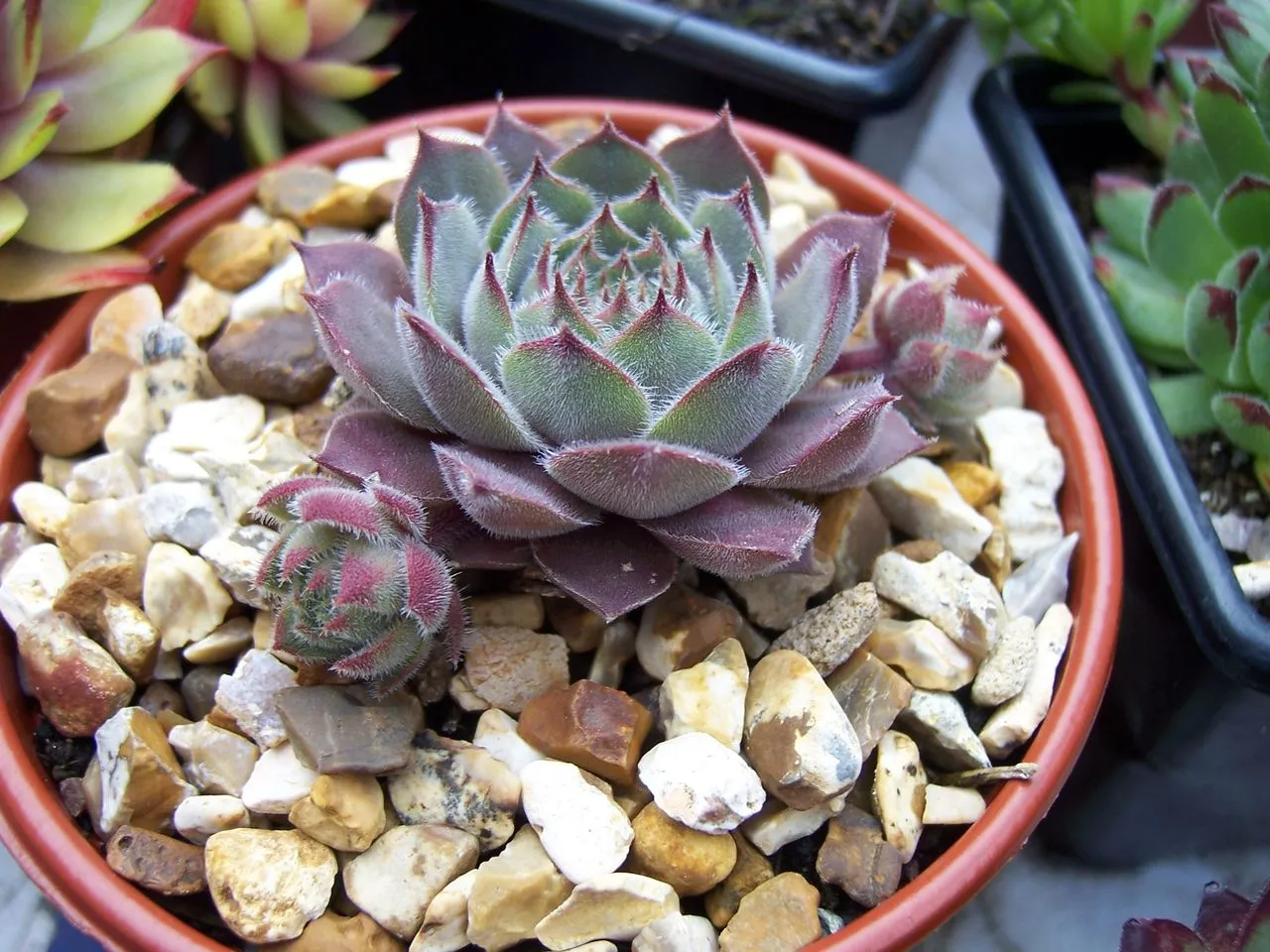
Sempervivum is the classic division plant. These clonal mat-formers produce rosettes connected by stolons, and a mature pan can be split annually if you want a tighter display or more plants. Each rosette should keep a tuft of roots or a piece of stolon with rooting points. Outdoor-grown houseleeks often tolerate rougher handling than indoor soft succulents, but they still recover faster when the root mat is teased apart rather than sliced through.
Rhizomatous Sedum types divide well, especially low mat-formers such as Sedum spathulifolium. These plants creep by short stems or rhizomatous crowns, and the natural breaks are often visible once the substrate is shaken away. This is not the same as leaf propagation for tender sedums. A divided S. spathulifolium piece should include rooted crown tissue, not only loose leaves.
Haworthia and Haworthiopsis are slow but tolerant. Overcrowded clumps of windowed haworthias and hard-leaved Haworthiopsis often become uneven after several years because old central roots die while new outer rosettes keep expanding. Division renews the clump and removes stale substrate from the middle. The plants are not fast to re-establish, so expect a conservative recovery rather than immediate visible growth.
Most stoloniferous aloes divide well when each section has its own roots. Aloe juvenna and Aloe brevifolia are good examples, forming crowded clusters that can be pulled into rooted fans or rosette groups. Keep the pieces generous. A single tiny aloe head with two damaged roots may survive, but a section with three to five stems and a useful root pad recovers with fewer losses.
Echeveria clumps can be divided, but with more caution. Many clumping echeverias have soft stems that snap under sideways pressure, especially after watering. If a rosette separates with roots attached, treat it as a division. If the stem breaks away without roots, it has become a stem cutting and needs the longer callus and rooting treatment used for cut heads.
Genera that resent division
Single-stemmed, tap-rooted Mammillaria should usually be left alone. A clumping mammillaria with clear offsets can be propagated by removing offsets, but a single-rooted body is not divisible. Cutting through the main stem or taproot creates a large wound in tissue that does not replace itself quickly. For tap-rooted forms such as Mammillaria hahniana, keep the crown intact unless you are dealing with emergency rot surgery.
Lithops and most other mesembs with a single paired body are not division candidates. One body is one plant. A true multiheaded old clump may sometimes be separated by an experienced grower if each head has its own root neck, but ordinary split bodies, twin leaf pairs, and seedlings are not divisible in the horticultural sense. Pulling them apart usually destroys the basal meristem.
Agaves make offsets, not true divisions. A pup with its own basal plate can be removed from the parent, but cutting through the central heart of an agave to make two plants is a rot invitation. The growing point sits low and protected in the basal crown. Once that heart is cut, the wound is broad, wet, and slow to seal.
The rule is practical: if you cannot identify two or more growing points with their own root systems, do not divide. Use offset removal, stem cuttings, seed, or no propagation at all.
Tools and timing
Water the clump 24-48 hours before division. This sounds counterintuitive because succulent wounds dislike moisture, but hydrated roots are more flexible and less likely to snap during detangling. The plant should be turgid, not waterlogged. If the substrate is still wet and heavy after two days, wait until it is barely damp before unpotting.
Prepare a clean bench, paper towels, a sterilised sharp blade, 70% isopropyl alcohol, dry mineral substrate, and pots that look slightly too small rather than roomy. Cinnamon or garden sulphur can be used on cut surfaces where fleshy connectors had to be sliced. They are not substitutes for drying time, but they help keep the wound surface dry and less hospitable to fungi.
Pot size matters during re-establishment. A 5 cm rosette belongs in a 7-8 cm pot, not a 12 cm pot. The extra volume in a large pot stays damp after watering because the new division cannot drink from it yet. That stagnant lower zone is where fine roots rot before the plant has visibly declined.
Use a mineral-forward mix similar to the one used for established succulents, but slightly more open for small divisions. Pumice, grit, coarse perlite, and a modest organic fraction work well. Avoid dense compost around recently disturbed roots.
The technique
Unpot the whole clump first. Do not try to divide a crowded plant while it is still wedged in the pot, because you cannot see the root architecture. Tip the pot sideways, support the crown with one hand, and slide the root mass out. If the pot is rigid and the root ball is jammed, squeeze the sides or run a blunt plant label around the inner wall rather than pulling upward by the leaves.
Tease away old substrate from the root mass. Use your fingers, a bamboo skewer, or a soft brush. You do not need to bare-root every fine root, but you do need enough visibility to see where one rosette's roots end and another's begin. Remove dead roots that are hollow, black, or papery. Keep firm cream, tan, or pale brown roots even if they look untidy.
Find the natural separation points. In Sempervivum, these are often stolon junctions. In Haworthiopsis, they may be tight seams between fans of leaves. In rhizomatous Sedum, the crown may come apart along creeping stems that already root at intervals. A good division point lets each piece leave with leaves, a growing centre, and roots.
Pull apart by hand where possible. Hold the plant low near the crown, not by the leaf tips, and use a slow rocking motion. If the clump resists, stop and look again. Resistance often means a main root is wrapped around the clump or a fleshy neck is still connecting the pieces.
Cut only when necessary. Sterilise the blade, then cut through the narrow fleshy connector between sections. Do not cut through major roots as a shortcut. Roots are the advantage division has over cuttings; sacrificing them turns a low-risk job into a recovery project. After any cut, dust the exposed surface lightly with cinnamon or sulphur and set the pieces on paper towel for 24-72 hours. Thin stolon cuts may need only one day. Thicker aloe or echeveria connectors need closer to three.
Pot each division dry. Set the plant at the same depth it grew before, with the crown above the substrate line. Spread roots outward if they are long enough, then fill around them with dry mix and tap the pot lightly to settle particles. Do not compact the substrate with force. Fine new roots need air spaces as much as moisture.
Aftercare
Keep newly potted divisions in bright shade or gentle morning light for the first week. Direct midday sun through glass can dehydrate disturbed roots faster than they can resume uptake. Outdoor divisions should be protected from rain until watering restarts.
Withhold water for 7-10 days after potting. This pause lets broken root tips seal and small crown wounds finish drying. A division with existing roots does not need the long drought of a rootless cutting, but immediate watering is the common way to turn bruised root tissue into rot.
After the pause, water lightly around the root zone and let the pot dry within a few days. Resume the normal wet-dry rhythm gradually. The plant may not visibly grow at first, because it is rebuilding fine absorbing roots below the surface. For pot-sizing ratios that keep a new division drying at the right speed, pot size selection covers the 2 cm increment rule for re-establishment. New root growth is often visible at drainage holes or around the edge of the root ball in 2-4 weeks. Full re-establishment usually takes 8-12 weeks, longer for haworthias in cool rooms.
Do not fertilise during the first month. Fertiliser salts around damaged roots draw water out of tissue and can scorch root tips. Once the plant is anchored and producing new leaves, use the same diluted feeding schedule you use for established plants.
Common mistakes
Dividing a plant that is only one crown. A large rosette in a small pot may need repotting, not division. If there is one growing point and one central root system, keep it intact.
Treating every pup as a division. A small offset without its own roots is an offset removal or cutting, depending on the genus. It needs different drying and watering expectations.
Slicing the root ball into equal pieces. Equal portions are useful for herbaceous perennials, not for succulents with uneven crown structure. Follow natural rooted sections rather than making symmetrical chunks.
Overpotting the divisions. A small rosette in a large pot dries too slowly. Match the container to the new root system, not to the size you hope the plant reaches in a year.
Watering immediately after surgery. Roots damaged during detangling cannot use a heavy watering at once. Give them 7-10 days, then restart with modest volume.
Dividing during dormancy. A dormant plant may sit unchanged for weeks after division. During that pause, wounds age, roots die back, and the substrate is easier to keep too damp.
See also
- A Beginner's Guide to Succulents: the light, watering, container, and substrate basics that decide whether divisions re-establish cleanly.
- When to repot: use repotting rather than division when the plant is one crown with a crowded root ball.
- Sedum division: rhizomatous sedums are a useful case study because the crown shows natural rooted break points.
- Callusing Explained — the 24-72 hour drying window after any cut surface in the division process.
- Succulent Soil and Substrate — the mineral-forward mix that lets disturbed roots re-establish without rot.
FAQ
How do I know if my plant is ready to divide?Look for multiple rosettes or stems with visible gaps between them, where each section has its own roots. If the plant is a single crown, repot instead of dividing.
Can I divide in winter?Not recommended - dormant plants don't heal quickly. Division during active growth (spring/summer) gives much faster recovery.
What if a division has no roots?It can still survive if it has enough leaf tissue for water storage. Let it callus 3-5 days, then treat as a cutting - water sparingly until roots form.
Frequently Asked Questions
How do I know if my plant is ready to divide?
Look for multiple rosettes or stems with visible gaps between them, where each section has its own roots. If the plant is a single crown, repot instead of dividing.
Can I divide in winter?
Not recommended - dormant plants don't heal quickly. Division during active growth (spring/summer) gives much faster recovery.
What if a division has no roots?
It can still survive if it has enough leaf tissue for water storage. Let it callus 3-5 days, then treat as a cutting - water sparingly until roots form.
What is the first step for dividing succulents: when the crown outgrows the pot?
Each division needs its own roots and at least 2-3 leaves to survive on its stored water.