Quick Answer
The short answer: The key differences are: Sempervivum is monocarpic (dies after flowering) and hardy to -25°C, while Echeveria is polycarpic (flowers repeatedly) and tender below -2°C.
Best first step: Check hardiness on the label - "hardy to -20°C" means Sempervivum. Check leaf surface - waxy bloom (pruinose) means Echeveria.
Avoid: Treating them interchangeably - they have completely opposite winter requirements.
A reader holds two rosette succulents from a garden centre and asks which is which. Echeveria and Sempervivum both sit in the Crassulaceae, both form tight rosettes of fleshy leaves, and both circulate in retail under the catch-all label "hens and chicks". The two most useful separators are not visual but biological: a Sempervivum rosette flowers once and dies (monocarpic), while an Echeveria rosette flowers repeatedly without dying (polycarpic); and Sempervivum is alpine-hardy down to -25 °C or below, while Echeveria is tender below about -2 °C. If you have either piece of information about the plant in front of you (its life history, or where it has overwintered), you have an answer. Here is the rest of the picture.
Both genera fall in the family Crassulaceae, but their natural habitats and evolutionary trajectories diverge sharply. Sempervivum is a small genus of about 40 to 50 species native to the mountains of Europe, the Caucasus, and into Iran, with most species growing at elevations between 1,000 and 2,500 m, often in rock crevices or on shallow soil over bedrock. Echeveria is a much larger genus of around 150 species native almost entirely to Mexico, with smaller representations in Central America and the northern Andes, typical habitats spanning oak-pine highlands and cloud forest at 1,500 to 3,000 m. Both lineages converged on the same architectural trick (compact basal rosette, succulent water-storing leaves, CAM photosynthesis), which is why the field separators below matter more than gross resemblance.
At a glance
| Character | Echeveria | Sempervivum |
|---|---|---|
| Reproductive habit | Polycarpic (rosette flowers many times) | Monocarpic (rosette flowers once, then dies) |
| Cold hardiness | Tender; damage below -2 °C | Hardy; most species tolerate -25 to -30 °C |
| Native range | Mexico to Andes | European Alps, Pyrenees, Caucasus, Iran |
| Flower shape | Tubular, bell-shaped, 5-petalled | Star-shaped, flat, 8-15 petalled |
| Flower colour | Red-yellow bicolour, coral, orange | Pink, magenta, red, rarely yellow |
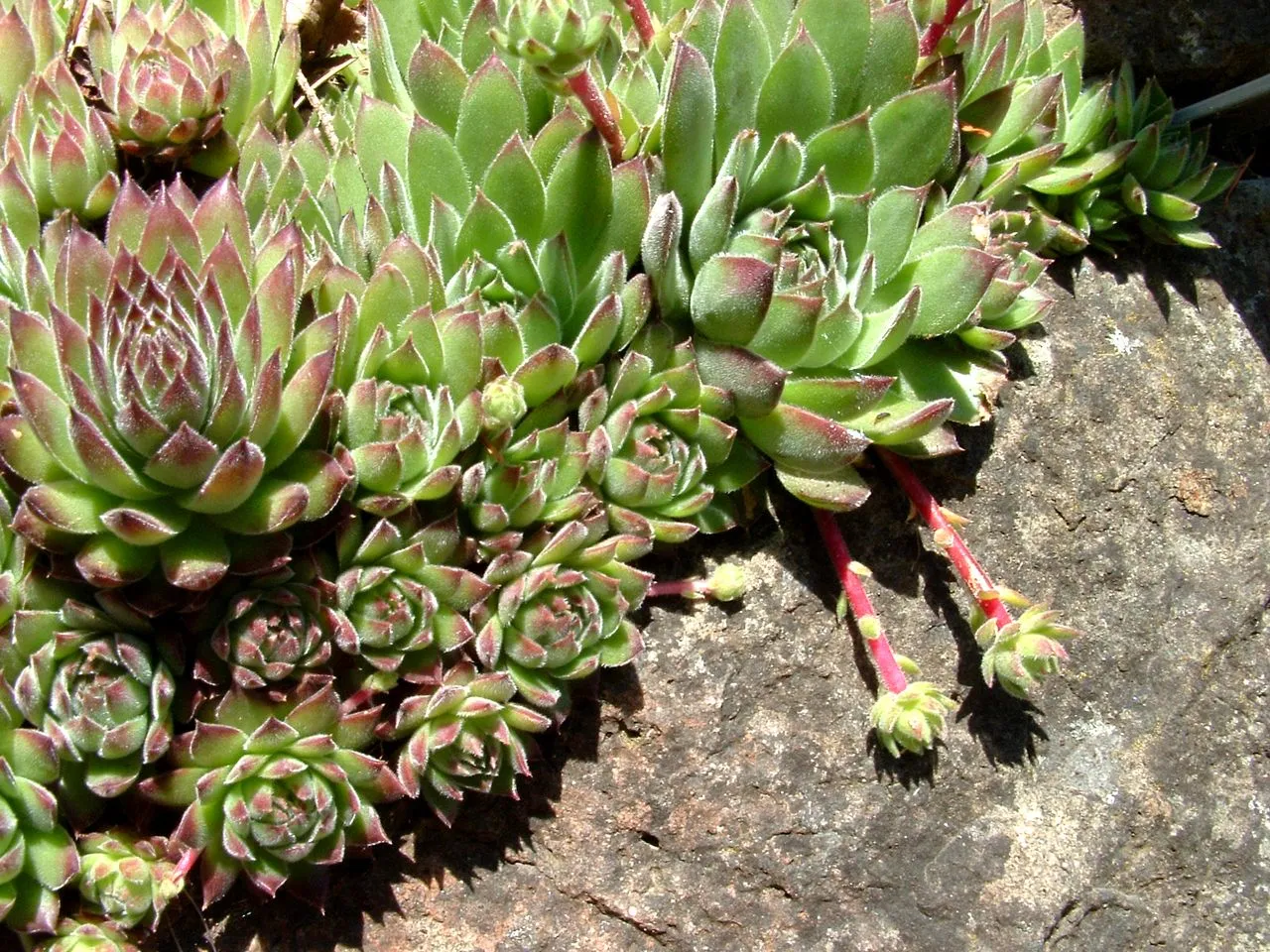
| Offset habit | Clustered tightly at base of parent | Carried out on visible stolons |
| Leaf surface | Pruinose; waxy bloom in many species | Glabrous; no wax bloom on most species |
| Adult rosette size | 5-30+ cm (typically 8-15 cm) | 2-15 cm (rarely larger) |
| Best garden use | Container, indoor, frost-free greenhouse | Outdoor rockery, green roof, alpine bed |
Key separators in the field
1. Monocarpy versus polycarpy. This is the deepest separator and the one with the most practical bearing on cultivation. A Sempervivum rosette flowers once in its life: the rosette elongates upwards into a bottlebrush-like terminal inflorescence over several weeks, sets seed, and the parent rosette itself dies. The colony persists because the parent has already produced offsets (the "chicks" of "hens and chicks"), which are now established and ready to flower in turn. The houseleek lineage on a roof tile may persist for a century, but no individual rosette in it lives more than a handful of years. Echeveria, by contrast, is polycarpic: a single rosette flowers in spring or summer, sometimes again later in the season, and continues vegetative growth from the same apical meristem for many years. The flower spike emerges laterally from between leaves rather than from the rosette's apex, leaving the rosette intact afterwards. If you are looking at a settled adult rosette and someone tells you it has flowered five years running, it is an Echeveria; if the rosette has elongated dramatically into a vertical spike and is preparing to bloom, it is almost certainly the terminal flowering of a Sempervivum.
2. Cold hardiness. Sempervivum is alpine in origin, with most species tolerating sustained temperatures of -25 to -30 °C without damage; S. arachnoideum and S. montanum survive winter under snow at 2,500 m in the Alps every year. They want a cold winter dormancy and dislike steady warmth. Echeveria is Mexican, frost-tender, and damages at roughly -2 °C: leaves blacken at the tips with brief exposure, and the rosette collapses if held below freezing for hours. Most cultivated echeverias are kept frost-free at 5 °C minimum overnight. The practical buyer test: a rosette overwintered outdoors in Belgium, Germany, or the UK and now thriving is a Sempervivum. A rosette that has lived its life on a sunny windowsill or in a heated conservatory is almost certainly an Echeveria.
3. Flower structure. Echeveria flowers are tubular and bell-shaped, 10 to 25 mm long, five-petalled with the petals partly fused at the base, and almost always bicoloured: red, coral, or orange exterior with a yellow or paler interior. They hang on a slender lateral inflorescence, often arching, and provide nectar to hummingbirds in their natural range. Sempervivum flowers are radically different: open, flat, star-shaped, with 8 to 15 free or barely fused petals arranged like a chrysanthemum or aster bloom, in pink, magenta, red, or occasionally yellow. They sit upright on a thick terminal stem above the dying rosette. A red bell on an arching stem is Echeveria; a flat pink star at the top of a hairy upright spike is Sempervivum.
4. Stolons and offset habit. Sempervivum characteristically produces visible stolons: slim above-ground runners (a few millimetres thick, 2 to 8 cm long) that emerge from the parent rosette and deposit a new daughter rosette at their tip. The chicks fan out around the hen on these short tethers, then the stolons wither and the daughter rosettes root in place. Walk past a settled Sempervivum clump in summer and the radial reach of stolons is obvious. Echeveria does not produce stolons of this kind. Offsets emerge from leaf axils at the base of the parent and stay closely clustered, often touching the parent rosette. A clump of Echeveria looks like a tightly packed bouquet; a clump of Sempervivum looks like a hen surrounded by chicks at slight remove.
5. Leaf surface and bloom. Many Echeveria species and most modern cultivars carry a pruinose surface, a waxy, powdery bloom that gives leaves a chalky, blue-green or silvery appearance and rubs off where touched. E. lilacina, E. peacockii, E. laui, and E. 'Lola' are paradigm cases. Sempervivum is glabrous on most species: leaves are typically glossy, smooth, and clean green or green tinged red or purple in winter. The exception worth knowing is S. arachnoideum, the cobweb houseleek, whose rosettes are crossed by white hair-like trichomes between leaf tips, but this is a hair fringe rather than a wax bloom. If a rosette has obvious chalky-white wax that smudges under a fingertip, it is an Echeveria. If it is glossy and clean, or has cobweb hair, it is a Sempervivum.
6. Adult size. Echeveria rosettes range from 5 cm in E. minima to over 30 cm in E. gibbiflora and large E. agavoides clones, with most cultivars sitting in the 8 to 15 cm range. Sempervivum tops out at roughly 15 cm in S. tectorum var. calcareum and most species are 4 to 10 cm. A 25 cm rosette is almost certainly Echeveria; a 4 cm rosette could be either, and the other separators above apply.
Edge cases and look-alikes
A handful of nearby genera turn up in the same trade and confuse beginners.
Jovibarba is a small segregate genus split off from Sempervivum by some taxonomists; it includes J. heuffelii and J. globifera (formerly S. soboliferum). The leaf rosettes look almost identical to Sempervivum, but two characters separate the two: Jovibarba flowers are tube-shaped and pale yellow with six petals, not flat and star-shaped with 8 to 15 petals; and J. globifera offsets are loose ball-rosettes that detach and roll away from the parent, rather than rooting on a stolon. A pale tubular flower on a Sempervivum-shaped plant is Jovibarba.
Aeonium is a separate genus of rosette Crassulaceae from Macaronesia (Canary Islands, Madeira, North Africa). Aeoniums look superficially Echeveria-like but flower from a terminal raceme that sits above the centre of the rosette, killing that rosette; and they are winter-growers, dormant in summer rather than the other way round. Most species also branch into shrubby plants with rosettes at the tip of woody stems, a habit absent from both Echeveria and Sempervivum. A. arboreum on a 60 cm woody stem is a tree-like silhouette no Sempervivum will match.
Greenovia, also from the Canary Islands and now subsumed into Aeonium by some authors, has a distinctive ball-rosette habit in summer dormancy, where leaves close into a tight green sphere. G. dodrentalis in this state can look briefly like a Jovibarba globifera offset, but it is winter-growing and frost-tender, and it opens out in autumn into a typical aeonium-shaped rosette.
Graptopetalum and ×Graptoveria hybrids carry pruinose leaves like Echeveria and small offsetting rosettes; G. paraguayense, the ghost plant, is sometimes mis-shelved next to echeverias. The flower decides: Graptopetalum has open star-shaped flowers with petals partly free, five-petalled but flat, and frequently red-spotted, intermediate between true Echeveria tubular bells and Sempervivum asters.
When the two get confused in trade
The mislabelling problem is real and predictable. Both Sempervivum species and a handful of Echeveria cultivars are sold under the common name "hens and chicks", with no distinction made on the label. Echeveria secunda in particular circulates as "Echeveria 'Hens-and-Chicks'", a marketing name not a cultivar code, and sits next to Sempervivum tectorum trays in spring at the same garden centre. The plants look broadly similar at 6 cm rosette size: small, tight, basal-offsetting rosettes of green leaves on the same propagation tray.
The practical buyer-beware point is the temperate-versus-tropical hardiness divide. A "hens and chicks" plant intended for an alpine trough or green roof in Cologne, Manchester, or Helsinki must be a Sempervivum to survive a single winter. A "hens and chicks" plant moved outdoors year-round in those same cities will die in its first November if it is an Echeveria. Conversely, an Echeveria will perform indefinitely as an indoor specimen or summer-only patio plant, where most Sempervivum will struggle: stable warm temperatures and low light kill Sempervivum faster than direct cold ever does.
Three quick supermarket-shelf tests, in priority order:
- Look for offsets on visible stolons fanning out from the parent rosette. Yes, it is a Sempervivum. Tightly clustered offsets touching the parent, it is an Echeveria.
- Rub a leaf gently. Powdery bloom that smudges to a darker green underneath, Echeveria. Glossy and clean (or cobweb hairs), Sempervivum.
- Check the provenance and care label. "Hardy to -20 °C" or "outdoor / alpine" indicates Sempervivum. "Bright light, frost-protect, indoor" indicates Echeveria.
Cultivation principles for both groups are covered in the beginner's guide. The compressed version: most Echeveria want a long warm growing season, fast-draining mineral substrate, and frost protection; most Sempervivum want full sun, gritty mineral substrate, freedom from summer humidity at the crown, and a real winter cold spell to set buds. Getting the genus right at point of purchase saves a season of disappointment in either direction.
See also
- Beginner's Guide to Succulents: light, water, and substrate fundamentals shared across both genera.
- The Complete Echeveria Guide: genus-level cultivation across Mexican highland species and modern hybrids.
- The Complete Sempervivum Guide: alpine-origin cultivation, hardiness range, and rockery and green-roof use.
- Winter watering protocol: how winter dormancy requirements differ between tender Echeveria and hardy Sempervivum
FAQ
Can I keep Echeveria outdoors in winter?
Only if above -2°C. Most Echeveria are frost-tender and will die below freezing. Bring indoors or keep in a frost-free greenhouse.
What about Sempervivum - can it stay outdoors?
Yes - Sempervivum is alpine-hardy to -25°C or below. It's ideal for outdoor rockeries and green roofs.
How do I tell them apart by offsets?
Sempervivum produces offsets on visible stolons that fan out from the parent. Echeveria offsets cluster tightly at the base.
Will my Echeveria die after flowering?
No - Echeveria is polycarpic and flowers repeatedly. Only Sempervivum dies after its one bloom.
Frequently Asked Questions
What is the first step for echeveria vs sempervivum: how to tell them apart?
Start by matching the symptom to the plant, substrate, light, and season before changing watering or treatment.
What should be avoided?
Avoid changing several variables at once; correct the limiting factor and observe the plant before escalating.
Which care factor matters most?
Match the plant to its light, substrate, pot size, and season. Most succulent failures trace to a mismatch between drying speed and the plant's current growth rate.
When should the plant be checked again?
Recheck after one to two weeks unless tissue is actively collapsing. Stable firmness and new growth are better signs than a fixed calendar interval.