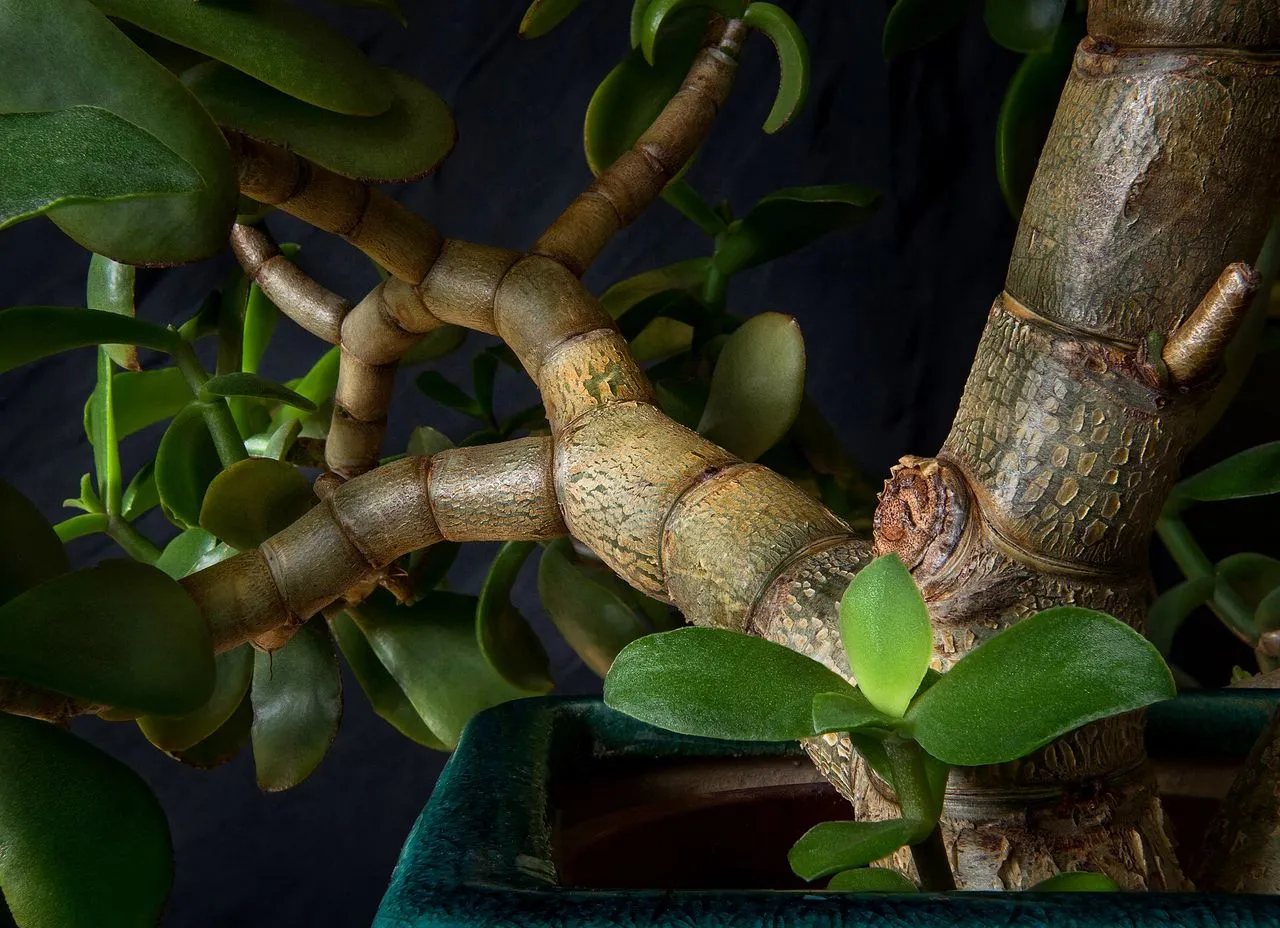
Aerial roots — fine, reddish-brown to tan roots that emerge from stem nodes above the substrate surface — appear on Crassula ovata and some other Crassula species in response to several different conditions. In most cases they are harmless, and in some they are actively useful. The key is reading what they signal: drought stress, root zone failure, low light, normal maturation in an old plant, or a propagation response after a stem cut.
Part of the Complete Crassula Guide.
Drought stress and atmospheric moisture seeking
The most common trigger for aerial roots in Crassula ovata is drought. When the root zone has been dry for an extended period, individual nodes along the stem retain an innate capacity to generate roots, and dry conditions combined with any ambient humidity can activate that capacity. These roots emerge from nodes near the soil line — often just a few centimetres above the substrate surface — and are finer than established underground roots, with a slightly fuzzy texture and a pale reddish-brown colour.
Drought-associated aerial roots appear alongside other drought signs: the pot is light, the substrate is dry through the full depth when tested at 3–4 cm, and the leaves are slightly soft in a rubbery rather than mushy way. They may wrinkle lengthwise. The stem and branch tips remain hard. The plant overall is firm.
A single thorough watering addresses drought aerial roots: fill the pot to the brim, allow it to drain, wait 10 minutes, and water once more. Empty the saucer. The aerial roots already present will remain — succulents do not reabsorb aerial root tissue — but no new ones should form once the watering cycle is restored to a proper wet-dry rhythm.
A jade in a very porous terracotta pot or a severely root-bound plant in an undersized container that dries out in under 5 days during the growing season may produce aerial roots semi-regularly. This is not harmful, but moving to a slightly larger pot or switching to unglazed ceramic at the next repot reduces the frequency.
Root zone failure and compensatory growth
Aerial roots can also signal root zone failure. When the underground root system has been damaged by overwatering, root rot, or prolonged cold, the plant may push new roots from the lowest accessible stem tissue in an attempt to replace lost below-ground function. These roots emerge at or just above the soil line and may actually penetrate the substrate surface if there is adequate moisture nearby.
This is a more serious cause than drought. Root-failure aerial roots are accompanied by distinctly different leaf symptoms: soft and mushy rather than rubbery, yellow-translucent rather than simply dull, and the pot is heavy with moisture rather than dry and light. The pot may smell sour. If these symptoms accompany aerial roots, unpot and inspect the plant immediately — do not delay. The rescue protocol is in jade plant root rot.
When repotting a plant that produced root-failure aerial roots, bury the stem 1–2 cm deeper than its previous level so that the aerial root nodes make contact with fresh substrate. They often become the first productive roots of the recovering plant.
Etiolation and low-light stem extension
A jade plant growing in insufficient light elongates its internodes — the stem sections between leaf pairs — and may produce aerial roots along the stretched portions. This happens because the extended stem tissue retains the root-generating capacity of each node, and the physiological stress of low-light elongation sometimes activates that capacity along multiple nodes simultaneously. These aerial roots appear in a line up the stretched stem rather than clustered at the soil line.
The primary cause is light, not water. Accompanying symptoms are diagnostic: internodes longer than 1–2 cm, leaves smaller and lighter-coloured than normal, no red blush on leaf margins, and a stem that bends rather than remaining rigidly upright. For the corrective approach and pruning technique see jade plant leggy. If the stem has already stretched to the point that pruning is the right response, the stretched section with its aerial root nodes makes excellent cutting material. The nodes root faster than bare-node cuttings.
Normal development in mature and bonsai specimens
Old Crassula ovata specimens, particularly those grown outdoors over many years or in long-term bonsai training, develop low surface roots and near-soil-level aerial roots as part of their natural structural maturation. These differ from stress-response roots: they emerge slowly over seasons or years, tend to become thicker and more woody with age, and often contribute to the exposed-root nebari surface structure prized in succulent bonsai practice.
For bonsai training purposes, deliberate surface root development is cultivated by gradually lowering the substrate surface over successive repots, exposing the base root structure incrementally. The technique is covered in crassula bonsai. Surface roots on a mature jade with an intact underground root system and a healthy canopy are not a problem and need no intervention.
After beheading and propagation
When a jade plant cutting is callusing and beginning to root, aerial roots commonly emerge from stem nodes above the final substrate level during the callusing period (5–10 days in dry shade) or shortly after the cutting is placed in substrate. These are a normal propagation response. The pre-formed root initials at stem nodes activate under the physiological conditions of a severed cutting.
Do not remove these roots. When placing the cutting into mineral mix, bury the stem to just below the lowest visible aerial root node if possible, so that node makes contact with substrate and can develop into a true underground root. Cuttings with multiple active aerial root nodes along the stem root more quickly and with greater stability than bare-node material.
How to identify the underlying cause
| Aerial root location | Leaf condition | Pot condition | Most likely cause |
|---|---|---|---|
| Near soil line only | Rubbery, slightly wrinkled, firm stem | Dry, very light | Drought stress |
| Near soil line | Soft, mushy, yellow-translucent | Heavy, wet, may smell sour | Root zone failure |
| Along stretched internodes | Small, thin, pale; no leaf blush | Appropriate moisture | Etiolation from low light |
| Thick, woody, multi-stem base | Healthy, firm, full canopy | Appropriate moisture | Normal mature growth |
| On fresh cutting post-behead | Firm, healthy cut face | Callusing — no substrate | Normal propagation response |
Risk and severity
Aerial roots from drought are low risk. The plant has not been seriously damaged. Water it, restore the watering cycle, and monitor.
Aerial roots from root zone failure are high risk and time-sensitive. Act the same day the combined diagnosis is made — wet heavy pot, soft mushy yellow leaves, possible sour smell, aerial roots at the soil line. A jade with a failing root system in wet conditions can lose the stem base within days.
Aerial roots from etiolation are medium risk. The plant is weakening from chronic light deficit but is not in immediate danger, unless it is also being overwatered simultaneously. Correct the light first, then decide whether beheading is necessary to reset compact form.
Aerial roots on a mature bonsai or large healthy specimen are no risk at all.
Solutions
Aerial roots from drought
Water thoroughly: fill the pot to the rim, drain, wait 10 minutes, and water once more. Empty the saucer within 30 minutes. Use pot weight as the primary trigger for future waterings — when the pot feels noticeably lighter than its just-watered weight and the top 3–4 cm of substrate is dry, it is time to water again. The existing aerial roots will not disappear but no new ones should develop once the cycle is stable.
Aerial roots from root failure
Unpot, remove all wet substrate, and cut away all dead root tissue with sterile scissors. Leave no rotten material attached. Dry the plant bare-root in bright shade with good airflow for 3–5 days. Repot into fresh, dry mineral mix. The aerial roots at the stem base may be buried 1–2 cm into the new substrate to serve as replacement underground roots. See jade plant root rot for the full procedure.
Aerial roots from etiolation
Move the plant to a south- or west-facing window providing at least 5 hours of direct light. If the stem has stretched to the point that it looks improbably tall and bare, cut just above a node bearing visible aerial root initials — the cutting roots faster than bare-node material. See jade plant leggy for the pruning and rooting approach.
Aesthetic removal
Aerial roots on an otherwise healthy plant can be removed with clean dry scissors for aesthetic reasons. Cut flush with the stem. No wound treatment is needed; the cut site calluses within a few days and does not invite rot. The plant will not be harmed.
Prevention
Maintain a consistent watering cycle using substrate dryness at 3–4 cm depth as the trigger rather than a fixed calendar. Provide at least 5 hours of direct light per day to prevent etiolation-driven aerial roots. Repot every 2–3 years into fresh mineral mix and use a pot only 2–4 cm wider than the root ball to avoid waterlogging. Inspect the stem base annually at repotting time for early signs of root decline.
See also
- Jade Plant Root Rot — the rescue protocol when aerial roots accompany root zone failure.
- Jade Plant Leggy — etiolation diagnosis and corrective pruning for stretched stems with aerial roots.
- Crassula Bonsai — surface root development as a deliberate aesthetic technique in mature specimens.
- Gollum Crassula — a C. ovata cultivar with particular tendency to produce stem-base roots.
Frequently Asked Questions
Are aerial roots on a jade plant normal?
They can be. Drought stress and etiolation are the most common triggers. On large mature specimens and bonsai-trained jades, low surface roots develop naturally as part of the woody structure.
Should I remove aerial roots from my jade plant?
Only for aesthetic reasons. They cause no harm and in some cases can be buried in fresh substrate during repotting to become functional underground roots.
Why does my jade plant have roots coming out of the soil?
Roots at or just above the soil surface indicate drought (the plant seeking surface moisture) or root zone failure (compensating for dead underground roots). The leaf condition and pot weight distinguish the two.
Can aerial root nodes be used for propagation?
Yes. Stem sections bearing visible aerial root nodes root faster than bare-node material. The pre-formed root initials at each node accelerate establishment in fresh substrate significantly.