| Symptom | Likely Cause | Risk | First Action |
|---|---|---|---|
| How Much Sun Is Enough | For Crassula ovata (the jade plant) and most common hobby species: | Keeping the root zone wet in cool weather or assuming every Crassula tolerates the same routine. | Place it in bright light and use a gritty, mineral-heavy substrate before adjusting water. |
| Signs Your Crassula Has Too Little Sun | Six signs consistent with chronic under-lighting: | Keeping the root zone wet in cool weather or assuming every Crassula tolerates the same routine. | Place it in bright light and use a gritty, mineral-heavy substrate before adjusting water. |
| Signs Your Crassula Has Too Much Sun | Two signs of excess sun, both uncommon on properly acclimated plants: | Keeping the root zone wet in cool weather or assuming every Crassula tolerates the same routine. | Place it in bright light and use a gritty, mineral-heavy substrate before adjusting water. |
Yes, a Crassula needs sun. The genus is native to the Cape Floristic Region and the Karoo of southern Africa, where most species grow in full sun on rock outcrops or exposed slopes. In cultivation, inadequate light is the single most common non-fatal problem on a Crassula, and it is the cause behind several of the symptoms most often reported as mysterious plant decline.
Part of the Complete Crassula Guide.
How Much Sun Is Enough
For Crassula ovata (the jade plant) and most common hobby species:
- Minimum. 5–6 hours of bright light per day, with at least some of that being direct sun through a window or unfiltered outdoor light.
- Ideal. Full direct sun through a south-facing window in temperate northern-hemisphere latitudes, or morning-plus-filtered-afternoon sun outdoors in summer.
- Too much. Sustained midday summer sun on a plant moved abruptly from a shaded greenhouse causes sunburn within hours. Acclimate over 2 weeks by moving the plant progressively into brighter positions.
Miniature species (C. 'Buddha's Temple', C. perforata, C. pangolin, C. socialis) need still more light and often require supplemental LED lighting through temperate winters to stay compact.
One shade-tolerant exception is worth knowing: Crassula multicava (fairy crassula) thrives in bright indirect light or dappled shade and is the one common species in the genus that does well without direct sun.
Signs Your Crassula Has Too Little Sun
Six signs consistent with chronic under-lighting:
- Stretched stems and widely-spaced leaves (etiolation). The plant reaches toward whatever light it has, producing pale thin growth.
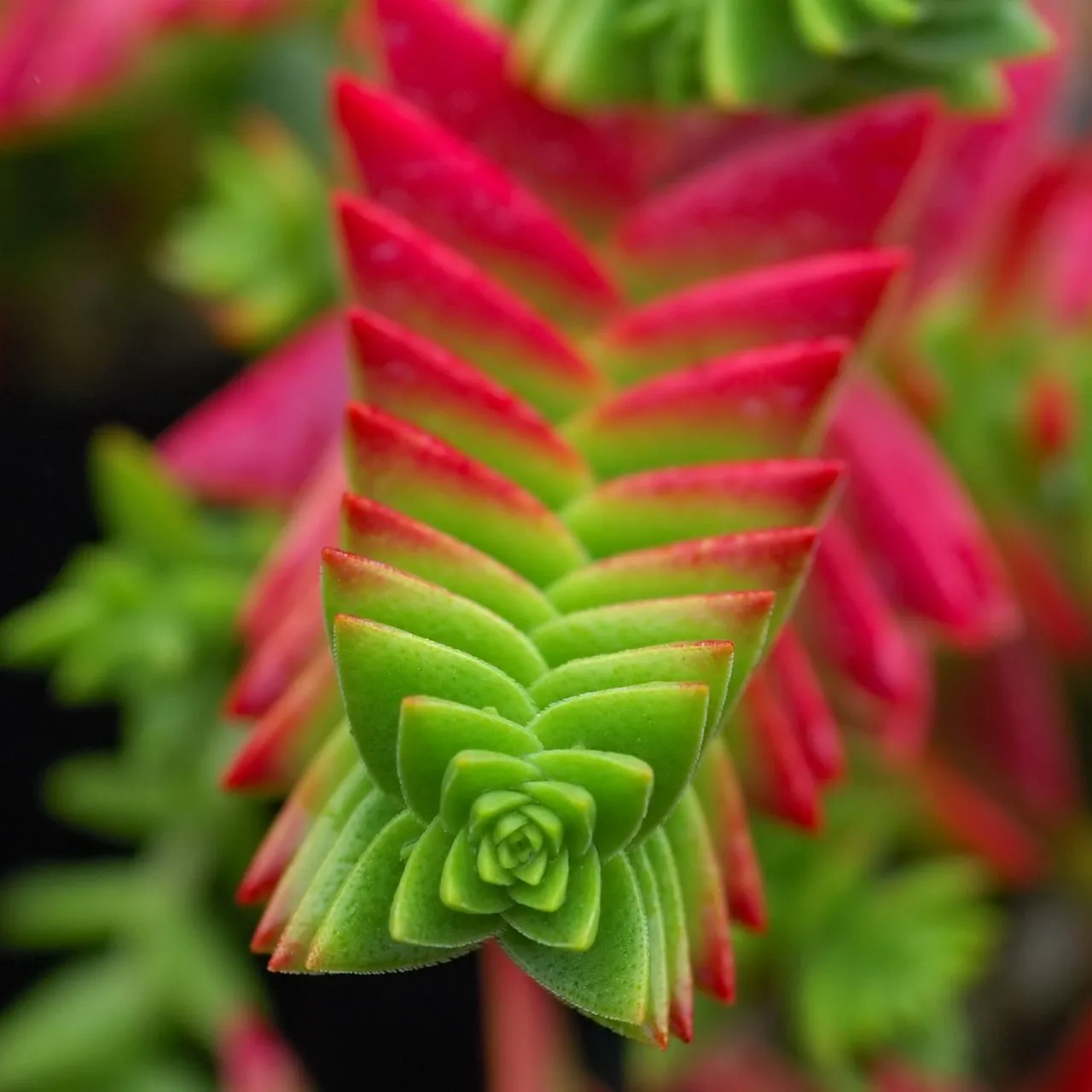
- Pale uniform green leaves. In good light, most Crassula show red margins or tips from protective anthocyanin production; a dull even green often means the plant has never seen enough light to trigger this response.
- Small new leaves. Each successive leaf pair is smaller than the last, as the plant scales back growth to what current photosynthesis can support.
- Weak stems that fall over. Without the structural strength that strong light drives, branches become floppy.
- No flowering. Mature C. ovata blooms in winter when grown in adequate light. A plant that has never flowered in several years is usually under-lit, not just young.
- Susceptibility to rot. A light-starved plant cannot metabolise water as fast as a healthy one, so ordinary watering schedules produce waterlogged roots.
Signs Your Crassula Has Too Much Sun
Two signs of excess sun, both uncommon on properly acclimated plants:
- White or bleached patches on the upper leaf surfaces. These are permanent cell-wall damage from sunburn and do not recover.
- Soft brown patches that appear after a heatwave. Usually the combination of hot midday sun plus a recent watering is the trigger.
What to Do
If your Crassula is showing the under-light pattern:
- Move it to the brightest window in your home, ideally south-facing.
- If no bright window is available, add a supplemental LED grow light running 12 hours per day at a distance that produces 10,000–20,000 lux at the canopy.
- Outdoors in the warm season, place the plant in a bright sheltered position, acclimating gradually from shade to sun over 10–14 days.
- If the plant is severely etiolated, behead the apical rosette or stem tip and re-root it (see propagation in the pillar guide). The stretched lower stem will not re-compact.
If it is showing sunburn, move it into a slightly more sheltered position and leave it alone; the burned leaves will drop in time and be replaced by new growth if the plant is otherwise healthy.
See also
- The Complete Crassula Guide — full cultivation reference.
- Crassula ovata — species-specific light needs for the most common Crassula.
- Fairy Crassula — the shade-tolerant exception in the genus.
- Jade Plant Leggy — what chronic under-lighting looks like in the most widely grown Crassula.
Frequently Asked Questions
What light does this Crassula need?
Bright light is the default. Compact species and red-flushing cultivars need several hours of direct sun after gradual acclimation.
How should it be watered?
Water thoroughly, then allow the upper 3–4 cm of substrate to dry before watering again. In cool winter conditions, reduce watering sharply.
What substrate works best?
Use a free-draining mix with substantial pumice, grit, or perlite. Dense peat-heavy compost keeps the root zone wet too long.
How is it propagated?
Stem cuttings are the most reliable method for most Crassula. Leaf cuttings work on jade-type plants but are less useful for tight stacked miniatures.