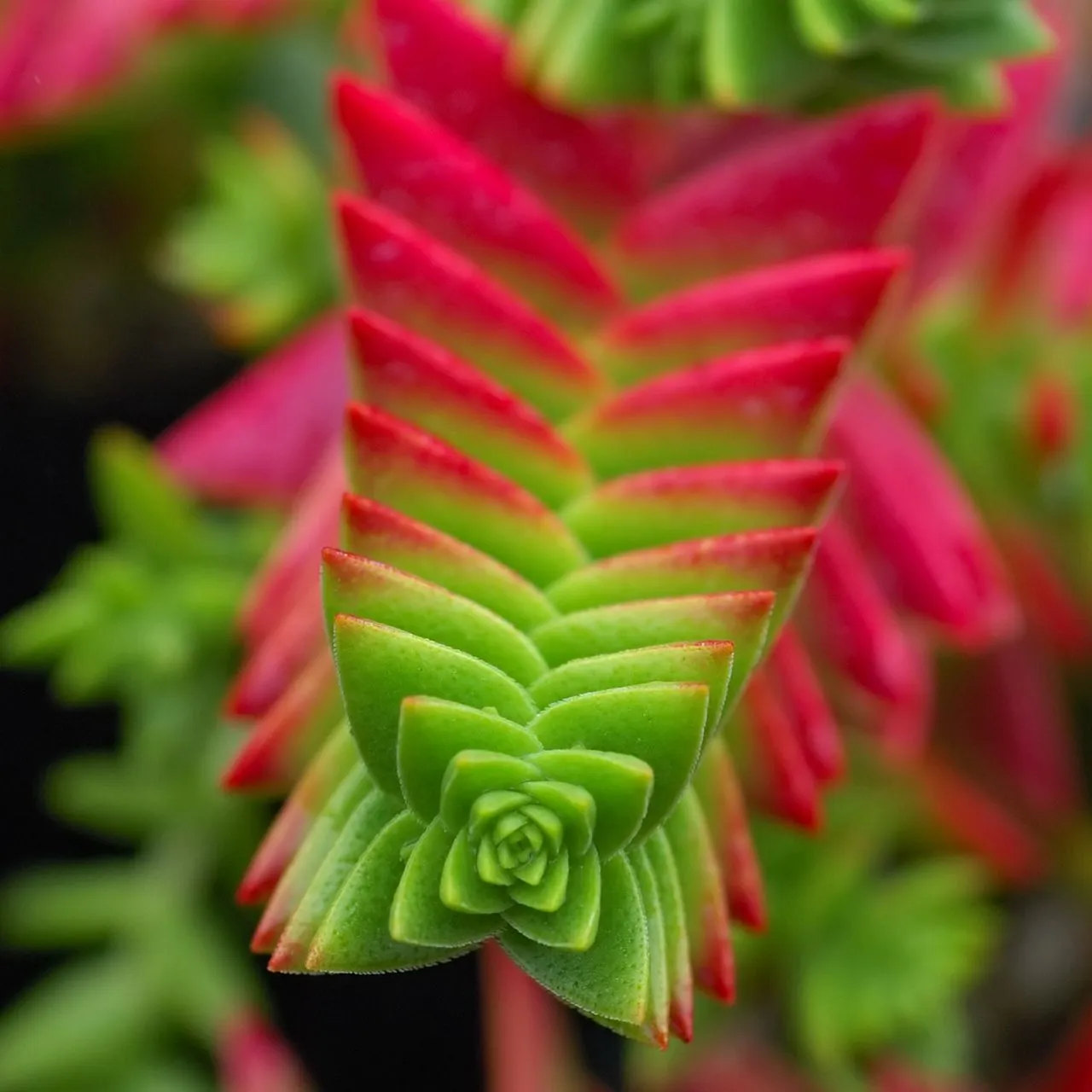
| Question | Short Answer |
|---|---|
| What light does this Crassula need? | Bright light is the default. |
| How should it be watered? | Water thoroughly, then allow the upper 3–4 cm of substrate to dry before watering again. |
| What substrate works best? | Use a free-draining mix with substantial pumice, grit, or perlite. |
| How is it propagated? | Stem cuttings are the most reliable method for most Crassula. |
Crassula 'Dorothy' is a variegated jade-type cultivar most often placed under Crassula ovata or Crassula arborescens depending on the clone. The plants sold under this name share cream-margined oval leaves on woody branching stems, with the cream turning pink to red-orange in strong light and cool temperatures.
Part of the Complete Crassula Guide.
Origin and Identity
'Dorothy' is one of several cream-margined Crassula cultivars that have circulated in the European and North American succulent trade since the late 20th century. Some of the plants sold under this name are chimeric sports of C. ovata; others appear to be back-crosses involving C. arborescens. The naming is unstable, and specimens labelled 'Dorothy' in one nursery may be labelled 'Hummel's Sunset', 'Tricolor', or simply Crassula ovata variegata elsewhere.
For practical purposes, treat 'Dorothy' as a variegated tree-form Crassula of ovata or arborescens type. The cultivation is the same.
Identification
- Shrubby habit with woody brown stems and branching canopy, to 30–60 cm in a pot.
- Leaves opposite decussate, fleshy, 3–5 cm long, oval to obovate.
- Variegation pattern: green central zone with irregular cream margins, the cream areas flushing pink-to-red under cool nights or strong light.
- Small pink-white stellate flowers in terminal clusters on mature plants, winter to early spring.
A closely-related cultivar sometimes confused with 'Dorothy' is 'Hummel's Sunset', which has more yellow-gold coloration and a clearer red margin. 'Tricolor' has sharper boundaries between green and cream zones and a generally more striking pattern.
Cultivation
Standard jade-type culture with the light requirement adjusted upward for variegated tissue.
- Light. Bright direct sun for at least 5–6 hours. Under low light the cream zones lose their warm pink flush, the plant stretches, and reverted all-green branches appear. A south-facing window is the minimum indoors.
- Substrate. Standard pillar mix (50% pumice or perlite, 30% grit, 20% loam-based compost).
- Water. Water when the top 3 cm of substrate is dry. Variegated plants photosynthesise less than green forms and grow more slowly, so in the same pot as a green jade they dry out more slowly and need proportionally less water.
- Temperature. 5°C–32°C. Not frost hardy. Cool nights (10°C–15°C) bring out the deepest pink-red leaf coloration.
- Feeding. Half-strength balanced feed once a month in spring and summer. Avoid heavy nitrogen; it encourages reversion.
Propagation
Stem cuttings from variegated tissue. Select a 6–10 cm shoot that shows clear cream-and-green pattern along its whole length, strip the lower leaves, callus for 5–10 days, and insert into gritty mix. Roots appear in 2–3 weeks.
Reverted all-green shoots root just as easily but produce plain-green plants with no commercial or ornamental value beyond a standard jade. All-white shoots (if they arise) have no chlorophyll and die within weeks.
Leaf propagation is unreliable for chimeric variegates because not every leaf carries both cellular lineages. Stem cuttings are the default.
Maintenance
Prune out any all-green reversion shoots at the base as soon as they appear. On a young plant, this may need to happen monthly; on an older stabilised plant, two or three times a year is usually enough.
Routine maintenance otherwise matches C. ovata: remove dead leaves, remove crossing branches, prune for shape in spring.
Notes
Toxicity applies as to all C. ovata-type Crassulas: toxic to cats, dogs, and horses per ASPCA listings. Place out of reach of pets.
Because the 'Dorothy' name is unstable, if you are buying the cultivar for a specific trait (say, the strong pink flush at leaf margins) inspect the plant in person and compare to a known-good reference. Mail-order stock labelled 'Dorothy' may vary considerably in pattern strength.
See also
- Variegated Crassula — general variegation notes.
- Crassula calico — patterned trailing cultivar.
- Crassula ovata — the parent species of most 'Dorothy' clones.
- Crassula arborescens — the silver dollar jade, another tree-form parent of some variegated cultivars.
Frequently Asked Questions
What light does this Crassula need?
Bright light is the default. Compact species and red-flushing cultivars need several hours of direct sun after gradual acclimation.
How should it be watered?
Water thoroughly, then allow the upper 3–4 cm of substrate to dry before watering again. In cool winter conditions, reduce watering sharply.
What substrate works best?
Use a free-draining mix with substantial pumice, grit, or perlite. Dense peat-heavy compost keeps the root zone wet too long.
How is it propagated?
Stem cuttings are the most reliable method for most Crassula. Leaf cuttings work on jade-type plants but are less useful for tight stacked miniatures.