| Question | Short Answer |
|---|---|
| What light does this Crassula need? | Bright light is the default. |
| How should it be watered? | Water thoroughly, then allow the upper 3–4 cm of substrate to dry before watering again. |
| What substrate works best? | Use a free-draining mix with substantial pumice, grit, or perlite. |
| How is it propagated? | Stem cuttings are the most reliable method for most Crassula. |
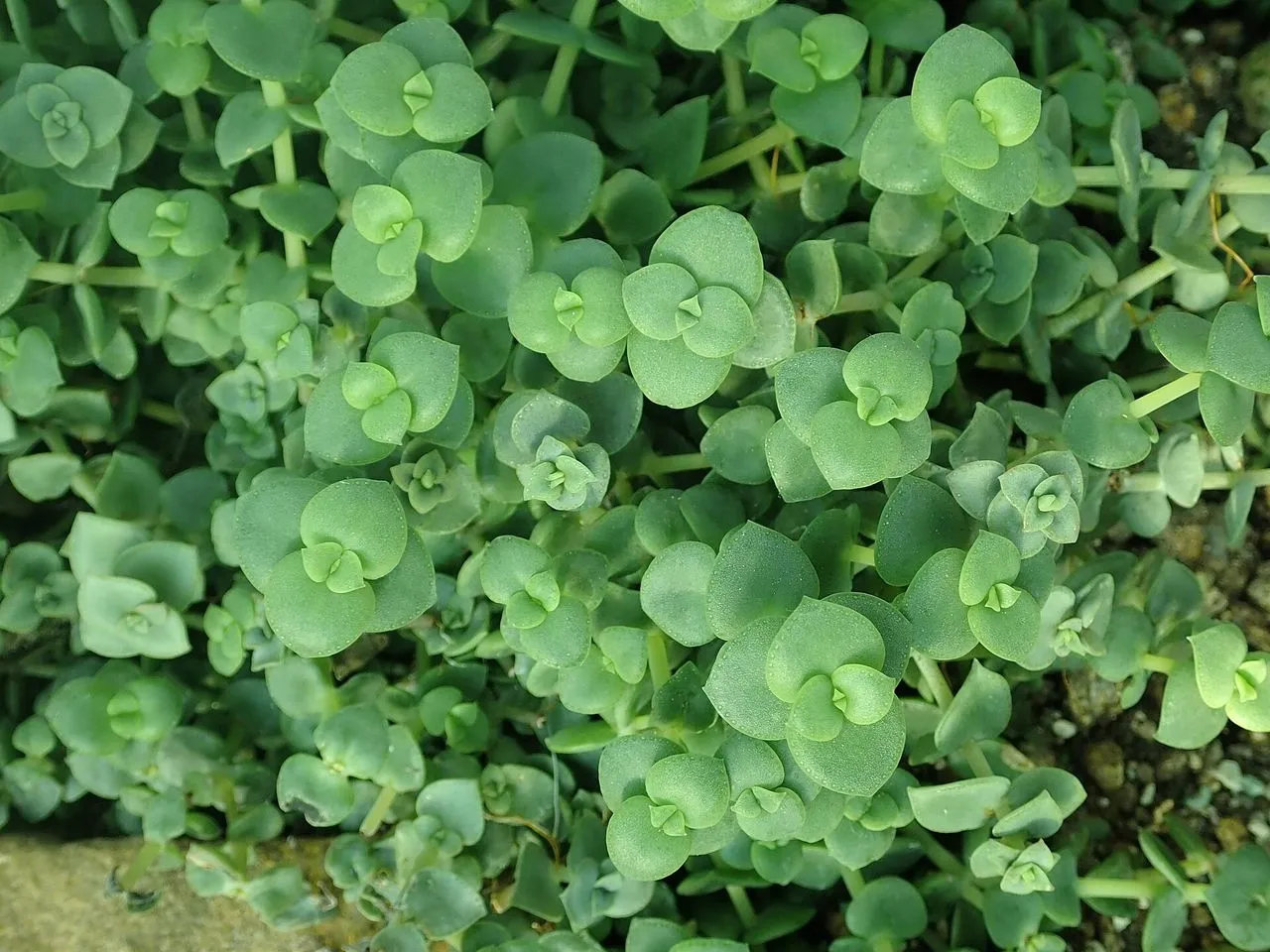
Crassula marginalis is a trailing southern-African leaf-succulent with thin wiry stems, small rounded leaves, and pronounced red margins that sharpen in strong light. The name is often used loosely in the trade and may refer to several related clones; the plants sold under this label share a consistent trailing habit and red-rimmed foliage that makes them useful for hanging displays.
Part of the Complete Crassula Guide.
Identification
- Stems slender, 2–4 mm thick, trailing or semi-pendent, eventually 30–50 cm long on an unpruned plant.
- Leaves opposite decussate, 6–15 mm long, ovate to almost round, thick but flattened, glabrous. Margins reddish-pink in moderate light, deepening to scarlet under stress.
- Leaf surface plain green, occasionally with a faint grey bloom on juvenile foliage.
- Small cream to pale pink stellate flowers in short lateral cymes; flowering sparse in cultivation.
A variegated selection is widely sold as Crassula marginalis rubra 'Variegata' or simply Crassula sarmentosa 'Comet'. The ongoing taxonomic question is whether C. marginalis is distinct from C. sarmentosa at all; some authors treat them as a single variable species. If your plant has clearly trailing stems, small red-edged leaves, and is happy to cascade over a pot edge, the name on the label is a secondary concern.
Cultivation
Treat it as a slightly more drought-tolerant version of C. ovata.
- Light. Bright indirect to several hours of direct sun. The red leaf margins intensify with stronger light; plants kept in dim conditions hold only a faint pink line at the edges and produce weak trailing growth.
- Substrate. Standard free-draining Crassula mix. The pillar recipe (50% pumice, 30% grit, 20% loam compost) suits it without modification.
- Water. Tolerates a slightly wetter regime than the miniatures. Water when the top 3 cm of substrate is dry; in active summer growth this is every 5–7 days outdoors. Reduce sharply in winter.
- Temperature. 5°C–32°C. Not frost hardy; protect below 5°C.
- Humidity. Ambient 30%–60% is fine. Good airflow reduces the risk of fungal leaf spots on the trailing tips, which occasionally sit on the pot rim and pick up moisture.
Propagation
Stem cuttings are reliable and fast. Cut a 5–10 cm trailing section, strip the lowest two leaf pairs, callus for 3–5 days, and insert 2 cm into gritty mix. Roots appear within 2 weeks. Multiple cuttings arranged evenly around a hanging pot fill it in within a single season.
Leaf propagation works but is slower than on C. ovata; the cut base is small and takes its time producing meristematic tissue. Use stem cuttings as the default.
Notes
Good trailing Crassula are unusual in the genus; most species are upright or mat-forming. C. marginalis and its close ally C. sarmentosa fill a niche in mixed succulent arrangements where a softer cascading line is needed. Plants become leggy and thin-looking after several years; a hard pinch of all growing tips in early spring encourages dense regrowth.
The leaves drop readily from stressed plants, especially after a dry spell followed by a heavy watering. The dropped leaves themselves do not root reliably, but the wounded stem usually back-buds from the nodes.
Sold in Europe occasionally as "Bella" or "Bella de Noche," both informal trade names for C. marginalis rubra. Neither is a botanical cultivar name.
See also
- Crassula sarmentosa — closely related, possibly conspecific trailing species.
- Crassula ovata — upright relative with similar culture.
- Crassula capitella — for readers after red-leaved Crassulas.
- Crassula platyphylla — broader-leaved trailing relative with similar display uses.
Frequently Asked Questions
What light does this Crassula need?
Bright light is the default. Compact species and red-flushing cultivars need several hours of direct sun after gradual acclimation.
How should it be watered?
Water thoroughly, then allow the upper 3–4 cm of substrate to dry before watering again. In cool winter conditions, reduce watering sharply.
What substrate works best?
Use a free-draining mix with substantial pumice, grit, or perlite. Dense peat-heavy compost keeps the root zone wet too long.
How is it propagated?
Stem cuttings are the most reliable method for most Crassula. Leaf cuttings work on jade-type plants but are less useful for tight stacked miniatures.