| Question | Short Answer |
|---|---|
| What light does this Crassula need? | Bright light is the default. |
| How should it be watered? | Water thoroughly, then allow the upper 3–4 cm of substrate to dry before watering again. |
| What substrate works best? | Use a free-draining mix with substantial pumice, grit, or perlite. |
| How is it propagated? | Stem cuttings are the most reliable method for most Crassula. |
Crassula obliqua is an older horticultural name that Kew's World Checklist of Vascular Plants currently treats as a synonym of Crassula ovata. Plants sold under the obliqua label today are, in practice, Crassula ovata (the jade plant, money plant) with no material difference in cultivation or appearance.
Part of the Complete Crassula Guide.
The Name and What It Meant
The epithet obliqua ("slanting, oblique") is said to refer to leaves held at a slight angle to the stem rather than perpendicular, a feature sometimes seen in vigorous sun-grown jade plants. Older European horticultural literature, including several 19th-century trade catalogues, carried Crassula obliqua as a distinct species. Modern taxonomic work has found no consistent morphological break between the plants formerly called C. obliqua and typical C. ovata populations, and the name has been sunk.
Two other synonyms of C. ovata commonly turn up in the trade: Crassula portulacea and Crassula argentea. All three names refer to the same species. If your plant tag says C. obliqua, C. portulacea, or C. argentea, treat it as C. ovata and follow the jade plant care routine.
Identification
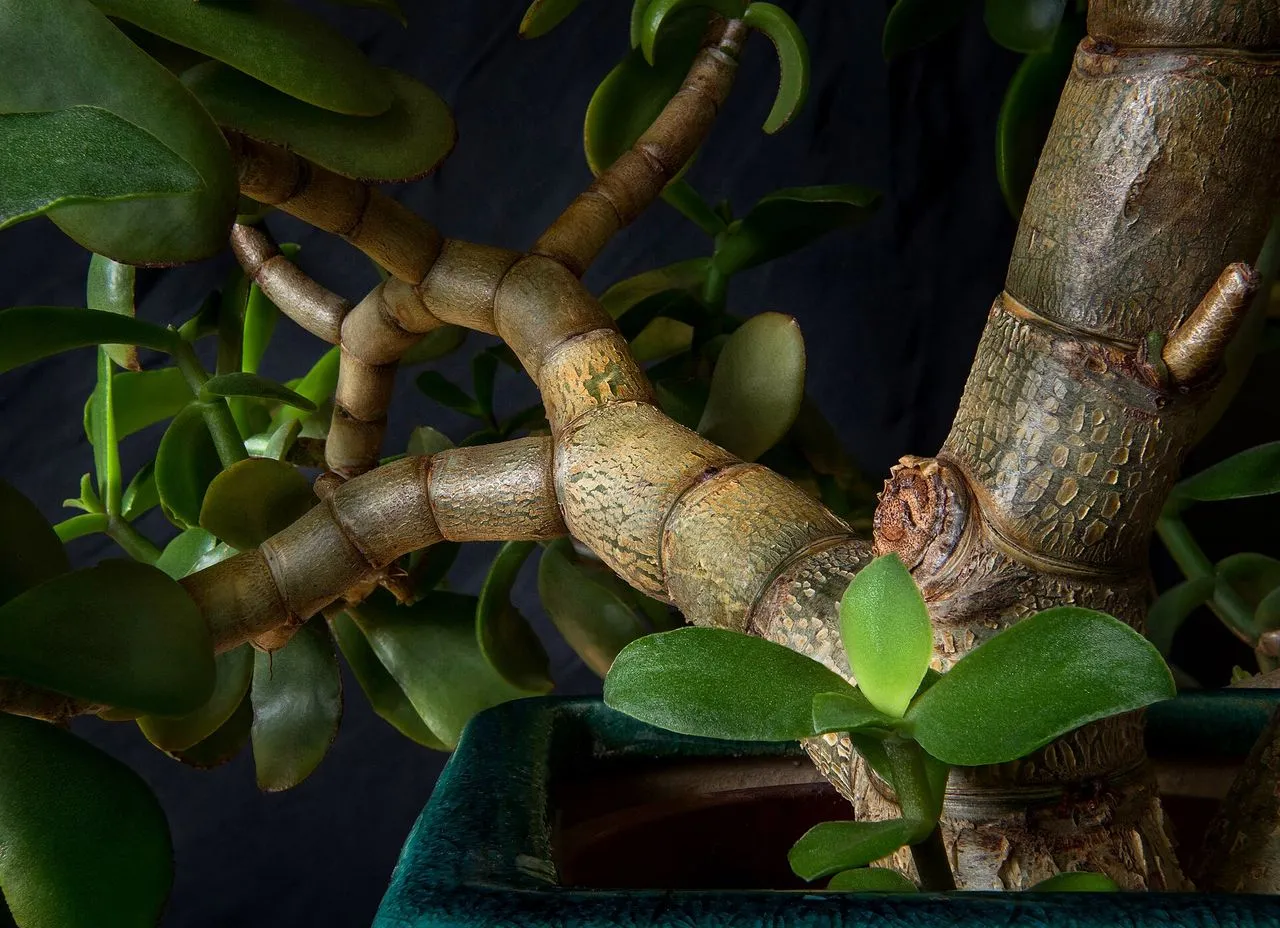
The plant sold as C. obliqua looks like a standard jade:
- Woody brown trunk with stout branches.
- Thick glossy oval leaves 3–6 cm long, opposite decussate in pairs along young stems.
- Pinkish-white starry flower clusters in winter to early spring on mature plants.
- Red leaf margins and red-tinted tips under strong light.
Some European stock sold as obliqua has slightly narrower or more elongated leaves than the flagship ovata. This is within the natural variation of the species; it is not a diagnostic feature.
Cultivation
Identical to C. ovata and the pillar default. Briefly:
- Bright light, including direct sun for several hours a day indoors or outdoors in summer.
- Free-draining mineral mix (50% pumice or perlite, 30% grit, 20% loam-based compost).
- Water thoroughly when the top 3 cm of substrate is dry; discard standing water from the saucer.
- Protect from frost; 5°C is a safe lower limit.
Mature plants flower in winter if they experience a cool rest (10°C–15°C) with less water from October to January. The bloom is a reliable marker that the plant is mature and being grown well.
Propagation
As for C. ovata: stem cuttings root easily after a short callus period; leaf propagation works slowly but reliably; water-rooting in a jar of clean water is a common casual method that produces functional roots within 2–3 weeks. See the pillar guide's propagation section for the full procedure.
Notes
If you are tracing the provenance of an older plant in a collection and the label reads Crassula obliqua, the name is genuine historical usage; no need to "correct" it to ovata unless the record matters for publication. For care purposes the two are the same plant.
A small number of European nurseries have continued selling C. obliqua as a distinct cultivar, usually on the basis of leaf habit rather than any verified taxonomic distinction. These are worth growing if you like the particular form, but not worth paying a premium over a standard C. ovata.
See also
- Crassula ovata — the accepted species.
- Crassula portulacea — another synonym of C. ovata.
- Crassula argentea — the third common synonym in cultivation.
- Crassula arborescens — a distinct species not synonymised with C. ovata, for comparison.
Frequently Asked Questions
What light does this Crassula need?
Bright light is the default. Compact species and red-flushing cultivars need several hours of direct sun after gradual acclimation.
How should it be watered?
Water thoroughly, then allow the upper 3–4 cm of substrate to dry before watering again. In cool winter conditions, reduce watering sharply.
What substrate works best?
Use a free-draining mix with substantial pumice, grit, or perlite. Dense peat-heavy compost keeps the root zone wet too long.
How is it propagated?
Stem cuttings are the most reliable method for most Crassula. Leaf cuttings work on jade-type plants but are less useful for tight stacked miniatures.