| Question | Short Answer |
|---|---|
| What light does this Crassula need? | Bright light is the default. |
| How should it be watered? | Water thoroughly, then allow the upper 3–4 cm of substrate to dry before watering again. |
| What substrate works best? | Use a free-draining mix with substantial pumice, grit, or perlite. |
| How is it propagated? | Stem cuttings are the most reliable method for most Crassula. |
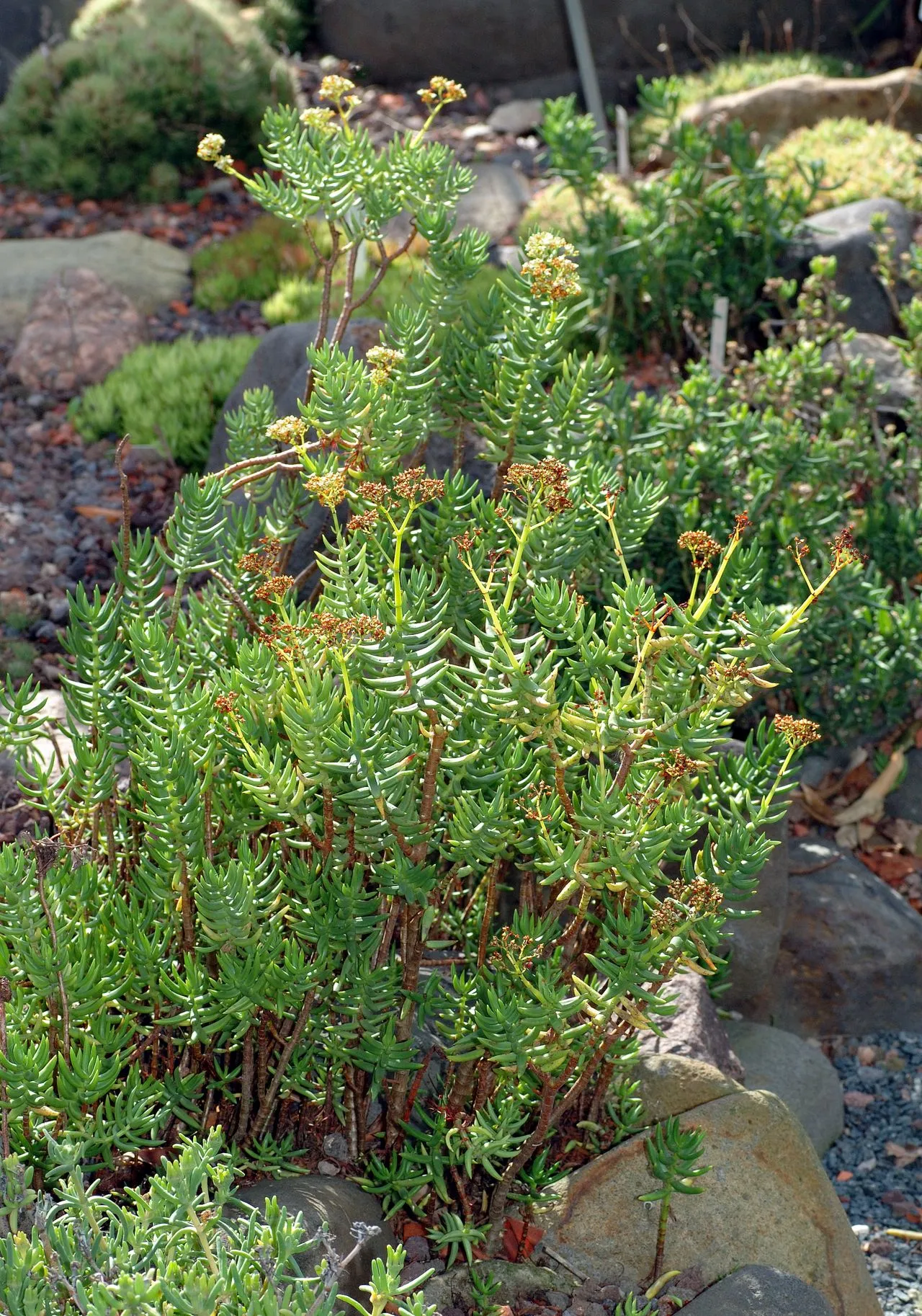
Crassula tetragona L., the miniature pine tree, was among the first South African succulents to receive a formal Linnaean name, described by Linnaeus in Species Plantarum in 1753. It occurs naturally on rocky hillsides through the Eastern Cape of South Africa and into southern Mozambique, from near sea level to about 1,500 m, where it grows as an erect, much-branched shrub 60 to 100 cm tall. The defining character is its leaves: short, narrow, cylindrical and pointed, arranged in four neat ranks of decussate pairs that meet at right angles, giving each branch the silhouette of a tiny conifer.
In cultivation the species rarely reaches its wild stature. Plants in pots typically settle at 30 to 60 cm, branch densely, and lignify at the base into a small woody trunk after three or four years. The leaves are glaucous mid-green when shaded and flush red-bronze along the tips and edges under sustained sun stress, a useful but reversible response that disappears after a week of softer light. Flowers are small, white, star-shaped, and held in flat-topped cymes at the branch tips in winter, usually June and July in habitat and December to February in northern hemisphere collections.
Habitat photographs from the Baviaanskloof and Albany regions show C. tetragona growing in shallow pockets of mineral grit on west-facing dolerite slopes, often alongside Aloe ferox and Cotyledon orbiculata. The substrate is sharp, low in organic matter, and dries fully between rains. Annual rainfall in the species' core range averages 250 to 500 mm, falling mostly as summer thunderstorms; winters are cool and dry. The plant is drought-deciduous: in extended dry periods it sheds its lower leaves, leaving the woody stems bare, then resprouts from each node when rain returns.
Part of the Complete Crassula Guide.
Identification
- Habit. Erect, freely branching shrub, 30 to 60 cm tall in pots, woody at the base on older plants.
- Leaves. Narrow, cylindrical, sharply pointed, 1.5 to 3 cm long and 3 to 5 mm wide. The single most diagnostic feature is the four-ranked arrangement: pairs of leaves are arranged decussately (each pair at right angles to the pair above and below), so that looking down the stem you see four columns of leaves.
- Colour. Glaucous green in shade; tips and margins flush red to bronze under direct sun, particularly through dry winters.
- Flowers. Small white stars, 4 to 5 mm across, in dense terminal cymes, winter blooming.
- Bark. Older stems develop a thin, peeling grey-brown bark.
The four-ranked leaf geometry separates C. tetragona cleanly from the three crassulas it is most often confused with in the trade.
Crassula perforata, the string of buttons, has stacked, opposite, triangular leaves whose paired bases fuse around the stem so that the stem appears to pass through each leaf pair. The leaves are flat, not cylindrical, and the plant climbs and trails rather than standing erect.
Crassula muscosa (sometimes sold as C. lycopodioides), the watch-chain or rat-tail crassula, carries leaves that are tiny (1 to 3 mm), scale-like, and pressed flat to the stem in tight overlapping ranks. The result is a slender green braid the thickness of a pencil. C. tetragona leaves are at least ten times longer and stand outward from the stem, not flattened to it.
Crassula ovata, the jade plant, has fat, rounded, obovate leaves 3 to 5 cm long held in opposite pairs but not in four ranks. Jade leaves are flat above, convex below, and obviously fleshy. They never read as needle-like, and the plant grows into a thick-trunked tree rather than a slender shrub.
A plant labelled C. tetragona that produces flat, paddle-shaped, or scale-pressed leaves is mislabelled. Look down the stem from above: four columns of outward-facing pointed leaves is the test.
Cultivation
C. tetragona is one of the more accommodating shrubby crassulas to keep in a mixed collection. It tolerates a wider range of conditions than C. perforata and is more forgiving of overwatering than C. muscosa, but the species rewards a few specific cultural choices.
Light. Full sun for at least four to six hours daily produces the tightest internodes and the strongest red-bronze flush. In low light the stems etiolate noticeably within weeks: internodes lengthen to 2 cm or more, leaves angle sharply upward, and the four-ranked geometry becomes hard to see. A south-facing window in temperate latitudes is usually adequate; outdoors, it grows best with morning sun and afternoon shade in regions where summer highs exceed 35 °C.
Water. Deep, infrequent watering during active growth (spring through early autumn). Allow the substrate to dry to within the bottom third of the pot between waterings; a 12 cm plastic pot typically goes 10 to 14 days between summer waterings indoors. In winter, when the plant is flowering or resting, reduce to a single light watering every four to six weeks. Lower-leaf drop is the species' drought signal: if more than the bottom two pairs yellow and fall in a month, water more often, not less.
Substrate. A free-draining mineral mix: roughly 60 to 70% mineral (pumice, coarse perlite, lava grit, or akadama) with 30 to 40% sieved peat-free coir or fine bark fines. The roots are fine and shallow, and they rot readily in mixes that hold water at the base. A 2 cm gravel topdress reduces the risk of crown contact with damp substrate after watering.
Temperature. Comfortable from 5 °C to 35 °C. Brief exposure to about −2 °C is tolerated when the substrate is bone-dry, but freezing of even slightly damp roots causes irreversible collapse. Move container plants under cover when overnight lows are forecast below 4 °C unless you are certain the mix has dried through.
Pot. A 10 to 15 cm clay or unglazed terracotta pot suits a single specimen. The species is shallow-rooted and does not benefit from depth; a pan-shaped pot 10 cm deep produces denser plants than a tall pot. Repot every two to three years; the brittle stems break easily, so handle by the woody base.
For substrate, light, and watering principles that apply across the genus, see the Beginner's guide to succulents.
Propagation
Stem cuttings are the standard and almost only method needed. Cut a healthy branch 5 to 10 cm long, ideally with three or more leaf pairs, just below a node. Strip the lower one or two leaf pairs, allow the cut to callus on a dry tray for three to five days, then insert the cutting 1 to 2 cm deep into a barely-damp mix of pumice and a little coir. Roots appear within two to three weeks at 18 to 25 °C, and the cutting can be treated as an established plant after about six weeks. Success rates above 90% are routine for spring or early-autumn cuttings; midwinter cuttings root more slowly and are somewhat more prone to rot.
Leaf propagation is technically possible but unreliable. The narrow leaves carry little stored water, callus poorly, and produce plantlets only sporadically. There is no good reason to use leaves when stem cuttings root so consistently.
Seed-grown plants are uncommon in the trade. Flowers are typically self-incompatible and require a second clone for viable set. If seed is available, surface-sow on a sterile pumice-coir mix, keep at 22 to 26 °C, and expect germination over two to four weeks. Seedlings reach a few centimetres in their first year and resemble the adult form by year two.
Notes
Several subspecies are recognised in the wild: C. tetragona subsp. acutifolia, subsp. lignescens, and subsp. robusta differ chiefly in leaf length, branch density, and degree of basal lignification. Most plants in commercial circulation are referable to subsp. robusta, the form with broader, slightly stouter leaves. Few growers will need to make the distinction, but be aware that "C. tetragona" labels in nurseries cover a fair amount of variation.
The species attracts mealybugs more than any other pest, particularly in the leaf axils where the tight geometry shelters the insects from contact sprays. Quarterly inspection with a hand lens, focused on the joint between leaf and stem on the lowest third of each plant, is the most reliable preventive. A 70% isopropanol swab on each visible mealybug clears small infestations without damaging the plant.
Toxicity is mild. Crassula species contain low levels of bufadienolides; ingestion can cause vomiting and lethargy in cats and dogs, but the species is not on any major regulatory toxicity list. Keep curious pets away from chewable specimens, and treat C. tetragona as low-risk in mixed indoor collections.
The miniature pine tree's chief virtue in collections is its rate of mass production. A single mother plant supplies ten to twenty cuttings per year with no apparent decline, and rooted cuttings reach 15 cm within twelve months. Few species make a more reliable starter for someone learning to handle Crassulaceae propagation at any volume.
See also
- The Complete Crassula Guide: genus overview and cross-species care principles.
- Beginner's guide to succulents: foundational substrate, light, and watering for the genus.
- Crassula perforata: the stacked, stem-piercing string of buttons, often confused with C. tetragona in catalogues.
- Crassula muscosa: the scale-leaved watch chain, the other miniature-conifer lookalike.
- Crassula rupestris: buttons on a string, another shrubby stacked-stem species with similar care.
Frequently Asked Questions
What light does this Crassula need?
Bright light is the default. Compact species and red-flushing cultivars need several hours of direct sun after gradual acclimation.
How should it be watered?
Water thoroughly, then allow the upper 3–4 cm of substrate to dry before watering again. In cool winter conditions, reduce watering sharply.
What substrate works best?
Use a free-draining mix with substantial pumice, grit, or perlite. Dense peat-heavy compost keeps the root zone wet too long.
How is it propagated?
Stem cuttings are the most reliable method for most Crassula. Leaf cuttings work on jade-type plants but are less useful for tight stacked miniatures.