| Question | Short Answer |
|---|---|
| What light does this Crassula need? | Bright light is the default. |
| How should it be watered? | Water thoroughly, then allow the upper 3–4 cm of substrate to dry before watering again. |
| What substrate works best? | Use a free-draining mix with substantial pumice, grit, or perlite. |
| How is it propagated? | Stem cuttings are the most reliable method for most Crassula. |
"White crassula" is not a single species but a common name used loosely for several distinct plants. It can mean a species with white flowers, a cream-variegated cultivar, or the white-bloom-covered leaf surfaces of species such as Crassula arborescens. Before assuming you know what you have, check which of these three your plant actually is.
Part of the Complete Crassula Guide.
The Three Likely Identities
1. Crassula alba (the botanical "white crassula"). An upright species from the Eastern Cape and KwaZulu-Natal with narrow lance-shaped leaves and small dense white-pink flower clusters on tall stalks in summer. The specific epithet alba is Latin for "white" and refers to the flower colour. This is the plant most likely to appear under "white crassula" in a specialist botanical context.
2. Crassula ovata 'Tricolor' and similar variegates. Jade plant cultivars with cream-white sectors in the foliage, flushing pink to red under strong light. In the mainstream houseplant trade, "white crassula" often refers to one of these cream-variegated C. ovata selections.
3. Crassula arborescens (silver dollar jade). A larger shrubby species with blue-grey rounded leaves covered in a waxy white bloom. Occasionally sold as "white crassula" on the basis of the pale foliage.
Less commonly, the name is applied to small white-flowered miniatures such as C. tecta or to white-flowered hybrids. If your plant is in bloom, the flower shape and size usually narrows identification quickly.
Identification of the Three
- Crassula alba is upright, 20–40 cm tall, with narrow ovate-lanceolate green leaves 3–7 cm long and a flower stalk carrying dense clusters of small white or cream flowers. The leaves turn reddish-purple in full sun; the "white" refers only to the bloom.
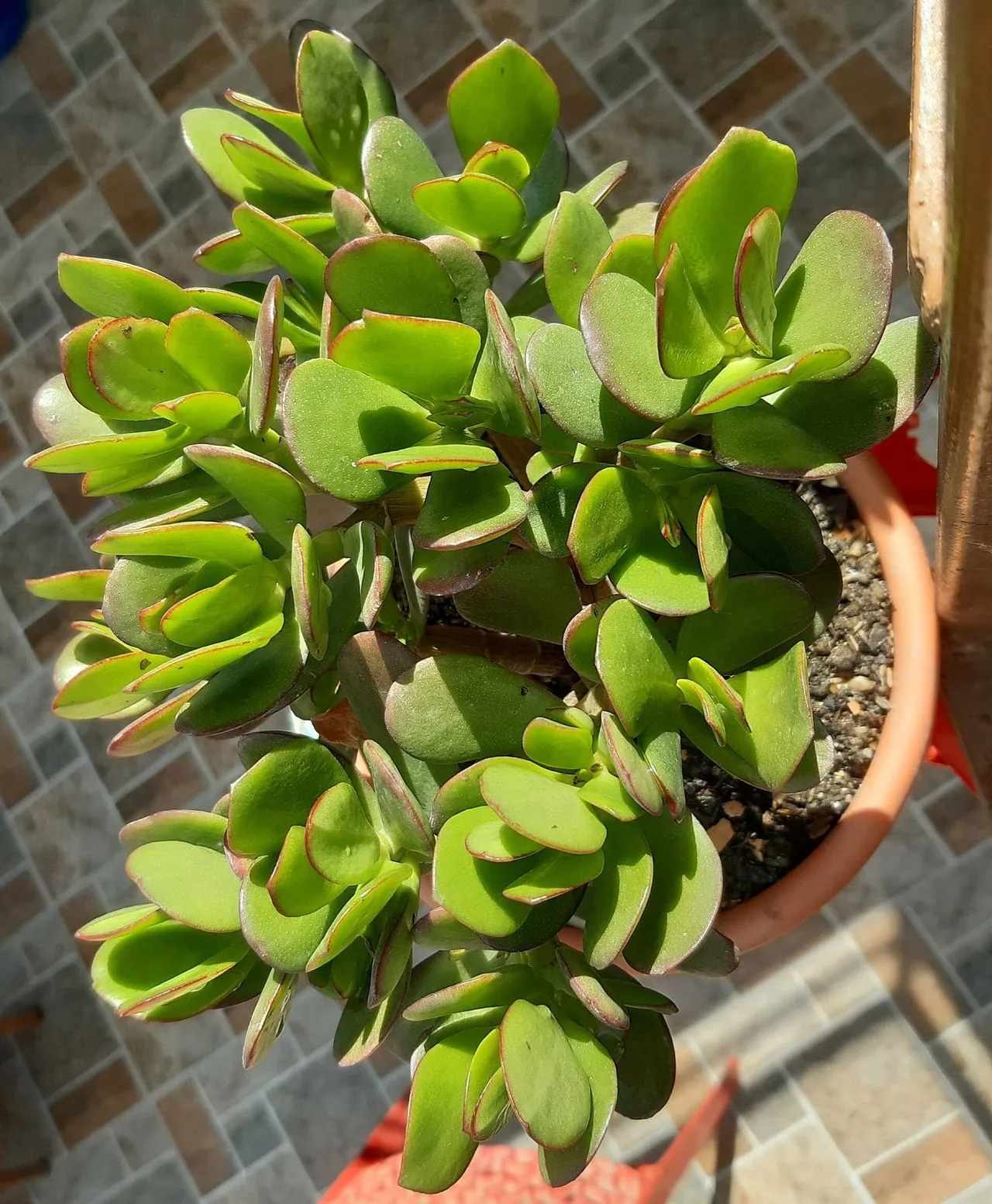
- Crassula ovata 'Tricolor' is a shrubby tree-form plant with thick glossy oval leaves marked in cream, green, and pink-red. The pattern is clearly visible year-round; in strong light the cream sectors flush deep pink.
- Crassula arborescens is shrubby like ovata but with almost circular blue-grey leaves 3–5 cm across, often edged in red. A waxy white surface bloom is visible on young leaves.
Cultivation
For all three, the standard pillar regime applies with the usual cultivar-specific adjustments:
- Crassula alba is a summer-growing species that flowers in midsummer. Treat it as a typical Eastern Cape Crassula: bright light, free-draining mineral substrate, water when the top 3 cm of substrate is dry. It tolerates slightly more water than the miniatures. Flower stalks can be cut back at the base after bloom.
- Crassula ovata 'Tricolor' follows the standard jade regime with higher light demand and careful pruning of all-green reversion shoots. See Variegated Crassula for reversion management.
- Crassula arborescens is more sun-tolerant than C. ovata and prefers a slightly faster-draining substrate. Its waxy bloom is a genuine physiological feature and does not regrow on leaves where it has been handled off, so handle with care.
Propagation
C. alba propagates readily from stem cuttings and seed; leaf propagation works but is slower. C. ovata 'Tricolor' propagates from variegated stem cuttings; leaf propagation is unreliable because not every leaf carries both cellular lineages. C. arborescens propagates from stem cuttings, generally slower to root than C. ovata.
Notes
If you bought a plant labelled only "white crassula" with no species name, your quickest route to a firm identification is to look at leaf shape and plant habit:
- Narrow lance-shaped leaves on an upright stem with a white flower spike: C. alba.
- Thick glossy oval leaves variegated cream and green on a tree-like shrub: C. ovata 'Tricolor' or similar variegate.
- Round blue-grey leaves with a dusty white surface on a thick-trunked shrub: C. arborescens.
Any of these respond to the pillar's default cultivation, with the specific adjustments noted above.
See also
- Crassula alba — the botanical "white crassula."
- Variegated Crassula — cream-variegated cultivars.
- Crassula arborescens — silver dollar jade with white-bloomed foliage.
- Crassula ovata — the jade plant, source of most cream-variegated "white crassula" cultivars in the trade.
Frequently Asked Questions
What light does this Crassula need?
Bright light is the default. Compact species and red-flushing cultivars need several hours of direct sun after gradual acclimation.
How should it be watered?
Water thoroughly, then allow the upper 3–4 cm of substrate to dry before watering again. In cool winter conditions, reduce watering sharply.
What substrate works best?
Use a free-draining mix with substantial pumice, grit, or perlite. Dense peat-heavy compost keeps the root zone wet too long.
How is it propagated?
Stem cuttings are the most reliable method for most Crassula. Leaf cuttings work on jade-type plants but are less useful for tight stacked miniatures.