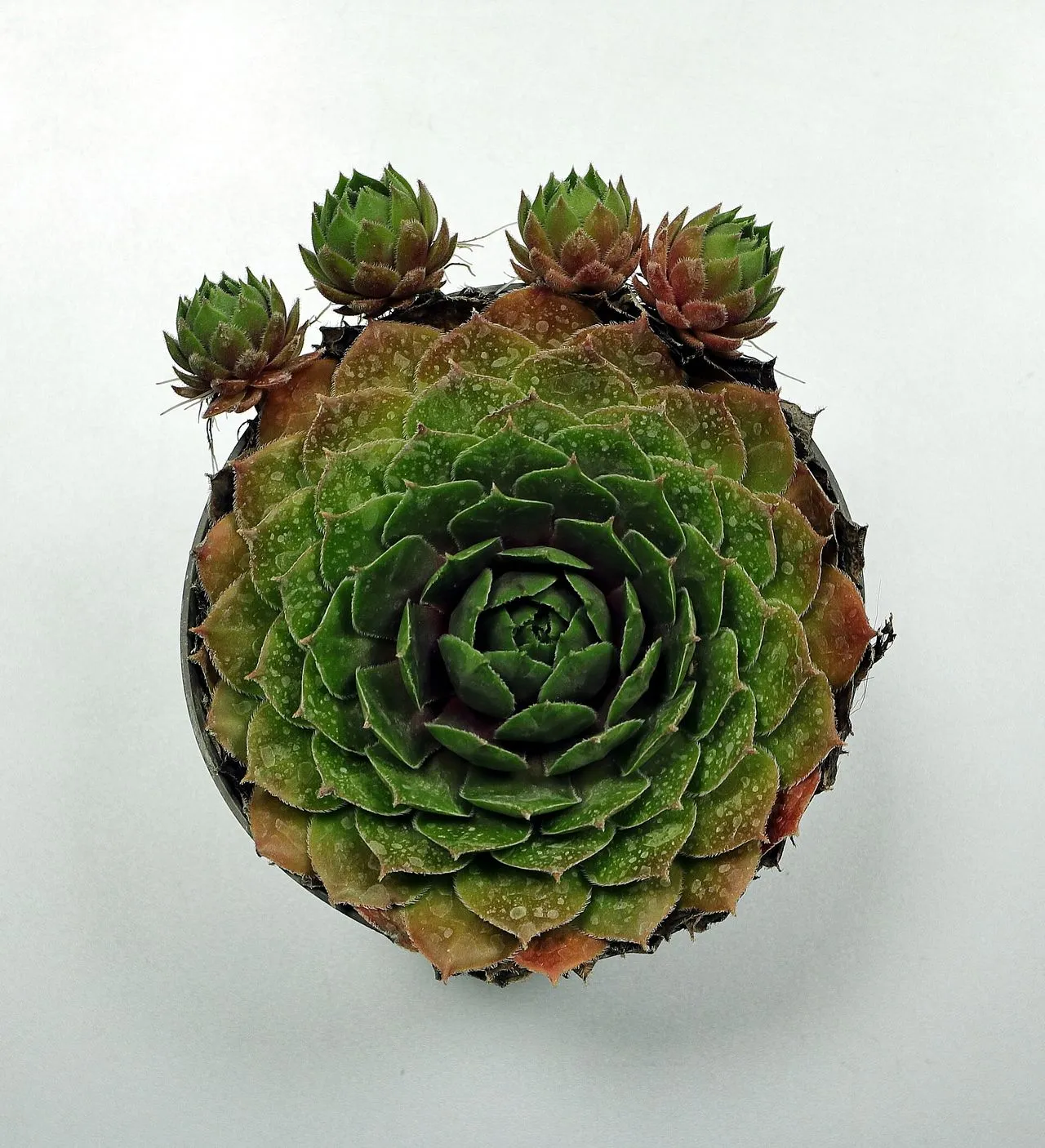
The tight, inward-curled rosette of a Sempervivum facing its first hard frost is one of the most recognisable sights in alpine gardening. Far from signalling distress, a closed rosette is the plant doing exactly what millions of years of mountain evolution have optimised it to do: reduce leaf surface area, protect the growing meristem, and wait. Understanding which curling is physiological and which is pathological is the starting point for correct diagnosis, and getting that distinction wrong leads to interventions that make the real problem worse.
Part of the Complete Sempervivum Guide.
Cold-season protective closure
The most common reason a Sempervivum curls its leaves is low temperature. When ambient air temperatures fall below approximately 5 °C, most rosettes begin closing: the outer leaves draw inward toward the growing point, the rosette takes on a compact, tight, rounded form, and in highly coloured cultivars the foliage darkens to deep burgundy or near-black as anthocyanin production increases with UV-stress accumulation. The mechanism is osmotic — leaf cells reduce their water content, causing the leaves to contract and curl by differential tension along the leaf margins.
This closure reduces the leaf surface area exposed to cold, desiccating air and creates a compact structure that slows heat loss from the growing point. In high-alpine species such as Sempervivum montanum, where winter temperatures routinely fall below −25 °C, this behaviour is a survival mechanism refined over millions of years. A rosette that was open and flat in September may be nearly spherical by November; this is the plant working correctly.
Cold-closed rosettes require no intervention. They do not need watering, feeding, or any positional adjustment. Leave them undisturbed. They will reopen within 3–7 days of temperatures consistently exceeding 5 °C in spring. A rosette that fails to reopen by mid-spring should be assessed for crown rot or frost injury at the growing point: press the centre gently — if it is soft or mushy, damage has occurred.
Drought-induced curling
Sempervivum tolerates extended drought, but in containers — where the root zone is small and subject to rapid drying — prolonged dry periods cause the leaves to curl as a water-conservation response. The mechanism parallels cold-closure: cells in the leaves lose turgor as the plant mobilises its water reserves toward the growing meristem and remaining root zone.
Drought-induced curling is distinguishable from cold-closure by its seasonal context and leaf texture. In summer drought conditions, the leaves feel limp or slightly soft when pressed rather than firm as in cold-closure. The substrate is dry to 4 cm depth or more, and the lower, older leaves may have begun to look slightly shrivelled, pulling inward at their edges rather than curling cleanly from the tip. The inner leaves, closest to the growing point, retain some firmness even when outer leaves are noticeably limp.
The correct response is a single thorough watering — not a daily light misting. Pour water until it runs freely from the drainage holes (for containers) or until the top 10 cm of soil are visibly damp (for ground planting). The rosette will begin to unfurl within 24–48 hours and should be fully open within 2–5 days as root water uptake resumes and turgor is restored. If leaves do not firm up within 48 hours despite moist soil, suspect root damage or root mealybug interfering with uptake rather than drought.
Heat stress and summer semi-dormancy
Above 28–30 °C, most Sempervivum rosettes enter a period of heat-related closure that superficially resembles both cold-closure and drought-closure. The outer leaves curl inward, the rosette tightens, and growth slows or stops entirely. This is summer semi-dormancy: in their native alpine habitat, the warm season is brief and intense, and the plants have adapted to slow metabolic activity during the hottest weeks rather than pushing growth through conditions that strain their systems.
Heat-induced closure requires no intervention. It is distinguishable from drought-closure by two features. First, the leaves remain fully turgid and firm — not limp or rubbery — because the plant has adequate water but has chosen to restrict active uptake during heat. Second, the closure partially relaxes in the evening as temperatures fall, giving the rosette a slightly different diurnal appearance. Plants in this state frequently also show intensified red or purple pigmentation as a UV-protection response, which should be read as a sign of vigour.
The situation that warrants attention is heat-closure combined with excess soil moisture. A tight rosette sitting in warm, damp substrate is at elevated risk for crown rot pathogens, because the humid microenvironment inside the closed rosette centre can become anaerobic. See Sempervivum rotting in summer for the full risk profile and intervention procedure.
Pest-induced curling and distortion
Aphids feeding at the growing point of a Sempervivum rosette cause the innermost, newest leaves to curl, pucker, and distort as feeding interrupts cell development in actively dividing tissue. This is the pest most reliably associated with curling as its primary visible symptom, because aphids preferentially target the soft, growing tissue at the rosette centre rather than the tougher, waxy mature leaves.
Aphid-induced curling has two diagnostic features that distinguish it clearly from environmental curling. First, it affects the newest, innermost leaves only, creating an asymmetric, irregular curl rather than the uniform inward closure of all leaves seen in cold- or heat-stressed plants. The outer, mature leaves of the rosette may look entirely normal while the inner growth is twisted and distorted. Second, it is accompanied by sticky, shiny honeydew deposits on the inner leaves, and often by visible insects — green, black, or grey-green depending on species — when the rosette centre is gently opened and examined with a hand lens.
Treat by rinsing the rosette centre with a strong jet of water to remove insects mechanically, then apply insecticidal soap solution at 5 ml per litre directed into the rosette centre weekly for four weeks. Inspect and treat all neighbouring rosettes; aphids spread rapidly through a mat in warm weather. See Sempervivum aphids for the complete treatment protocol and species identification.
Physical crowding
In a dense, established mat where rosettes press against each other, the outer leaves of interior rosettes can be physically bent rather than physiologically curled — mechanically deformed by contact with neighbouring rosettes rather than contracting from internal osmotic change. The distinction is visible on inspection: physically bent leaves point outward and downward where they meet neighbours, often at irregular angles, while physiologically curled leaves contract symmetrically toward the centre of their own rosette regardless of neighbouring plants.
Physical crowding deformation carries no risk beyond aesthetic. The solution is mat division: separate the colony every 3–4 years using a hand fork, remove declining central rosettes, and replant active chicks with 5–8 cm of clear spacing between them.
How to identify the cause
| Observation | Likely cause |
|---|---|
| Full rosette closes uniformly; autumn or winter; leaves firm | Cold-protective closure — normal |
| Outer leaves limp and curling; warm dry conditions; dry soil | Drought stress |
| Rosette tightens in midday heat; leaves remain firm; soil moist | Summer semi-dormancy — normal |
| Innermost new leaves distorted asymmetrically; sticky residue | Aphid feeding |
| Outer leaves bent outward or sideways; rosettes pressing together | Physical crowding |
| Curling plus mushy, discoloured, foul-smelling centre | Crown rot — not a curling problem |
Risk and severity
Cold-closure, heat semi-dormancy, and moderate drought-closure carry no risk to plant health. They are adaptive responses that resolve without intervention. Severe drought — where leaves are visibly limp and the substrate has been dry for four or more weeks — warrants a single deep watering, but this represents the far end of the spectrum and is uncommon in ground-planted mats in temperate climates.
Aphid-induced curling escalates if untreated. Honeydew encourages sooty mould growth, and a sustained infestation can suppress or permanently deform the growing point. A rosette heavily infested through an entire growing season without treatment may not recover full symmetry. Act within two weeks of noticing the symptom.
Crown rot presenting with associated curling is an emergency requiring same-day action: remove the affected rosette, assess surrounding chicks for firmness, improve drainage. The detailed protocol is in why is my Sempervivum dying.
Solutions
Cold-closure and heat semi-dormancy
No action required. Remove any cloches or sheltering covers in spring to allow the rosette full sun and airflow as temperatures rise. Do not water into a cold, closed rosette in autumn or winter — the combination of water trapped in the closed rosette and cold temperatures is a primary driver of crown rot.
Drought-closure
Water once, thoroughly, until water exits the drainage holes or the soil at 10 cm depth is visibly damp. Do not water again until the top 3–4 cm are fully dry. Expect leaves to begin unfurling within 24–48 hours. If the rosette does not respond within 48 hours despite adequate soil moisture, unpot and inspect the root ball for rot or root mealybug.
Aphid infestation
First rinse the rosette centre with a strong water jet to dislodge most insects mechanically. Then apply insecticidal soap at 5 ml per litre, directed directly into the rosette centre and over the inner leaves. Repeat weekly for four weeks. Inspect and treat all rosettes within 30 cm of the original infestation. Isolate affected container plants from other collections during treatment. Avoid broad-spectrum insecticides outdoors, as these also kill the aphid predators (ladybirds, lacewing larvae, parasitoid wasps) that naturally regulate outdoor populations.
Physical crowding
Divide the mat using a hand fork. Lift individual rosettes, separate them by hand or with clean scissors, and replant with 5–8 cm spacing. Water lightly once after replanting and resume normal watering after two weeks once new root contact with the substrate is established.
Prevention
Spacing at planting: Plant individual rosettes or offset groups at 5–8 cm gaps at the outset. The rosettes will meet over 2–3 seasons, but should not be overlapping from the start. This also ensures the airflow between individual crowns that prevents crown rot and makes aphid populations visible before they establish fully.
Autumn watering discipline: Do not water in autumn once temperatures have fallen consistently below 10 °C. Allow autumn rainfall to provide the only moisture input, and move container plants under an open shelter (which provides a roof but no warmth) to keep the crowns dry during wet spells. The plants do not need the warmth — they need the dryness.
Spring aphid inspection: The first aphid generation appears in April to May as new soft growth begins. A weekly visual inspection of rosette centres through spring, with action at first sighting, prevents a small infestation from establishing colony-wide. A 3x magnifying lens makes early detection straightforward and adds less than a minute to each inspection round.
Full sun placement: Plants in shade are more prone to pest attack and less able to express the cold-closure colouration response that signals the plant is performing correctly. A minimum of 6 hours of direct, unfiltered outdoor sunlight is the threshold for healthy Sempervivum growth, as detailed in the complete Sempervivum guide.
See also
- Sempervivum turning brown — distinguishing healthy cold-season colour changes from frost injury or disease.
- Sempervivum winter damage — when low temperatures cause actual tissue damage rather than the protective closure described here.
- Sempervivum rotting in summer — how warm humidity can damage rosettes that appear to be in normal heat semi-dormancy.
Frequently Asked Questions
Why is my Sempervivum rosette closing up?
Rosette closure is a normal physiological response to cold, heat, or drought. The plant reduces its leaf surface area to conserve water and protect the growing point. It reopens when conditions moderate, typically within 3-7 days.
Should I water a Sempervivum with curling leaves?
Not automatically. In autumn and winter, curling is cold-protective and watering is unnecessary. In summer, check the substrate: if the top 4 cm are bone dry and there has been no rain for 3 weeks or more, water once deeply. Otherwise wait.
Do Sempervivum stay curled all winter?
Yes. Most rosettes remain partially or fully closed throughout winter dormancy, especially in cold, dry air or under snow cover. This is completely normal. They reopen in spring as temperatures consistently exceed 5 °C.
Can curling leaves indicate aphid damage?
Yes. Aphids feeding at the growing point of the rosette cause asymmetric distortion and curling of the innermost new leaves. This is distinguishable from environmental curling because it affects only the newest central leaves and is accompanied by sticky residue or visible insects when the rosette is gently opened.