| Symptom | Likely Cause | Risk | First Action |
|---|---|---|---|
| Cause 1: Monocarpic flowering (not dying, completing life cycle) | The most common reason a sempervivum "dies" is that it is flowering. | Trying to save rust-infected rosettes with home fungicide; they must be removed and discarded. | Check whether the centre has bract-like flowering growth, soft black rot, or orange-brown rust pustules before acting. |
| Cause 2: Crown rot from winter wet | The second most common cause of death is wet-cold rot. | Trying to save rust-infected rosettes with home fungicide; they must be removed and discarded. | Check whether the centre has bract-like flowering growth, soft black rot, or orange-brown rust pustules before acting. |
| Cause 3: Rust infection | The most dangerous of the three, because it is contagious to the rest of your collection. | Trying to save rust-infected rosettes with home fungicide; they must be removed and discarded. | Check whether the centre has bract-like flowering growth, soft black rot, or orange-brown rust pustules before acting. |
A sempervivum that appears to be dying is almost always suffering from one of three specific problems, and the fix in each case is different. This is a short diagnostic guide. Use it to identify which of the three is happening in your plant, then act accordingly.
Part of the Complete Sempervivum Guide.
Before starting: confirm the plant is actually a Sempervivum. Garden centres label Echeveria and even young Aeonium as "hens-and-chicks". An Echeveria grown outside in winter in a temperate climate will rot; if that is what you bought, the plant is not dying, it was misidentified. See the complete Sempervivum guide for the distinguishing characters.
Cause 1: Monocarpic flowering (not dying, completing life cycle)
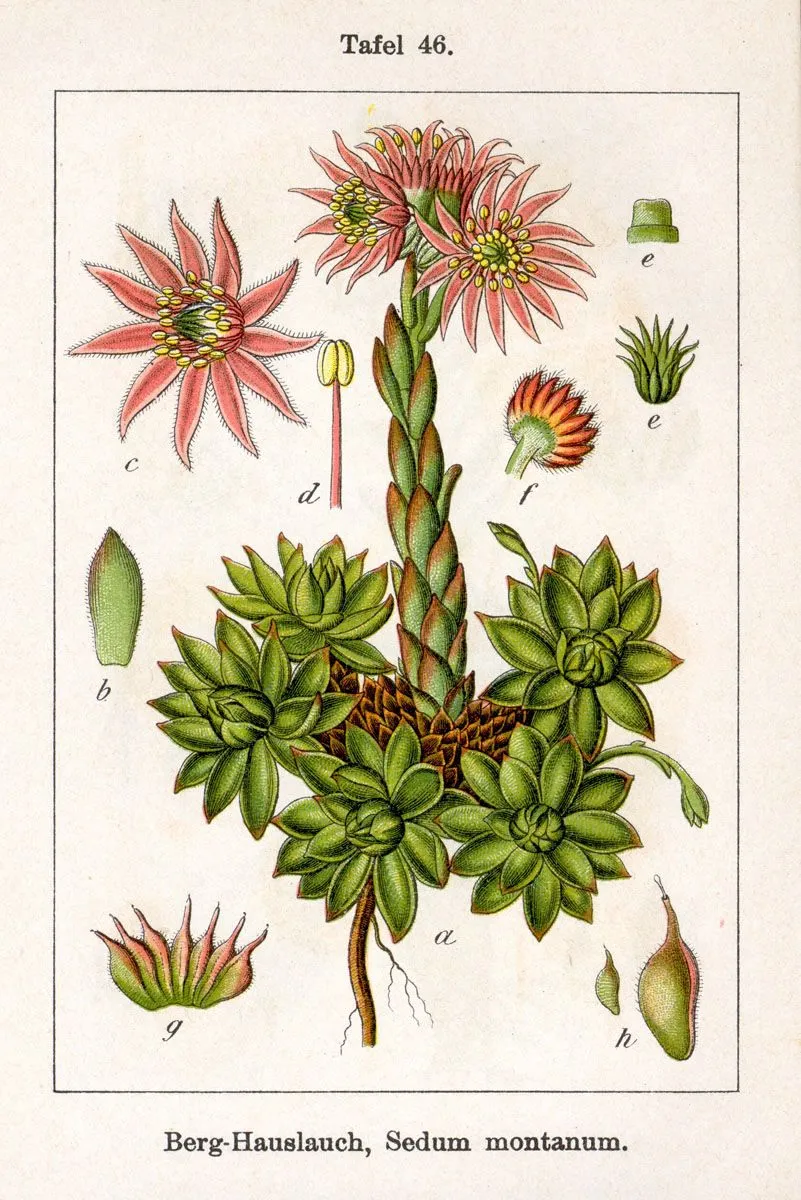
The most common reason a sempervivum "dies" is that it is flowering. Every individual rosette in the genus is monocarpic: it flowers once and then dies. This is built into the genus and is not a sign of poor care. In fact it is usually a sign of excellent care, because only well-fed mature rosettes accumulate enough reserves to bolt.
Signs.
- The mother rosette stretches vertically, with the central leaves becoming smaller and increasingly bract-like up the stem.
- A thick fleshy flower stalk 10–40 cm tall emerges from the centre.
- Star-shaped 12-petalled pink to red flowers open in a flat-topped cluster at the top.
- After flowering, 4–6 weeks later, the whole rosette browns and collapses.
What to do. Nothing. Allow the rosette to flower for the bees, then remove the dead husk. The surrounding chicks, which the mother has already produced over the preceding 2–4 years, will fill the gap within a season. The colony is not dying, only the individual rosette.
If you desperately want the rosette to survive, cutting the flower stalk at the base as soon as it appears sometimes (not reliably) lets the plant revert to vegetative growth for one more season. More often it still dies, just quietly.
Cause 2: Crown rot from winter wet
The second most common cause of death is wet-cold rot. Sempervivums are cold-hardy to −30 °C when dry; they are not hardy to +2 °C when sitting in wet compost.
Signs.
- The centre of the rosette goes soft, translucent, and collapses inward.
- A foul smell at the growth point.
- Black or brown mush spreading outward from the centre.
- Often follows a warm wet winter or a planter that does not drain.
What to do. The affected rosette is not recoverable. Remove it and any adjacent rosettes showing soft spots. Check the surrounding chicks: if they still have firm pale centres they will usually survive. Lift the whole colony, shake out the compost, and replant in fresh gritty substrate, 60% horticultural grit to 40% loam. Move the container to where it gets shelter from winter rain, or drill more drainage holes in the base. The plants do not need warmth in winter, only dryness at the crown.
Cause 3: Rust infection
The most dangerous of the three, because it is contagious to the rest of your collection.
Signs.
- Orange-brown to rust-brown pustules on the leaves, usually on the underside first.
- Affected rosettes become distorted and stunted.
- The whole plant slowly wastes; over months rather than weeks.
What to do. The infection is Endophyllum sempervivi, a rust fungus specific to Sempervivum. It overwinters inside the rosette itself and is not eradicated by any home-use fungicide. Remove affected rosettes entirely, double-bag them, and dispose of them in household waste (not compost). Sterilise your tools. Watch the rest of the collection for a full season; any rosette that develops pustules must be destroyed immediately. Do not buy new sempervivums from any supplier that has sold you rust-bearing plants.
If none of the above fits
Other less common problems and their fixes are in the common problems table in the main guide. The four worth mentioning here:
- Rosette elongating with full-sized leaves (not bracts): etiolation from insufficient light. See etiolated Sempervivum.
- Leaves shrivelled and paper-thin: drought, rare in this genus. Water once; rehydration takes 48 hours.
- White cottony tufts in leaf axils: mealybug. 70% isopropyl alcohol on a cotton swab.
- Colony simply shrinking year on year in a planter it has been in for 5+ years: substrate exhaustion. Repot in fresh mix.
Sempervivums are hard to kill once you rule out flowering (not your fault), winter wet (fixable), and rust (preventable). Work through those three and most diagnostic cases resolve themselves.
See also
- Etiolated Sempervivum — distinguishing flowering stretch from light-starvation stretch.
- The Complete Sempervivum Guide — monocarpy, cultivation, full problem table.
- Sempervivum tectorum — the most forgiving species to restart with.
Frequently Asked Questions
Do sempervivums die after flowering?
Yes. Each rosette is monocarpic and dies after flowering, but surrounding offsets keep the colony alive.
Can crown rot in sempervivum be reversed?
No. Remove the affected rosette and any soft neighbours, then improve drainage and winter rain shelter.
What does Sempervivum rust look like?
It produces orange-brown to rust-brown pustules, often first on leaf undersides, followed by distortion and slow decline.
How do I tell flowering from etiolation?
Flowering has a central stalk with progressively smaller bract-like leaves. Etiolation has full-sized leaves stretched apart by visible internodes.