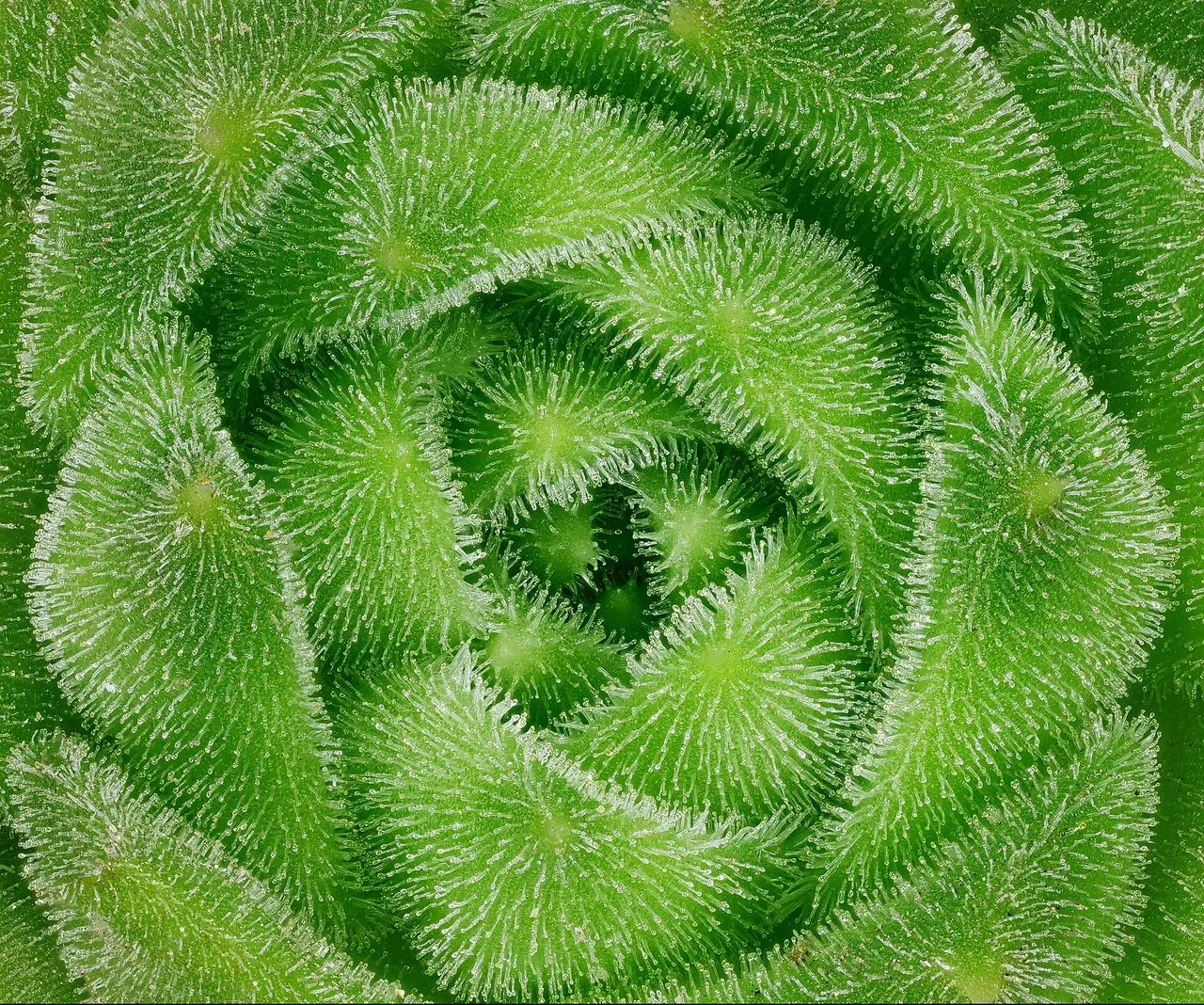
Quick answer: Sempervivum usually fades when the plant gets less direct light, less UV, warmer nights, richer soil, or too much water. The green is not always a problem. It often means the plant has stopped producing as much anthocyanin. Restore color slowly with brighter outdoor light, leaner soil, and careful watering.
Part of the Complete Sempervivum Guide.
How anthocyanins produce Sempervivum colour
Anthocyanins are a family of water-soluble flavonoid pigments produced in plant epidermal cells as a photoprotective and oxidative-stress response. In Sempervivum, they accumulate primarily in the outermost cell layer of the leaves — the epidermis — and are responsible for the full red-to-purple-to-near-black colour spectrum visible in named cultivars. The green baseline comes from chlorophyll in the deeper mesophyll layers. When anthocyanins accumulate, they mask the green and shift the perceived leaf colour toward the red end of the spectrum. More anthocyanin means deeper colour; less means the green baseline shows through.
Anthocyanin biosynthesis is governed by a regulatory pathway that responds to three principal stimuli: ultraviolet radiation (particularly UV-A at 315–400 nm and UV-B at 280–315 nm), low temperature (typically below 10–15 °C), and cellular stress from drought or nutrient restriction. These stimuli operate on the same downstream biochemical pathway and act synergistically — a cold spell in full outdoor sun will intensify colour more dramatically than either factor alone, which is why autumn provides the most vivid Sempervivum colour of the year.
The practical consequence is that Sempervivum colour is a proxy measurement of environmental intensity: how much UV the plant is absorbing, how cold the recent nights have been, and how lean the substrate is. A uniformly green Sempervivum is a plant operating in low-stress conditions. A near-black one is at maximum physiological engagement with its environment.
Insufficient light: the primary cause of colour fading
The most common reason a coloured Sempervivum fades to green is insufficient UV exposure. This is particularly common when plants are moved indoors for winter, relocated to a shaded position, or placed on a covered patio or balcony. Standard window glass transmits visible light but filters most UV-B and a significant proportion of UV-A — the wavelengths most relevant to anthocyanin production. A plant on a bright south-facing windowsill receives adequate visible light for photosynthesis but typically insufficient UV to maintain colour.
The greening process is gradual. A plant moved from full outdoor sun to an indoor windowsill may retain reasonable colour for 2–4 weeks as existing anthocyanins persist in the leaf cells before they are diluted by new, underpigmented growth. By 6–8 weeks, the new leaves produced indoors are fully green, and the overall rosette has shifted noticeably toward green. The outer older leaves retain their colour longer than the new inner growth, so the rosette often develops a two-tone appearance — coloured outer whorl, green centre — that marks the transition point.
The solution is direct outdoor placement. Move the plant to a position receiving at least 6 hours of unfiltered direct sunlight daily. Visible colour recovery begins within 10–14 days as the newly formed epidermal cells in the inner leaves accumulate anthocyanins, and is substantially complete within 4–6 weeks. The specific cultivar affects how deep the recovered colour will be. Cultivars marketed as near-black — such as Sempervivum 'Black' — require conditions approaching 8 hours of direct sun combined with cold nights to reach their advertised depth of colour.
Warm temperatures and the seasonal colour cycle
Low temperature is an independent and powerful trigger for anthocyanin production in Sempervivum, operating separately from UV. As nights fall below 10 °C in early autumn, most cultivars begin to intensify significantly: the red becomes deeper, the purple denser, and near-black cultivars develop the near-black colouring for which they are photographed. This is the seasonal intensification that specialist growers exploit by buying and photographing plants in October.
As temperatures warm through late spring and summer, many cultivars soften toward green or bronze, even in full sun. This is the reverse of the cold-stress response: with no cold trigger, less anthocyanin is produced and the green baseline shows through more strongly. In a mild maritime climate where night temperatures rarely fall below 8 °C even in October, the autumn intensification is less dramatic than in continental climates with sharp autumn cooling. This is a climate effect, not a cultivation error.
The degree of seasonal colour variation is cultivar-dependent. Some deeply-pigmented selections — particularly those in the red-to-black spectrum — retain reasonable colour year-round in full sun even without cold intensification. Others, especially those with lime-green or pale pink pigmentation in their breeding, look dramatically different in summer versus winter. Understanding what is genetic and what is environmental for the specific cultivar prevents misdiagnosis of summer greening as a growing problem.
Over-watering and nitrogen: suppressing stress pigments
Both over-watering and high-nitrogen feeding suppress anthocyanin production by removing the cellular stress that triggers it. A well-watered, well-fed plant is not stressed, and a plant that is not stressed has no metabolic requirement to produce protective pigments. In addition, nitrogen specifically stimulates chlorophyll synthesis and promotes the production of lush, soft, fast-growing green tissue that dilutes any existing pigmentation.
The practical consequence: Sempervivum grown in rich garden soil, watered on a regular schedule, and fertilised with a general-purpose balanced fertiliser will remain green even in full outdoor sun. This is a combination that produces vigorous, healthy growth, but not the colourful tightly-stressed appearance of a specialist's collection. There is no pathology here — the plant is thriving — but the trade-off is colour.
To maintain colour, grow in a lean, gritty substrate — at least 60% inorganic material by volume — with no added fertiliser in the planting mix. Water only when the substrate is dry to 3–4 cm. The mild chronic drought stress of this regime maintains anthocyanin production. If any fertiliser is used at all, apply a low-nitrogen, high-potassium formulation (such as tomato feed diluted to half strength) once in spring, never more frequently.
Etiolation: colour loss combined with structural change
A specific pattern of colour loss accompanies etiolation — the growth-elongation response to insufficient light. As a Sempervivum etiolates, the rosette opens and spreads as internodes lengthen, and all new growth produced during the etiolation is paler and less pigmented than the original leaves, because it has formed in low-UV conditions. The result is a plant that looks washed out, loose, and with visibly paler inner leaves compared to the outer whorl.
This presentation is distinguishable from straightforward colour fade by the structural change that accompanies it: an etiolated plant has an open, splayed rosette with stretched leaf spacing and visible stem, while a plant that has simply lost pigment remains compact and symmetrical — it is just green rather than coloured. The distinction matters because etiolation requires moving the plant to brighter light and potentially beheading or dividing it to restore compact form, while simple colour fade requires only repositioning for UV and cold exposure. See etiolated sempervivum for the full diagnostic and correction procedure.
Genetic limits: not all cultivars are deeply coloured
Colour fade is sometimes simply a case of mismatched expectations against a cultivar's actual genetic colour potential. Not all Sempervivum cultivars are deeply pigmented. Species and cultivars in the S. arachnoideum group have their ornamental character in the white cobweb trichomes rather than in leaf colour, and will remain predominantly green regardless of sun or cold. Lime-green cultivars selected for unusual foliage colour rather than pigmentation intensity will not become red under any conditions.
The colour visible in specialist nursery photographs is typically the maximum achievable for that cultivar under optimal conditions — early autumn, full sun, cold nights, lean substrate. A plant in different conditions will show less colour, and a lower-pigmentation cultivar will never match the advertised colour regardless of conditions. Purchase plants from suppliers who photograph them outdoors in contextually accurate conditions, not under studio lighting or in artificially saturated images. The ruby heart cultivar is a useful example: the red is confined to the rosette centre, and the outer leaves remain green under all conditions.
How to identify the cause of colour loss
| Observation | Likely cause |
|---|---|
| Plant recently moved indoors or to shade; rosette compact | UV deficit — insufficient light |
| Warm mild season; adequate sun; no cold nights | Seasonal summer greening — normal |
| Rich substrate; frequent watering; nitrogen fertiliser applied | Over-watering or nitrogen suppression |
| Rosette open and stretched; paler new inner leaves | Etiolation — structural light-deficit response |
| Plant was purchased green; no colour in any season or position | Low-pigmentation cultivar |
| Colour normal in autumn; fades in summer each year | Seasonal cycle — normal for this cultivar |
Risk and severity
Colour fading carries no risk to plant health. A green Sempervivum is a healthy Sempervivum — it is simply not expressing its pigmentation response under current conditions. Etiolation that accompanies colour fade does carry a structural risk, as the open rosette is less able to protect its growing point and the elongated internodes do not contract when conditions improve. But colour loss alone, without structural change, is entirely cosmetic and has no effect on plant welfare, longevity, or reproduction.
There is no urgency in addressing colour fade. Address it when convenient by correcting placement or substrate. The plant will not suffer in the interim.
Restoring vivid colour
- Move to full outdoor sun. Six to eight hours of direct, unfiltered outdoor sunlight daily is the single most effective action. A covered balcony, patio roof, or window glass will not substitute.
- Allow cold nights to work. Autumn is the season of maximum colour. Moving outdoors in summer provides a start, but the strongest colour returns from September onward as nights cool below 10 °C.
- Reduce watering. Water only when the substrate is dry to 3–4 cm. The mild drought stress of a drying cycle between waterings contributes to anthocyanin production.
- Lean substrate. If repotting is appropriate, use a 60% grit or pumice mixture with minimal organic content. Avoid enriched potting compost.
- No nitrogen fertiliser. If fertiliser is used at all, choose low-nitrogen, high-potassium, once in spring only.
Prevention
Buy in autumn. Plants purchased in September or October will show their maximum colour, because the cold-stress intensification is actively happening at that time. A near-black plant in October reveals what the cultivar can achieve; a plant in a spring sale shows only the post-winter recovery green with no guarantee of the autumn peak colour. Use the autumn purchase as your benchmark.
Site in the most exposed position available. Rock gardens, south-facing raised beds, elevated troughs, wall tops, and open paving positions all provide stronger UV intensity and larger day-to-night temperature swings than sheltered corners, covered patios, or flat beds with overhead vegetation. The closer the growing environment approximates the high-alpine native habitat — exposed, full-sun, with significant temperature swings — the better the sustained colour through the growing season.
Understand the genus's placement requirements. The complete Sempervivum guide specifies why Sempervivum is not a houseplant genus. The combination of filtered indoor light, stable temperatures, and regular watering that suits indoor plants is precisely the combination that suppresses colour production. An indoor Sempervivum will stay green regardless of cultivar.
See also
- Sempervivum turning brown — distinguishing the brown-to-maroon pigmentation of cold-stress anthocyanin from the brown of disease or frost injury.
- Etiolated Sempervivum — colour fade accompanied by rosette stretch and open form, requiring both repositioning and physical correction.
- Sempervivum 'Black' — a deeply-pigmented cultivar that illustrates the maximum achievable anthocyanin colouration under ideal outdoor stress conditions.
What setup helps Sempervivum color come back?
Start with light, then check drainage. A gritty mix such as Bonsai Jack Succulent and Cactus Soil helps keep roots from sitting wet, while a small full-spectrum lamp such as SANSI Grow Lights for Indoor Plants can help indoor plants that cannot get enough sun. As an Amazon Associate, we earn from qualifying purchases, at no extra cost to you.
Will a grow light fully replace outdoor sun?
Not usually. Sempervivum color responds strongly to outdoor light, cool nights, and seasonal stress. A grow light can reduce stretching indoors, but the strongest red and purple tones usually return outside after gradual acclimation.
Quick answer: why is my Sempervivum losing color?
Most Sempervivum color loss is a light and season issue, not a disease. The same rosette can look red in cool spring sun, green in mild summer growth, and darker again when nights cool. If the plant is stretching, soft, or staying wet, fix care first; color follows health.
As an Amazon Associate, we earn from qualifying purchases, at no extra cost to you. If the plant is in moisture-heavy potting soil, moving it into a faster draining mix such as Miracle-Gro Cactus, Palm & Citrus Potting Mix is a reasonable start, though outdoor Sempervivum often still benefits from extra pumice or grit.
How do you bring Sempervivum color back?
Increase light gradually, especially if the plant has been indoors or under shade cloth. Give morning sun first, then more direct sun if the leaves stay firm. Let the soil dry between watering and avoid high-nitrogen feeding, which pushes soft green growth instead of compact, colored rosettes.
Is green Sempervivum unhealthy?
Not necessarily. Green growth can simply mean the plant is in active growth and not under color-triggering stress. Worry more about shape and texture. A tight green rosette is usually fine. A pale, stretched rosette with gaps between leaves needs more light.
Frequently Asked Questions
Why has my red Sempervivum turned green?
The red colour is produced by anthocyanins, which require UV light, cold, or drought stress to be synthesised. If the plant has been moved indoors, placed in shade, overwatered, or grown through a consistently mild warm period without cold stress, the anthocyanins are not produced and the colour reverts to green chlorophyll.
Will the colour come back if I move it outside?
Yes, in most cases. Move the plant to full outdoor sun, reduce watering slightly, and expect visible colour recovery within 2-4 weeks. Cold nights in autumn — below 10 °C — accelerate recovery significantly. Cultivars vary in how vivid they become.
Does fertilising affect Sempervivum colour?
Yes. High-nitrogen fertiliser stimulates lush green vegetative growth and actively suppresses anthocyanin production. A lean substrate with minimal available nitrogen keeps the plant mildly stressed, which maintains colour. Avoid high-nitrogen feeding if colour is the goal.
Why does my Sempervivum look more colourful in winter than summer?
Cold temperatures are one of the strongest anthocyanin triggers in Sempervivum. As temperatures fall below 10 °C in autumn and winter, many cultivars intensify dramatically — this is normal and expected. The intensification continues through winter and peaks in the coldest period before the plant re-greens slightly in spring warmth.
Is green Sempervivum unhealthy?
No. A green but compact rosette can be healthy. Color often fades during warm, mild growth. If the rosette stretches, softens, or stays wet, improve light, drainage, and watering before trying to force stronger color.