| Question | Short Answer |
|---|---|
| Is Sempervivum 'Black' a species? | No. |
| Why did my black sempervivum turn green-purple? | Partial shade, humidity, nutrient-rich substrate, or warm nights reduce anthocyanin expression. |
| How large are black sempervivum cultivars? | Typical mature rosettes are 5–8 cm across with flat tectorum-style form. |
| Do black sempervivums come true from seed? | No. |
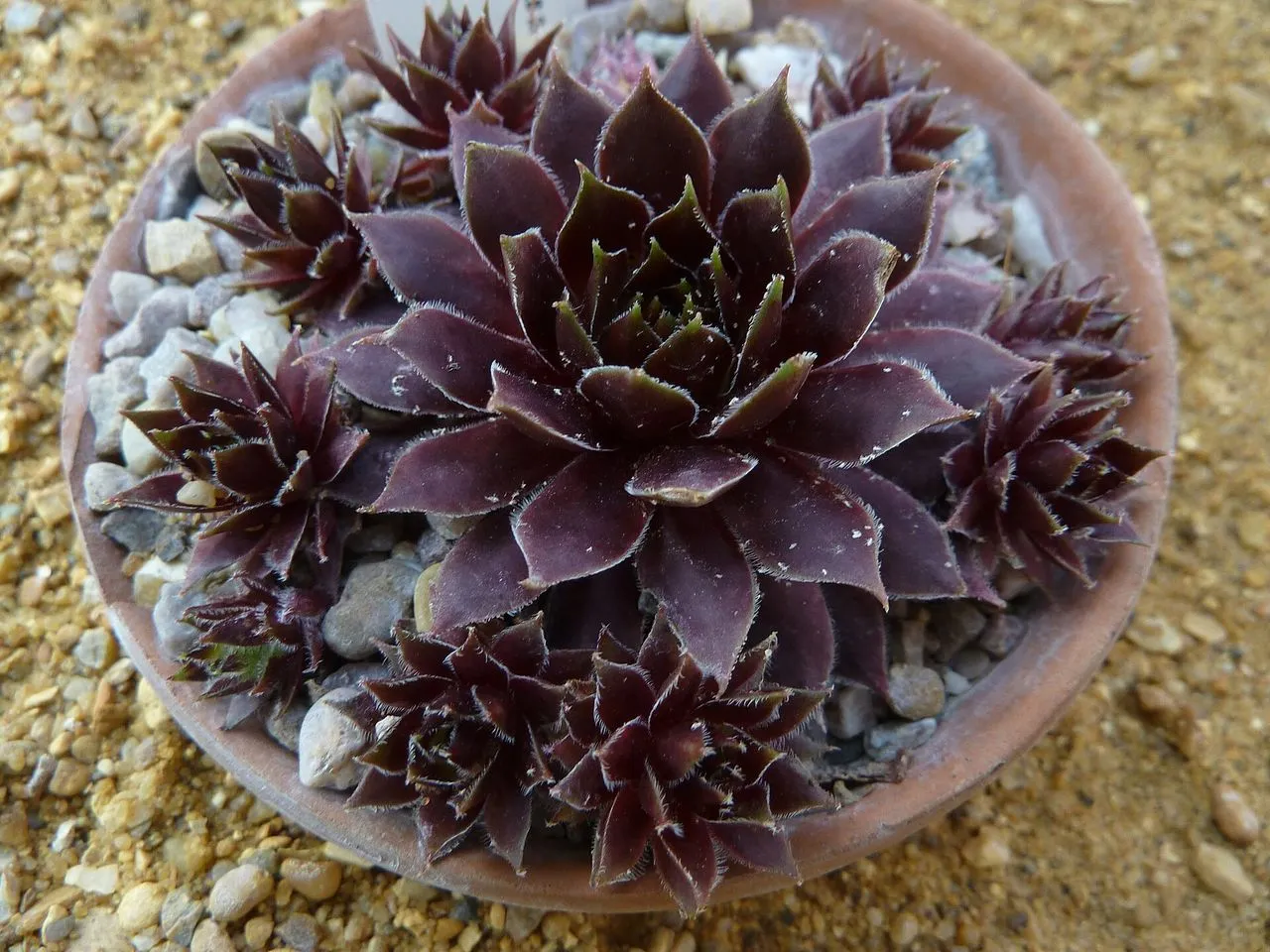
"Sempervivum Black" is a trade name used loosely in the succulent market for any of several near-black-pigmented Sempervivum cultivars, most commonly Sempervivum 'Black Prince', S. 'Black', and S. 'Black Mini'. There is no botanical species called Sempervivum nigrum; the darkness is a breeding result, not a wild type.
Part of the Complete Sempervivum Guide.
Most "Black" cultivars are S. tectorum or S. tectorum × S. marmoreum hybrids selected over successive generations for maximum anthocyanin accumulation. The pigment is the same family of compounds that reddens autumn leaves; in these cultivars it accumulates to the point where the rosette reads as black-purple in sun.
Identification
Typical "Black" cultivar morphology:
- Rosettes. 5–8 cm across at maturity, flat and open in the tectorum style.
- Leaves. Obovate, 2–4 cm long, glabrous, ciliate at the margin. Leaf colour ranges from deep wine-red through black-purple to a true near-black in the darkest selections, with a narrow green or olive band at the very base where the leaf emerges from the rosette centre.
- Colour expression. Maximum pigmentation in late spring and autumn under bright, cold conditions. In summer heat the centre of the rosette shifts to a dull green. In deep winter the leaves pull in tight and the whole plant becomes almost uniform black.
- Inflorescence. Typical tectorum-group pink star-shaped flowers on a 20–30 cm scape, when they appear.
Without a cultivar tag, telling 'Black Prince' from 'Black' from a darker seedling of 'Ruby Heart' is effectively impossible. If provenance matters, buy from a named-cultivar specialist and keep the label.
Cultivation
The single most important point: anthocyanin pigmentation is a stress response, not a stable pigment like chlorophyll. A "Black" cultivar grown in partial shade or high humidity will revert to muddy green-purple within a few weeks. To keep the black you need:
- Full, unfiltered sun. Six hours minimum, ideally all day.
- Cool nights. Pigment intensifies below 15 °C.
- Lean substrate. Low nitrogen. Any nutrient flush pulls the plant back toward green growth.
- Some drought stress. Keep the substrate on the dry side through spring and autumn.
Otherwise cultivation is the genus default. Fully hardy in USDA zones 4–8.
Propagation
Standard offset division. Chicks come true to the parent because these are vegetatively propagated clones. Any "Black" plant grown from seed will revert toward pink-tipped green rosettes within a generation.
Notes and Quirks
Be cautious of mass-market labelling. Garden centres will sometimes label any dark-leaved succulent as "Sempervivum Black". Check the flower (12-petalled star, pink) and the offset habit (stolons producing chicks at the base); if either is wrong you are not holding a Sempervivum. In particular, Aeonium arboreum 'Zwartkop' is occasionally mislabelled this way and is a very different tender plant.
The "deepest black" marketing claims for a new cultivar tend to last two seasons before the next "blacker" selection arrives. In practice the darkness ceiling sits somewhere around Munsell 5R 2/2; genuinely black pigment in leaf tissue has not yet been bred.
See also
- Sempervivum 'Ruby Heart' — red-hearted sibling in the dark-pigmented group.
- Sempervivum tectorum — the underlying species.
- Red Beauty Sempervivum — the bright-red counterpart to the black selections.
- Sempervivum 'Gold Nugget' — the yellow counterpoint; black and gold together make a high-contrast trough.
Frequently Asked Questions
Is Sempervivum 'Black' a species?
No. It is a trade label for several dark-pigmented cultivars, not a botanical species.
Why did my black sempervivum turn green-purple?
Partial shade, humidity, nutrient-rich substrate, or warm nights reduce anthocyanin expression. Move it back to lean full-sun conditions.
How large are black sempervivum cultivars?
Typical mature rosettes are 5–8 cm across with flat tectorum-style form.
Do black sempervivums come true from seed?
No. Named black selections must be propagated by offsets; seedlings usually revert toward pink-tipped green rosettes.