| Question | Short Answer |
|---|---|
| What makes 'Ruby Heart' different from 'Red Beauty'? | 'Ruby Heart' concentrates red pigment in the inner rosette while the outer leaves stay green to olive. |
| How big does Sempervivum 'Ruby Heart' get? | Mature rosettes are 5–8 cm across with flat open growth and short stolon offsets. |
| Does 'Ruby Heart' tolerate lower light? | It tolerates a bright half-day position better than fully red cultivars, but it still is not a houseplant and needs outdoor sun. |
| How do you propagate 'Ruby Heart'? | Use offset division. |
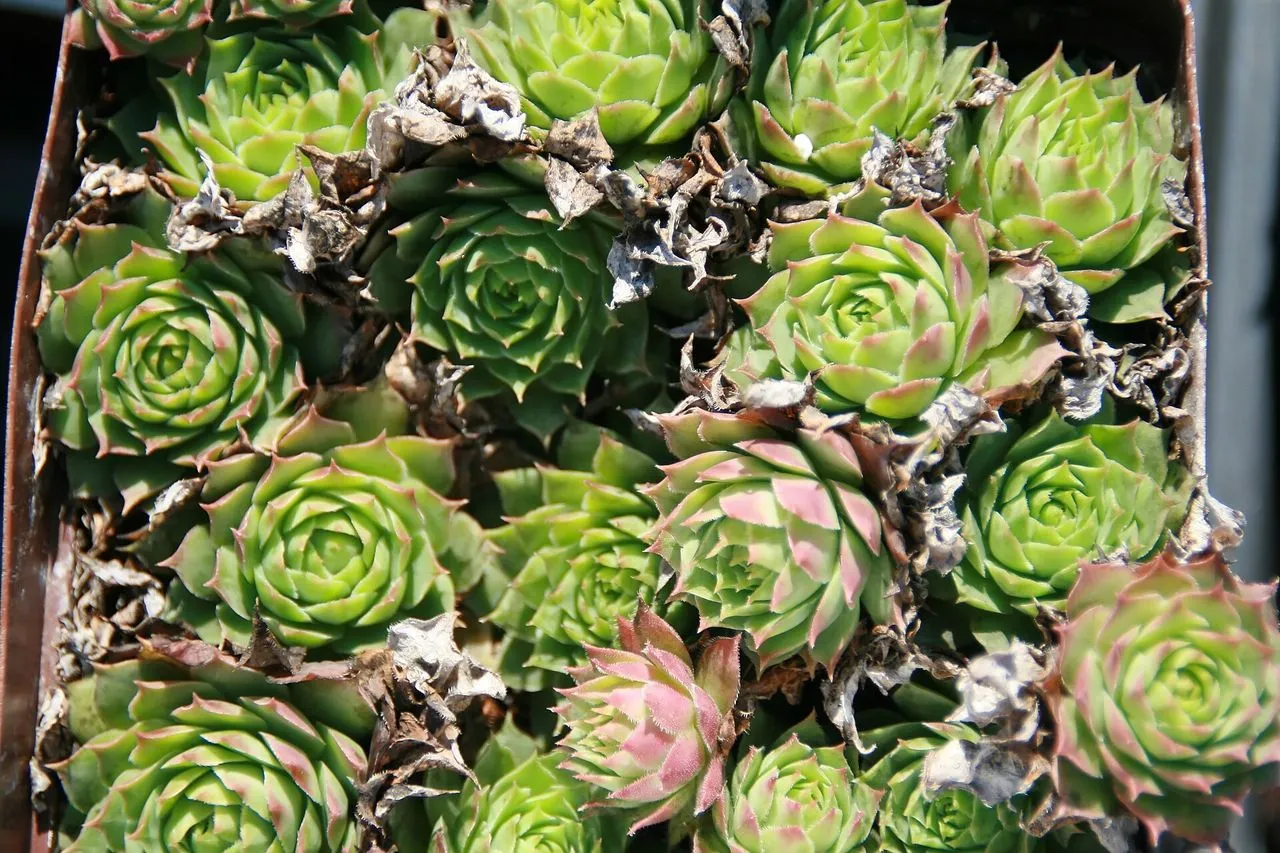
Sempervivum 'Ruby Heart' is a two-toned cultivar characterised by a deep red rosette centre surrounded by green-to-olive outer leaves. The colour pattern is unusual for the genus, where pigmentation more commonly starts at the leaf tips and progresses inward with cold.
Part of the Complete Sempervivum Guide.
The cultivar is a S. tectorum group hybrid of unpublished parentage, distributed across the European and North American markets from the late 1990s onward. The "ruby heart" naming is now also used in the Chick Charms series for a related selection; some suppliers treat the two as synonymous, others as distinct clones.
Identification
- Rosettes. 5–8 cm across at maturity, flat and open.
- Leaves. Obovate, 2–3.5 cm long, glabrous with ciliate margins. The defining character is the colour gradient: the inner three to five whorls of leaves run deep burgundy-red to near-black at the heart of the rosette, while the outer leaves stay olive-green to dull bronze. In cold weather the red deepens and spreads outward; in summer heat the rosette appears more uniformly green with only a small red dot at the centre.
- Inflorescence. Standard tectorum-group pink 12-petalled star flowers on a 20–30 cm scape.
- Offsets. Freely produced on short stolons. Chicks are pre-coloured with the same red-heart pattern from early development.
Cultivation
'Ruby Heart' follows the genus defaults exactly. Full sun, gritty substrate, minimal watering, no feed. Hardiness is USDA zones 4–8, reliable to approximately −30 °C dry.
One specific note: the red-heart colour holds better than the all-red pigment of cultivars like 'Red Beauty' because only the inner rosette leaves are stress-pigmented. The outer leaves carry most of the photosynthetic load, so the plant tolerates lower light levels without losing all colour. In practice this means 'Ruby Heart' is a slightly better candidate for a bright but not blazing position than a fully red-pigmented cultivar. It is not a houseplant — full sun remains essential for meaningful colour — but it tolerates a half-day east-facing terrace where 'Red Beauty' would go green.
Propagation
Offset division. Chicks inherit the red-heart pattern and come true to parent. No special handling required; standard stolon-cut technique. Establishment in 2–3 weeks.
Notes and Quirks
Do not fertilise. Any applied nitrogen pushes the outer leaves into vigorous green growth and the red heart becomes proportionally smaller within two or three leaf whorls. Lean substrate and drought stress keep the outer ring thin and the red centre prominent.
The two-toned pattern makes 'Ruby Heart' a strong specimen plant on its own; a single mature rosette photographs better than many all-red cultivars because the contrast draws the eye. In a mixed trough it works well next to blue-glaucous selections (where the red heart stands out against blue neighbours) and less well next to other red cultivars (where the distinction is lost in the overall red tone).
See also
- Sempervivum 'Red Beauty' — the fully red-pigmented alternative.
- Sempervivum 'Black' — the darker end of the same red-purple spectrum.
- Sempervivum Chick Charms — the commercial series in which related red-heart selections appear.
- Sempervivum 'Pacific Blue Ice' — the blue contrast companion that makes the red heart stand out in a mixed trough.
Frequently Asked Questions
What makes 'Ruby Heart' different from 'Red Beauty'?
'Ruby Heart' concentrates red pigment in the inner rosette while the outer leaves stay green to olive. 'Red Beauty' colours the whole rosette red.
How big does Sempervivum 'Ruby Heart' get?
Mature rosettes are 5–8 cm across with flat open growth and short stolon offsets.
Does 'Ruby Heart' tolerate lower light?
It tolerates a bright half-day position better than fully red cultivars, but it still is not a houseplant and needs outdoor sun.
How do you propagate 'Ruby Heart'?
Use offset division. Chicks inherit the red-heart pattern and establish in 2–3 weeks.