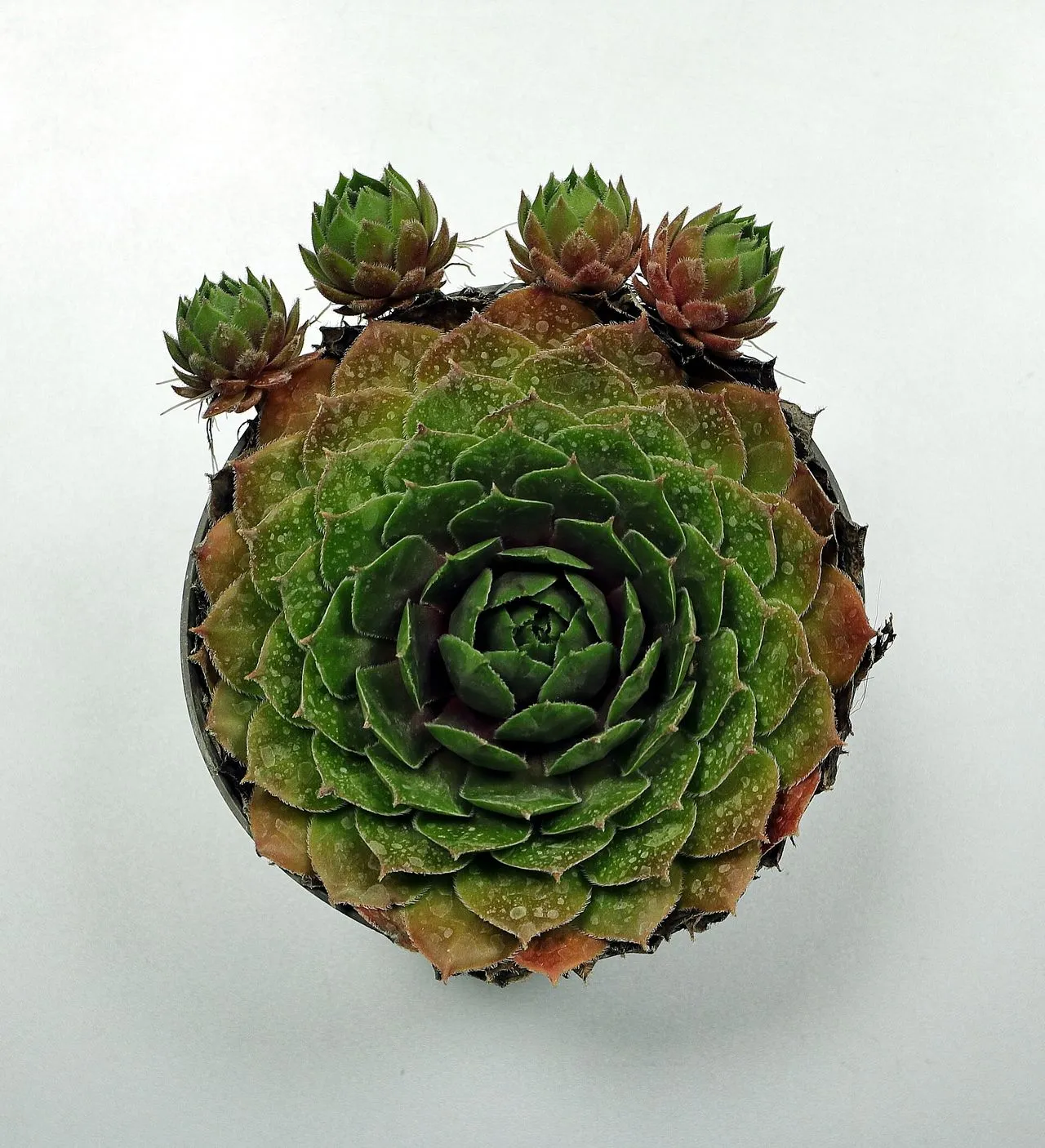
Sempervivum rosettes turn brown in five distinct ways, and only two of them indicate a problem. The species name means "always alive" — semper vivum — which reflects the genus's extreme resilience, but it also creates unrealistic expectations. A rosette browning and dying after flowering is not the plant failing; it is the plant completing its lifecycle exactly as intended.
Part of the Complete Sempervivum Guide.
Normal monocarpic death after flowering
The single most commonly reported sempervivum browning is not a problem at all. Sempervivum is monocarpic: each individual rosette flowers once in its lifetime and then dies. When a rosette is ready to flower — typically after 2–4 years of growth — the centre growth point elongates rapidly into a tall flower spike carrying dozens of star-shaped flowers (usually pink, red, or yellow). After the flowers fade and set seed, the rosette collapses inward, browns, and dies over 4–8 weeks.
This process is normal, inevitable, and not preventable. The rest of the mat continues growing through the offsets (chicks) that the rosette produced in its lifetime. Remove the dead rosette once it is fully dry by gently twisting it off the stolon — check first whether the attachment point still has offsets underneath that have not yet been visible above the dying tissue.
Stress coloration — not browning
Before diagnosing a colour problem, confirm the colour is actually brown rather than a stress colour. Sempervivum produces anthocyanin pigments in response to:
- Cold temperatures (below 10 °C)
- High UV light in summer
- Drought and low nutrient conditions
This stress coloration produces purple, copper, bronze, mahogany, or deep red rosettes — colours that can be confused with browning in photographs or in dim light. A stressed rosette with anthocyanin pigmentation is firm, compact, and correctly shaped. The pigmentation fades as conditions moderate. It is protective and completely harmless.
Sunburn and bleaching
Direct, intense summer sun — particularly on south-facing slopes or terraces, or on compact rosettes in containers without afternoon shade — can burn the outer leaves of Sempervivum beyond their normal stress-coloration response. The leaf surface bleaches to pale cream or tan, then brown. Unlike stress colouration, sunburn damage is localised to the most exposed surfaces, often produces crisp or papery patches rather than uniform discolouration, and does not reverse when conditions cool.
Sempervivum tolerates more direct sun than most succulent genera, but even this tough genus has limits. A rosette that was moved from shade to full summer midday sun without acclimatisation, or that sits on heat-reflective gravel or stone in high summer, can show sunburn bleaching on its outermost leaves. Move or shade the plant temporarily during the hottest part of summer afternoons if sunburn is recurring.
Winter frost and desiccation damage
Sempervivum is famously frost-hardy — most species tolerate temperatures below −20 °C — but the manner in which it experiences frost determines whether it is damaged. A dry, dormant rosette in well-draining soil survives extreme cold without damage. A rosette that has been wet in autumn, then frozen, then thawed repeatedly, may show outer leaf damage or partial crown collapse.
The appearance of frost-damaged sempervivum: outer leaves turn brown, tan, or grey and collapse flat against the soil in late winter or early spring. The centre crown, however, usually remains intact — either firm green tissue or a tightly closed bud that opens as temperatures rise. Most frost-damaged rosettes recover fully once temperatures stabilise above 5 °C. Allow the dead outer leaves to dry off naturally; new compact leaves push outward from the centre as spring growth resumes.
Containers are more vulnerable than garden-planted sempervivum because the roots freeze through the pot wall as well as from the top. Container plants benefit from mulching the pot with straw, burlap, or being moved to an unheated but frost-protected position (below 5 °C to maintain dormancy, above −10 °C to prevent container freeze-through).
Crown rot — the genuine emergency
The one form of browning that represents a real threat is crown rot: the growing centre of the rosette becomes mushy, dark, and malodorous. Crown rot in Sempervivum results from:
- Water sitting in the rosette during cool or cold conditions
- Waterlogged soil in winter or heavy summer rain on compacted soil
- Poorly ventilated positions where rosettes stay wet for hours after rain
- Overhead watering into the crown (outdoor rain cannot be controlled, but overhead irrigation can)
Crown rot progresses from the centre outward, unlike monocarpic death which progresses from the outer leaves inward toward the already-elevated central stem. The tissue is wet, not papery. A sour smell is detectable at close range.
Act immediately: use sterile tweezers to remove wet, blackened central leaves. If the crown tissue (the growing point at the exact centre) is still firm, the rosette may survive if dried immediately and moved to excellent airflow. More often, the rosette is lost but offsets on the stolon survive. Separate healthy offsets, allow their attachment points to dry for 2–3 days, and replant in fresh, sharp-draining grit mix away from the previously affected position.
Drought and outer leaf desiccation
Extended drought causes the outermost leaves to desiccate and brown while the centre rosette maintains itself on stored water. This produces a ring of papery brown outer leaves around a compact, firm, green centre. It is easily confused with frost damage but occurs in summer heat rather than winter. The substrate is bone dry.
Soak once thoroughly and allow to drain. The centre rosette will continue from where it was; the dead outer leaves will remain brown and should be peeled off once fully dry.
How to distinguish the causes
| Pattern | Texture | Season | Other signs | Cause |
|---|---|---|---|---|
| Browning from centre outward, flower spike present | Papery, collapsing | Any (usually summer) | Flower stalk visible | Normal monocarpy |
| Uniform purple, bronze, copper | Firm, compact | Autumn–winter or drought | Whole mat changes colour | Anthocyanin stress coloration |
| Bleached patches on outer leaves | Crisp | Summer | Sun-facing surface only | Sunburn |
| Outer leaves flat and brown, centre firm | Papery | Late winter–spring | After frost | Winter frost desiccation |
| Centre mushy, dark, smells sour | Wet, soft | Any (often autumn/spring) | No flower spike | Crown rot |
| Outer ring of dry brown leaves, firm centre | Papery | Summer | Dry substrate | Drought desiccation |
Solutions
Monocarpic death
Remove when fully dry. Recover offsets. No treatment needed.
Stress coloration
Enjoy it — colours are seasonal and protective. No treatment.
Sunburn
Provide light afternoon shade in summer for the hottest months. The damage is permanent but not life-threatening.
Frost desiccation
Allow dead outer leaves to dry and peel them off in spring. New growth recovers the rosette. Improve drainage before the following autumn.
Crown rot
Remove all wet central tissue. Dry the rosette in good airflow. Recover offsets to replant. Improve drainage and airflow to prevent recurrence.
Drought desiccation
Water once. Resume demand watering. Remove dry outer leaves.
See also
- Frost damage recovery — the cross-genus procedure for assessing and recovering from winter frost damage.
- Root rot diagnosis — when crown rot is accompanied by root death, the full inspection and recovery procedure applies.
- Sempervivum tectorum — the common houseleek; the most widely grown species and the benchmark for normal autumn colour change.
- Sempervivum arachnoideum — the cobweb houseleek; the fine hairs trap moisture and can make distinguishing rot from normal browning slightly harder at first glance.
Frequently Asked Questions
Why is my Sempervivum rosette turning brown in the centre?
Most likely it has flowered or is about to flower. The central growth point of the rosette elongates into a flower stalk, and the rosette ceases producing new leaves. It dies after flowering — this is monocarpy and is normal for the genus. Offsets (chicks) at the base survive.
Is it normal for Sempervivum to turn bronze or copper-coloured?
Yes. Stress coloration from cold, drought, or high UV light causes anthocyanin accumulation, turning rosettes purple, bronze, red, or copper. This is protective pigmentation, not browning from disease. The rosette remains firm.
Why are the outer leaves of my Sempervivum brown and papery?
Normal outer-leaf senescence — the oldest outermost leaves dry and brown as the rosette grows from the centre. Also caused by winter desiccation, mild frost, or drought. Papery outer leaves that peel off cleanly are not a health concern.
What causes a Sempervivum to go brown and mushy at the base?
Crown rot, usually from a combination of waterlogged soil and poor airflow, or water sitting in the rosette during cool weather. This is the one form of browning that is a genuine emergency — the crown is dying and offsets must be recovered immediately.