| Question | Short Answer |
|---|---|
| How do I identify Sempervivum arachnoideum? | Look for small rosettes with white trichome threads spanning from leaf tip to leaf tip. |
| How hardy is Sempervivum arachnoideum? | It is reliable to about −25 °C in dry conditions. |
| Why is my cobweb houseleek flowering early? | The species is shorter-lived than many tectorum-group plants and often flowers in its second or third year. |
| Can Sempervivum arachnoideum be propagated from leaves? | No practical leaf method exists. |
Sempervivum arachnoideum L. (cobweb houseleek, spider web houseleek) is the second foundational species of the genus after S. tectorum. Linnaeus described it in 1753; the epithet arachnoideum comes from the Greek arachne (spider) and refers to the distinctive white trichome threads that span the tips of the leaves like a pulled cobweb.
Part of the Complete Sempervivum Guide.
It grows wild across the higher European mountains, from the Pyrenees through the Alps to the Carpathians, at elevations from 1,500 m up to about 3,200 m, often in sun-baked crevices on granite and schist. It is one of the most consistently alpine sempervivums in cultivation.
Identification
- Rosettes. Tight, nearly globose when young, opening slightly with age; 1–3 cm across in wild plants, up to 5 cm in selected garden forms.
- Leaves. Obovate-lanceolate, 0.5–2 cm long, usually red-flushed or red-tipped, with a blunt apex bearing a tuft of white filament-like trichomes. The trichomes from adjacent leaves connect across the top of the rosette, producing the cobweb effect. Coverage ranges from a light veil in var. tomentosum to a dense white fuzz that almost obscures the leaves in selections like 'Stansfieldii'.
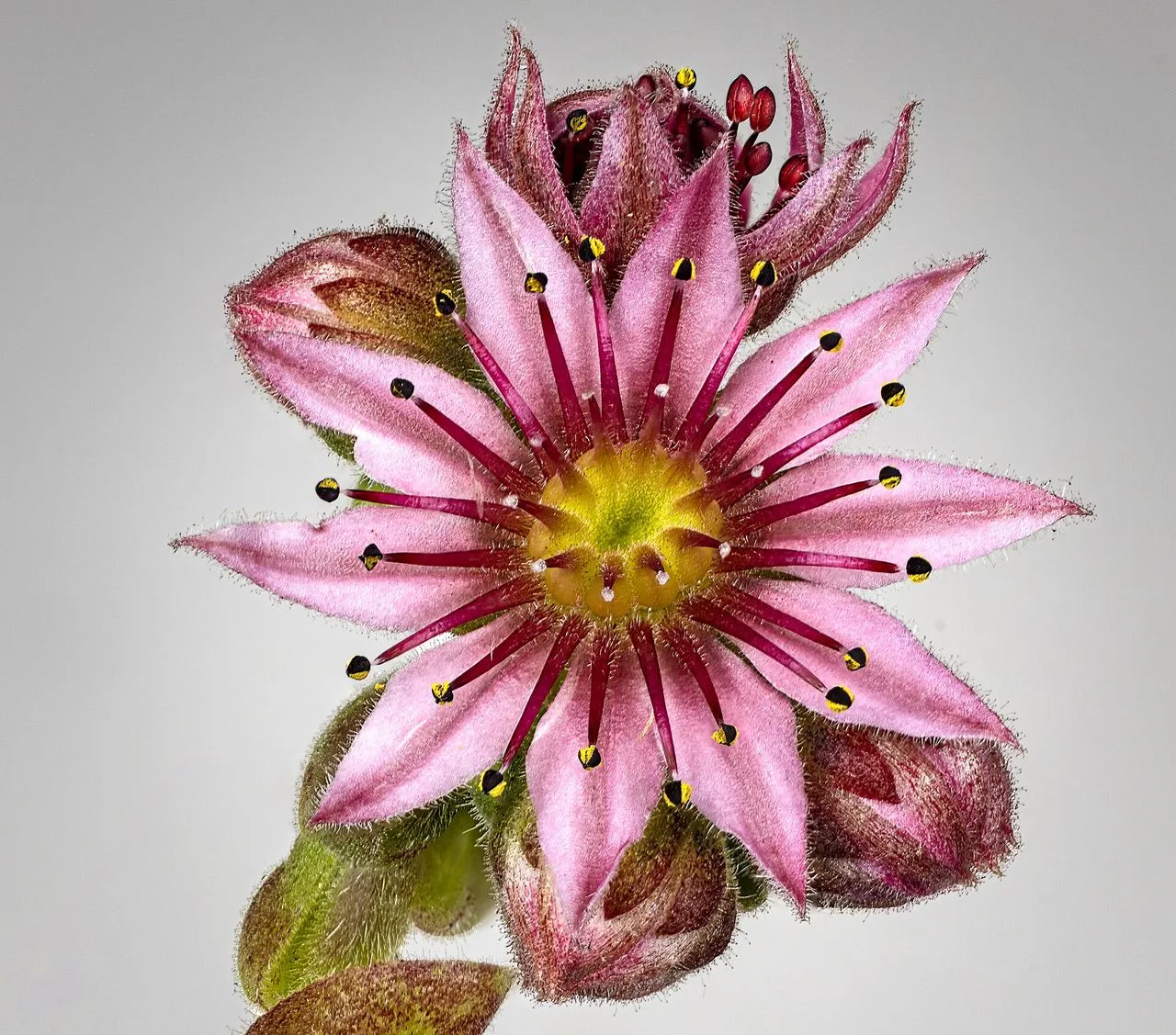
- Inflorescence. A short scape 8–15 cm tall (shorter than S. tectorum), with 8–10 rose-pink to carmine flowers per cyme. Petals are 12 in count, in the genus norm.
- Offsets. Produced freely on very short stolons, 1–3 cm long. Colonies are denser and more clumping than S. tectorum.
The webbing is the diagnostic character. Nothing else in the genus spins trichome threads between leaf tips at this density. Be aware that webbing intensity is environmental: plants grown in cool, bright, dry alpine conditions produce maximum web; the same clone in a shaded humid greenhouse produces much less. Buy in summer to see the real expression.
Cultivation
Cultivation follows the pillar defaults with two adjustments worth making.
First, S. arachnoideum dislikes summer humidity more than most sempervivums. The trichome webbing traps moisture, and in a wet summer rosettes can sit damp for days. Plant on a steeper slope, or top-dress more heavily with 5–10 mm grit, to keep water off the webbing. In maritime climates a tilted alpine trough is better than a flat planter.
Second, the species is slightly shorter-lived than the tectorum group. Individual rosettes often flower in their second or third year rather than the fourth or fifth. That is not a problem, but it means the turnover in a colony is higher and you will see monocarpic death more often. This is normal; see why Sempervivum die for the full picture.
Hardiness is USDA zone 5, reliable to around −25 °C in dry conditions. Wet winter cold is more of a risk than dry winter cold at any temperature.
Propagation
Offset division is the only practical route. Chicks form in dense clusters very close to the mother, so use fine-pointed scissors rather than a blade. Cut the stolon, lift the chick with a dibber, and replant immediately in gritty substrate. Do not try to propagate by detaching webbed leaves; the webbing itself holds moisture against the cut base and encourages rot.
Notes and Quirks
S. arachnoideum is one parent of a huge share of the cobweb cultivar market. Any named cultivar labelled "cobweb", "webbed", "spider", or 'Arachnoideum' something is almost certainly a direct derivative or an arachnoideum × tectorum cross. For the hybrid group see Cobweb Sempervivum.
The webbing is a physiological shade and reflection layer, not a defence against insects. In hot exposed alpine sun the trichomes reduce leaf surface temperature by several degrees and reflect UV back off the rosette. Remove the webbing by accident when handling, and the affected area will not re-web; those leaves will keep their nakedness until they senesce.
See also
- Cobweb Sempervivum — the cultivar group built around this species.
- Sempervivum tectorum — the other foundational species.
- Sempervivum montanum — similar alpine habitat, no webbing.
Frequently Asked Questions
How do I identify Sempervivum arachnoideum?
Look for small rosettes with white trichome threads spanning from leaf tip to leaf tip. No other common Sempervivum produces such dense cobwebbing.
How hardy is Sempervivum arachnoideum?
It is reliable to about −25 °C in dry conditions. Wet winter cold is more dangerous than lower dry temperatures.
Why is my cobweb houseleek flowering early?
The species is shorter-lived than many tectorum-group plants and often flowers in its second or third year. The flowering rosette dies, but offsets continue the colony.
Can Sempervivum arachnoideum be propagated from leaves?
No practical leaf method exists. Use offset division with fine scissors because the chicks sit close to the mother.