| Question | Short Answer |
|---|---|
| What makes a sempervivum a cobweb type? | Cobweb types carry fine white trichomes that connect adjacent leaf tips across the rosette. |
| Does cobweb sempervivum webbing protect against insects? | No. |
| Why is my cobweb sempervivum losing its webbing? | Damaged webbing does not regenerate on the same leaf. |
| Can cobweb sempervivums be propagated from leaves? | No. |
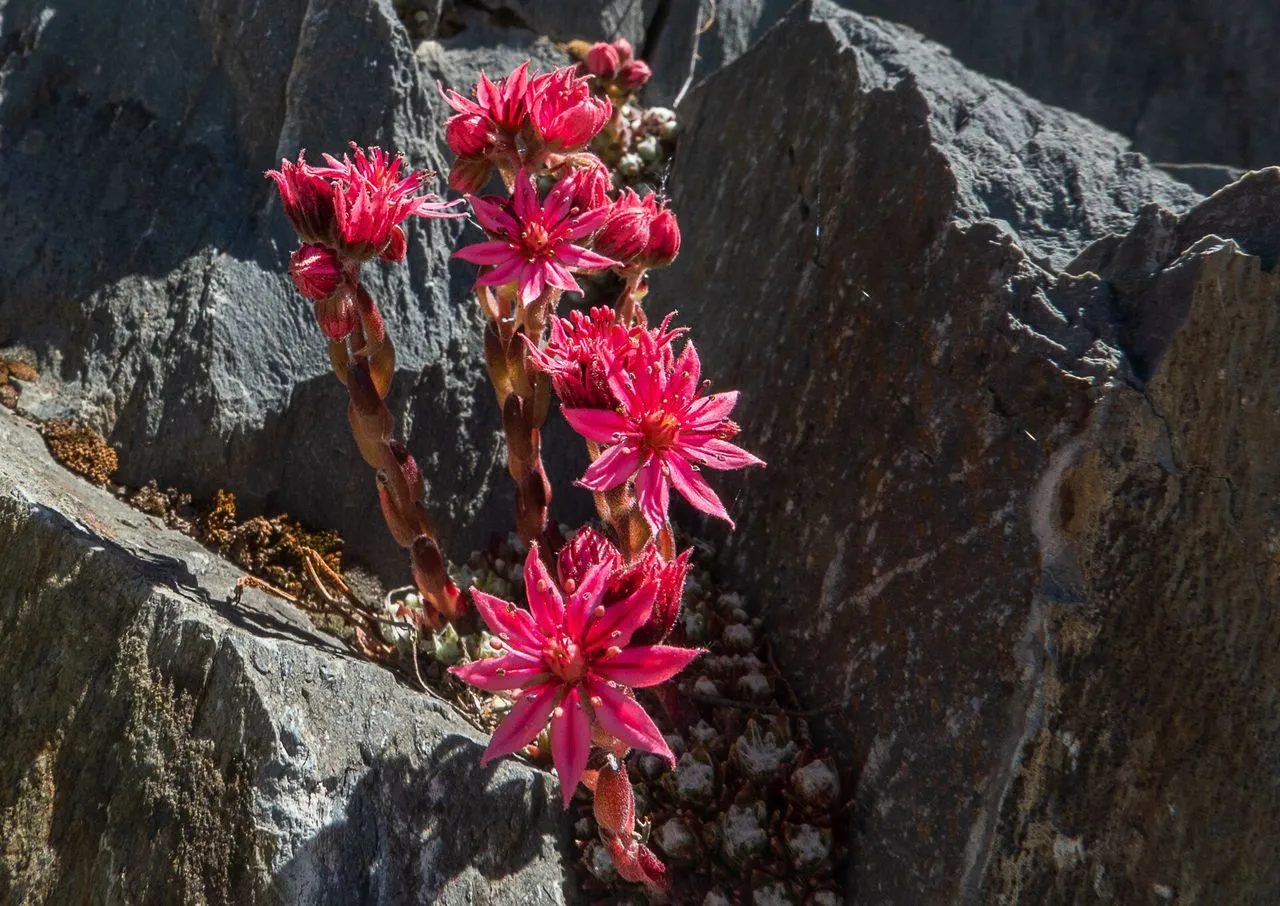
"Cobweb sempervivum" is the horticultural umbrella term for Sempervivum arachnoideum L. and the many cultivars and interspecific hybrids derived from it. All share a single conspicuous character: fine white trichome filaments span the tips of the rosette leaves like a pulled spider web.
Part of the Complete Sempervivum Guide.
For the wild-type species itself, see Sempervivum arachnoideum. This article covers the group as a whole, including named cultivars and common hybrids, and focuses on what the webbing is for and how to keep it looking good in cultivation.
What the webbing actually is
The web is not silk and the plant is not related to spiders. Each white thread is a non-living trichome, a modified epidermal hair that grows out from the leaf tip and connects to the adjacent leaf. Multiple trichomes from multiple leaves form the cobweb structure across the top of the rosette.
The function is a physiological adaptation to high-altitude sun. At the elevations where wild S. arachnoideum grows, UV flux is intense and the rosette would otherwise overheat. The trichome layer:
- Reflects UV and excess visible light.
- Reduces the leaf surface temperature by several degrees through shading.
- Traps a thin layer of humid air against the rosette centre, reducing transpiration loss.
Webbing density is heritable but also plastic. The same clone will produce much denser webbing in strong light and cool nights than in dim humid conditions. Buy webbed cultivars in summer or autumn to see the expression you will get.
Named cultivars and hybrids
The main group members you will encounter in trade:
- S. arachnoideum var. tomentosum — the densest-webbed wild variant, from the higher Alps.
- S. 'Stansfieldii' — a classic heavily webbed selection, compact rosette, deep red leaf base.
- S. 'Laggeri' — slightly larger rosette, medium webbing, widely naturalised in gardens.
- S. 'Cobweb Buttons' — a tight globose form, web almost obscures the leaves.
- S. arachnoideum × tectorum hybrids — larger rosettes than pure arachnoideum, webbing intermediate; most commercial "cobweb hens-and-chicks" at garden centres sit in this group without a specific cultivar name.
Cultivar identification from a single specimen is often unreliable. If the name matters, buy from a specialist with labelled stock.
Cultivation
Cobweb sempervivums follow the pillar cultivation defaults with two specific adjustments.
Watering. The webbing traps water. Overhead watering leaves droplets sitting in the cobweb for hours, which in humid conditions grows mildew and eventually rot at the growth point. Water at the soil, not the rosette, using a long-spouted watering can or a small irrigation dripper. In wet climates, top-dress heavily with grit so any rain runs off immediately.
Position. Plant on slopes, in wall crevices, or tilted troughs where water cannot pool in the rosette. A flat planter in a maritime climate is the worst possible combination.
Otherwise cultivation is genus-generic. Full sun. Gritty lean substrate. Hardiness to USDA zone 5, roughly −25 °C dry. Winter wet is the only serious risk.
Propagation
Offset division. Cobweb cultivars produce chicks densely clustered around the mother, often partly hidden under the webbing. Use fine scissors, cut the short stolon, and lift the chick with a dibber. Replant in gritty substrate.
Do not attempt leaf propagation. The webbing mats wet the cut surface and rot is near-certain. Sempervivums in general are poor from leaves; cobweb selections are worse.
Notes and Quirks
Webbing does not regenerate on damaged leaves. If you bruise a rosette or rub off the web handling the plant, that leaf stays bald until it senesces and is replaced. Handle cobweb plants by the substrate or the base, never by the rosette.
The web can look alarmingly like spider mite infestation to a newcomer. The distinction is easy: trichome threads are rigid, radiate from leaf tips, and connect adjacent leaves in a geometric pattern. Spider mite webbing is irregular, dense, and comes with stippled damage on the leaf surface. If in doubt, hold the rosette up to the light.
See also
- Sempervivum arachnoideum — the wild-type species.
- Sempervivum montanum — a common hybridising partner in cold-hardy alpine crosses.
- Sempervivum tectorum — the other side of most cobweb-hybrid parentages.
Frequently Asked Questions
What makes a sempervivum a cobweb type?
Cobweb types carry fine white trichomes that connect adjacent leaf tips across the rosette. The feature comes from Sempervivum arachnoideum and its hybrids.
Does cobweb sempervivum webbing protect against insects?
No. The webbing is a physiological shade and reflection layer, not spider silk or pest defence.
Why is my cobweb sempervivum losing its webbing?
Damaged webbing does not regenerate on the same leaf. New leaves can produce denser webbing when grown in strong light and cool nights.
Can cobweb sempervivums be propagated from leaves?
No. Offset division is the practical method; detached webbed leaves rot readily because the trichomes hold moisture at the cut surface.