| Question | Short Answer |
|---|---|
| Why is Sempervivum tectorum called roof houseleek? | The epithet tectorum means of the roofs and refers to the old European practice of planting it on thatched and tiled roofs. |
| How large does Sempervivum tectorum get? | Mature rosettes are 5–15 cm across, making it one of the larger common houseleek species. |
| How many offsets does S. tectorum produce? | A mature rosette can produce 10–20 chicks per season under good conditions. |
| How hardy is Sempervivum tectorum? | It is hardy to about −30 °C if the crown remains dry, and is suitable for USDA zones 3–8 outdoors. |
Sempervivum tectorum L. (common houseleek, roof houseleek) is the type species of the genus and the plant most European gardeners picture when they hear the English name "houseleek". Linnaeus described it in 1753 and the specific epithet tectorum, "of the roofs", refers to the medieval practice of bedding it into thatched and tiled coping as a living fire-suppressant and lightning charm.
Part of the Complete Sempervivum Guide.
In the wild S. tectorum occupies rocky outcrops, dry walls, and stabilised scree across the mountain arc from the Pyrenees through the Alps and into the Carpathians, between roughly 700 m and 2,800 m. It is by some margin the most widely distributed species in the genus, which helps explain its extreme tolerance of cultivation conditions.
Identification
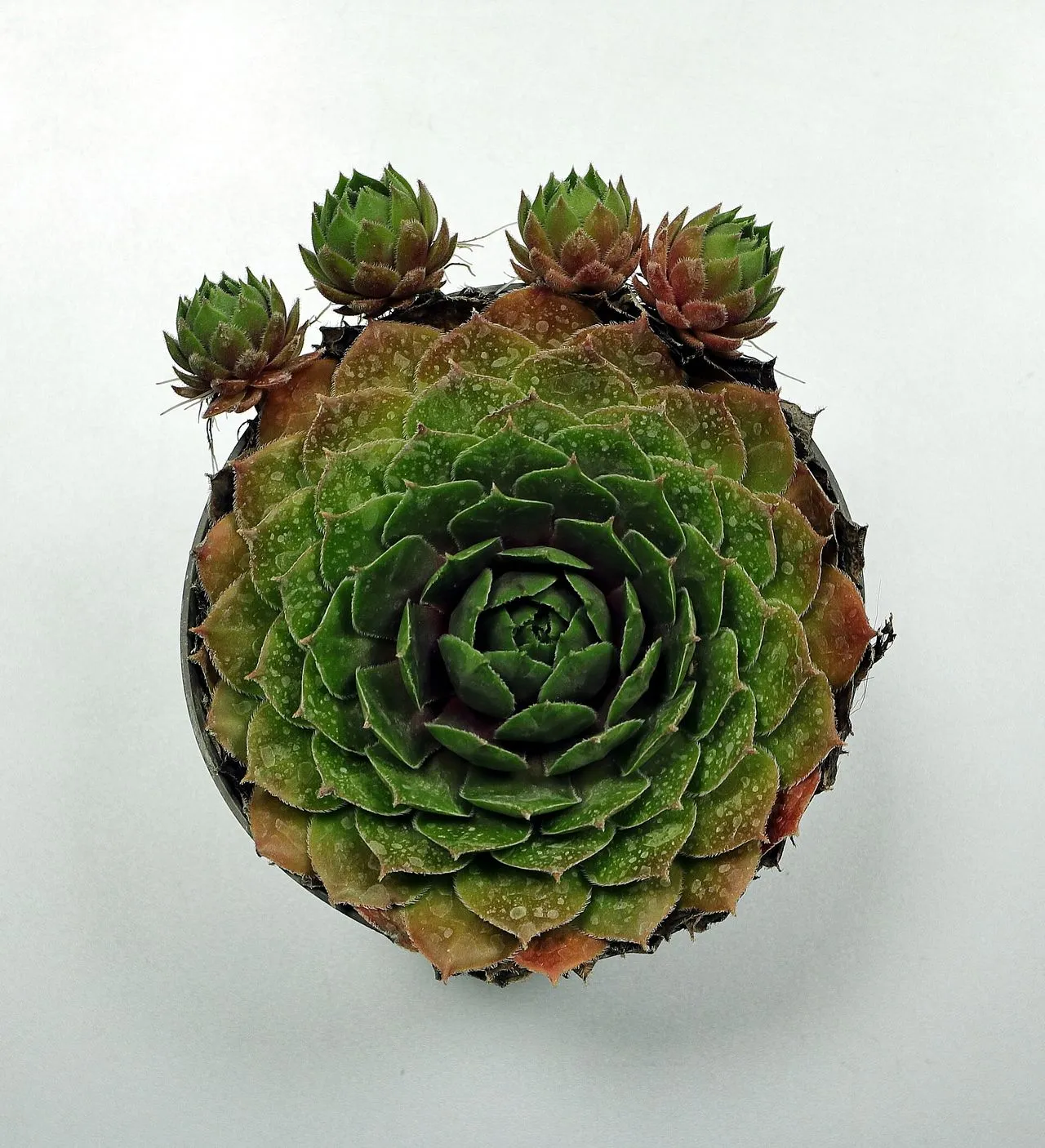
- Rosettes. Flat and open, 5–15 cm across at maturity, among the larger in the genus.
- Leaves. Obovate, 3–5 cm long, 1–2 cm wide at the broadest point, terminating in a short mucronate tip. Margins are ciliate with short bristles. The leaf surface is glabrous, not hairy or cobwebbed (this is the first character to check when separating it from S. arachnoideum).
- Colour. Grey-green to bluish-green, with the upper third of each leaf flushing red to purple-brown in sun and cold. The classic form has a sharply defined dark leaf tip against a paler base.
- Inflorescence. A stout scape 20–40 cm tall carrying a flat-topped cyme of 12-petalled star-shaped flowers, dull pink to purplish-pink, in early to mid summer.
- Offsets. Produced freely on short stolons 2–5 cm long; a mature rosette yields 10–20 chicks per season in good conditions.
Cultivation
Cultivation is the genus default with no caveats. Full sun, gritty scree-style substrate, minimal watering, no winter cover needed in any temperate climate. USDA zones 3 to 8 outdoors; hardy to roughly −30 °C if the crown stays dry. Of all sempervivums this is the one that truly does not care about cold.
The only point where S. tectorum diverges from the generic care pattern is its tolerance of slightly richer substrate. Plants on pure scree stay compact and red-tipped; plants in a 50/50 grit-to-loam mix grow larger, greener, and multiply faster. Choose based on whether you want maximum ornamental colour or maximum offset production.
Container plants appreciate repotting every third spring. Field-planted colonies can be left in place for a decade before they exhaust the substrate; the signal is rosettes beginning to shrink year on year.
Propagation
Offset division is trivially easy. When a chick has produced its own roots (visible as small white points at the base of the new rosette, typically 4–8 weeks after the chick first appears), cut the stolon with sterile scissors and either leave the chick in place to fill in or lift and replant. No callusing needed. Establishment takes 2–3 weeks.
Seed propagation is possible but most seed-grown offspring will not match the parent. S. tectorum hybridises readily with other species in the genus, so open-pollinated seed from a mixed collection produces mongrels of variable quality.
Notes and Quirks
The roof-planting tradition is not a gardening myth. The specific epithet was given because the plant was so consistently grown on rooves across mainland Europe that Linnaeus treated it as the plant's definitive habitat. In 795 Charlemagne ordered it planted on every roof in his empire as fire protection; whether the order worked or not, the practice persisted in parts of France and Germany into the twentieth century.
S. tectorum is the genetic backbone of a large share of the 7,000+ registered cultivars. If you are reading a cultivar description that mentions "Sempervivum tectorum type" it means the plant inherits the open flat rosette form from this species.
Historical taxonomic note: several plants once described as S. tectorum subspecies have been elevated to full species status (S. calcareum, S. cantabricum). If you are reading older literature, assume the circumscription is wider than current treatment.
See also
- Sempervivum arachnoideum — the cobweb houseleek, the other main wild type.
- Cobweb Sempervivum — overview of the arachnoideum group.
- Sempervivum montanum — the more compact alpine sibling.
- Red Beauty Sempervivum — one of the widely grown tectorum-group hybrid cultivars.
Frequently Asked Questions
Why is Sempervivum tectorum called roof houseleek?
The epithet tectorum means of the roofs and refers to the old European practice of planting it on thatched and tiled roofs.
How large does Sempervivum tectorum get?
Mature rosettes are 5–15 cm across, making it one of the larger common houseleek species.
How many offsets does S. tectorum produce?
A mature rosette can produce 10–20 chicks per season under good conditions.
How hardy is Sempervivum tectorum?
It is hardy to about −30 °C if the crown remains dry, and is suitable for USDA zones 3–8 outdoors.