| Question | Short Answer |
|---|---|
| How do I identify Sempervivum 'Kalinda'? | Look for a notably even 6–9 cm flat rosette with green to blue-green leaf bases and soft rose-pink upper quarters. |
| When is 'Kalinda' most colourful? | The pink expression peaks in late spring and autumn. |
| Is 'Kalinda' the same as 'Kalindi'? | Older references sometimes use 'Kalindi', but current European trade uses 'Kalinda' for the same practical clone. |
| How do you propagate Sempervivum 'Kalinda'? | Use offset division. |
Sempervivum 'Kalinda' is a cultivar of the S. tectorum group characterised by an unusually regular, flat rosette with soft rose-pink leaf tips. The cultivar was introduced into European trade in the late twentieth century and has spread steadily since as a reliable medium-sized ornamental selection.
Part of the Complete Sempervivum Guide.
The parentage is not formally documented; morphology places it in the S. tectorum × S. marmoreum hybrid group, which is responsible for many of the cleaner-pigmented commercial cultivars.
Identification
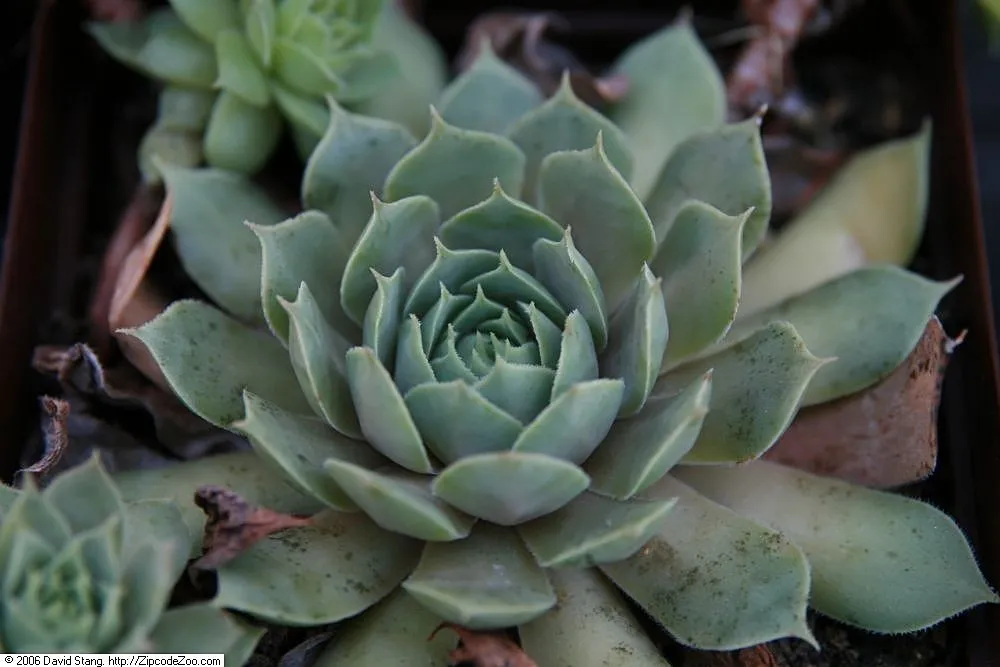
- Rosettes. 6–9 cm across at maturity, flat and notably symmetric — the leaves lie in a particularly even radial pattern with little of the slight irregularity seen in many other cultivars.
- Leaves. Obovate, 2.5–3.5 cm long, glabrous with ciliate margins. Base colour is mid-green to blue-green, with the upper quarter of each leaf flushing a soft rose-pink in sun and cold. The transition between green and pink is gradual rather than sharp, giving the rosette a painterly gradient effect.
- Colour behaviour. Pink expression peaks in late spring and autumn. In summer heat the pink fades and the rosette reads almost entirely green-blue. Winter intensifies the pink into a deeper rose-red. This seasonal cycle is more pronounced in 'Kalinda' than in most cultivars, making it a useful indicator plant for seasonal change in a mixed trough.
- Inflorescence. Standard pink 12-petalled star flowers on a 20–30 cm scape. Flowers and leaf tips together make a harmonious display.
- Offsets. Freely produced on short stolons; chicks show pink tips from their earliest whorls.
Cultivation
'Kalinda' follows the pillar defaults with no significant adjustment. Full sun, gritty substrate, minimal watering, no feed. Hardy in USDA zones 4–8, reliable to approximately −30 °C dry.
The cultivar responds particularly well to the cool-night conditions of spring and autumn. If you are growing in a climate with hot summers, expect the summer phase to look dull; the autumn colour push is where the cultivar earns its place.
One practical note: the symmetric rosette looks best when the plant is grown in a position where it can be viewed from above — a raised trough, a wall-top planter, a small pedestal pot. In a flat-bed planting the symmetry is mostly wasted because the viewer sees the rosette edge-on.
Propagation
Offset division. Chicks come true to parent clone. Standard technique: cut stolon, lift, replant in gritty substrate. Establishment in 2–3 weeks.
Do not grow from seed if you want 'Kalinda' specifically. Seed-grown progeny from 'Kalinda' flowers will segregate into a mix of pink-tipped, red-tipped, and plain green rosettes, and the tight symmetry of the original clone will not carry through reliably.
Notes and Quirks
The cultivar name is sometimes spelled "Kalindi" in older references, but 'Kalinda' is the form used in current European trade and by the International Crassulaceae Network. Both names refer to the same clone in practice.
'Kalinda' is occasionally confused with 'Jade Rose', another pink-tipped tectorum-group cultivar, but the two differ in intensity and distribution of pink. 'Jade Rose' has a slightly more uniform pink wash across the whole leaf, while 'Kalinda' has a sharper pink-at-tip, green-at-base contrast. Side by side the distinction is clear; apart, naming on a garden centre label is often unreliable.
See also
- Sempervivum 'Ruby Heart' — a related two-tone cultivar with red rather than pink.
- Sempervivum 'Red Beauty' — the fully red-pigmented version of the same colour family.
- Sempervivum tectorum — the species this cultivar derives from.
- Sempervivum 'Pilatus' — another compact symmetric alpine selection.
Frequently Asked Questions
How do I identify Sempervivum 'Kalinda'?
Look for a notably even 6–9 cm flat rosette with green to blue-green leaf bases and soft rose-pink upper quarters.
When is 'Kalinda' most colourful?
The pink expression peaks in late spring and autumn. Summer heat makes the rosette read more green-blue.
Is 'Kalinda' the same as 'Kalindi'?
Older references sometimes use 'Kalindi', but current European trade uses 'Kalinda' for the same practical clone.
How do you propagate Sempervivum 'Kalinda'?
Use offset division. Chicks come true to the parent and establish in 2–3 weeks in gritty substrate.