| Question | Short Answer |
|---|---|
| Why is Sempervivum cebenense often misspelled cebenese? | Garden-centre labels often corrupt the Latin name. |
| How do I identify Sempervivum cebenense? | The leaves are uniformly pubescent across both surfaces, giving a velvety feel. |
| How many offsets does Sempervivum cebenense produce? | Expect about 3–5 offsets per mother rosette per season, slower than the 10–20 offsets common in S. |
| How hardy is Sempervivum cebenense? | It is hardy to about −25 °C when dry. |
Sempervivum cebenense Coste (often misspelled "cebenese" in the horticultural trade, including in our slug) is a compact pubescent houseleek endemic to the Cévennes mountains in southern France. The species was described by Hippolyte Jacques Coste in 1903; the epithet refers to the classical Latin name Cebenna for the Cévennes range.
Part of the Complete Sempervivum Guide.
In the wild its range is remarkably small. It occupies granite and gneiss outcrops on Mont Aigoual and the surrounding massif at 800–1,400 m, often on the steep south-facing faces where most competing vegetation cannot establish. Its restricted distribution makes it less commonly seen in collections than the widely distributed sempervivums, but it is straightforward in cultivation.
Identification
- Rosettes. Small and tight, 2–5 cm across at maturity, with a nearly globose juvenile form opening to a slightly flattened adult rosette.
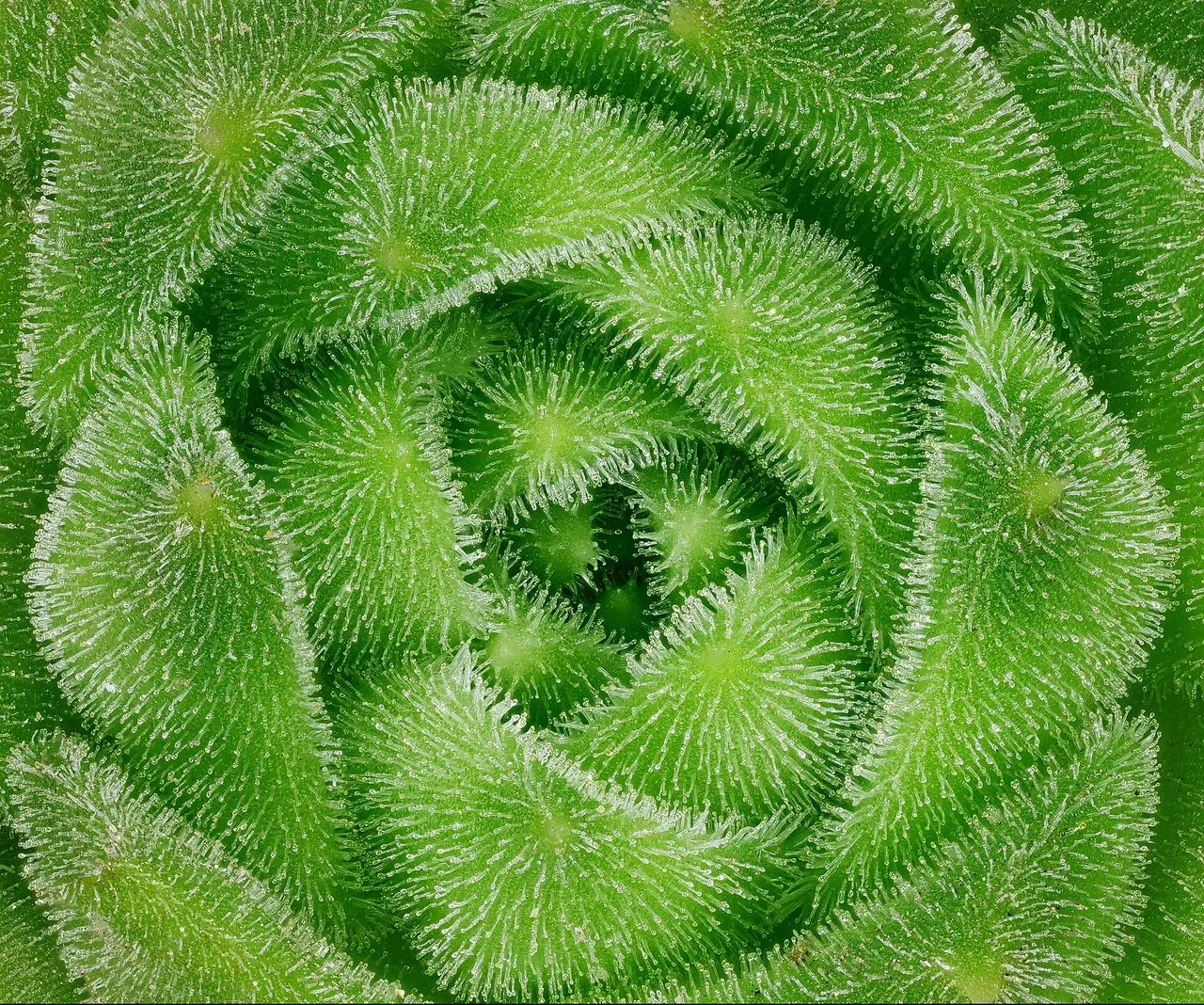
- Leaves. Obovate-oblanceolate, 1.5–2.5 cm long, densely pubescent on both surfaces with short glandular hairs. This is the diagnostic character: the leaves feel velvety to the touch, not hairy-fringed at the edge like S. tectorum but uniformly fuzzy across the whole blade.
- Colour. Grey-green dusted with the pubescence, which scatters light and produces a silvery appearance. Leaf tips flush wine-red in sun and cold.
- Inflorescence. A scape 10–20 cm tall bearing 8–12 rose-purple star-shaped 12-petalled flowers in early summer.
- Offsets. Produced on short stolons; colonies form slowly but steadily.
The pubescence distinguishes it clearly from S. tectorum (glabrous) and from S. arachnoideum (trichomes only at leaf tips, not all over).
Cultivation
Treat as a typical alpine Sempervivum with one significant adjustment: the pubescence traps water. In a wet maritime summer the rosettes can stay damp for days after rain and are prone to rot at the growth point.
Plant on a slope, in a wall crevice, or in an alpine trough at an angle where water runs straight off. Top-dress with at least 1 cm of grit tight to the collar. If you are growing in containers in a climate with wet winters, keep the pots under glass from October through March; the plants do not need warmth, they need a roof.
Otherwise cultivation is generic for the genus. Hardy in USDA zone 5, reliable to about −25 °C dry.
Propagation
Offset division. The chicks are small and close to the mother, often tucked under the fuzzy leaves. Use fine scissors and lift with a dibber. No callus needed. The species is slow to build up a colony compared to S. tectorum — expect 3–5 offsets per mother rosette per season rather than 10–20.
Notes and Quirks
S. cebenense has hybridised in cultivation with several other European species; many "hairy-leaved" garden sempervivums have cebenense blood in the background. A particularly common cross is S. cebenense × S. tectorum, traded simply as "pubescent tectorum" without a cultivar name.
The spelling "cebenese" seen in garden centre labels is a corruption; the correct Latin is cebenense. Our URL preserves the common misspelling for search compatibility, but treat the correct name as authoritative in any reference material.
See also
- Sempervivum montanum — another small, cold-hardy European alpine.
- Sempervivum arachnoideum — the trichome-covered neighbour.
- Sempervivum tectorum — the genus type species.
- Cobweb Sempervivum — the other distinctively textured alpine group for trough contrast.
Frequently Asked Questions
Why is Sempervivum cebenense often misspelled cebenese?
Garden-centre labels often corrupt the Latin name. The correct species name is Sempervivum cebenense, named for the Cévennes.
How do I identify Sempervivum cebenense?
The leaves are uniformly pubescent across both surfaces, giving a velvety feel. That differs from ciliate S. tectorum margins and tip-webbed S. arachnoideum.
How many offsets does Sempervivum cebenense produce?
Expect about 3–5 offsets per mother rosette per season, slower than the 10–20 offsets common in S. tectorum.
How hardy is Sempervivum cebenense?
It is hardy to about −25 °C when dry. Persistent wet around the pubescent crown is the greater risk.