| Question | Short Answer |
|---|---|
| Why is 'Pacific Blue Ice' blue? | A thick layer of epicuticular wax scatters light and gives the leaves a blue-silver appearance. |
| Does the blue colour change by season? | Only slightly. |
| How big does 'Pacific Blue Ice' get? | Mature rosettes are 6–10 cm across and freely produce wax-coated blue chicks. |
| Can I restore rubbed-off wax? | No. |
Sempervivum 'Pacific Blue Ice' is a cultivar selected for exceptional blue-glaucous leaf coloration, originating from the Pacific Northwest breeding programme led by Sandy MacPherson in Oregon and distributed commercially from the early 2000s. The cultivar has since been incorporated into the Chick Charms licensing series.
Part of the Complete Sempervivum Guide.
The blue colour comes from a thick coating of epicuticular wax (pruinose bloom) on the leaf surface. Unlike anthocyanin-based red pigmentation, which is a stress response, the wax is a structural feature that is present on the leaf from emergence and persists year-round with only minor seasonal variation.
Identification
- Rosettes. 6–10 cm across at maturity, flat and open in the tectorum style, slightly larger than average for a commercial cultivar.
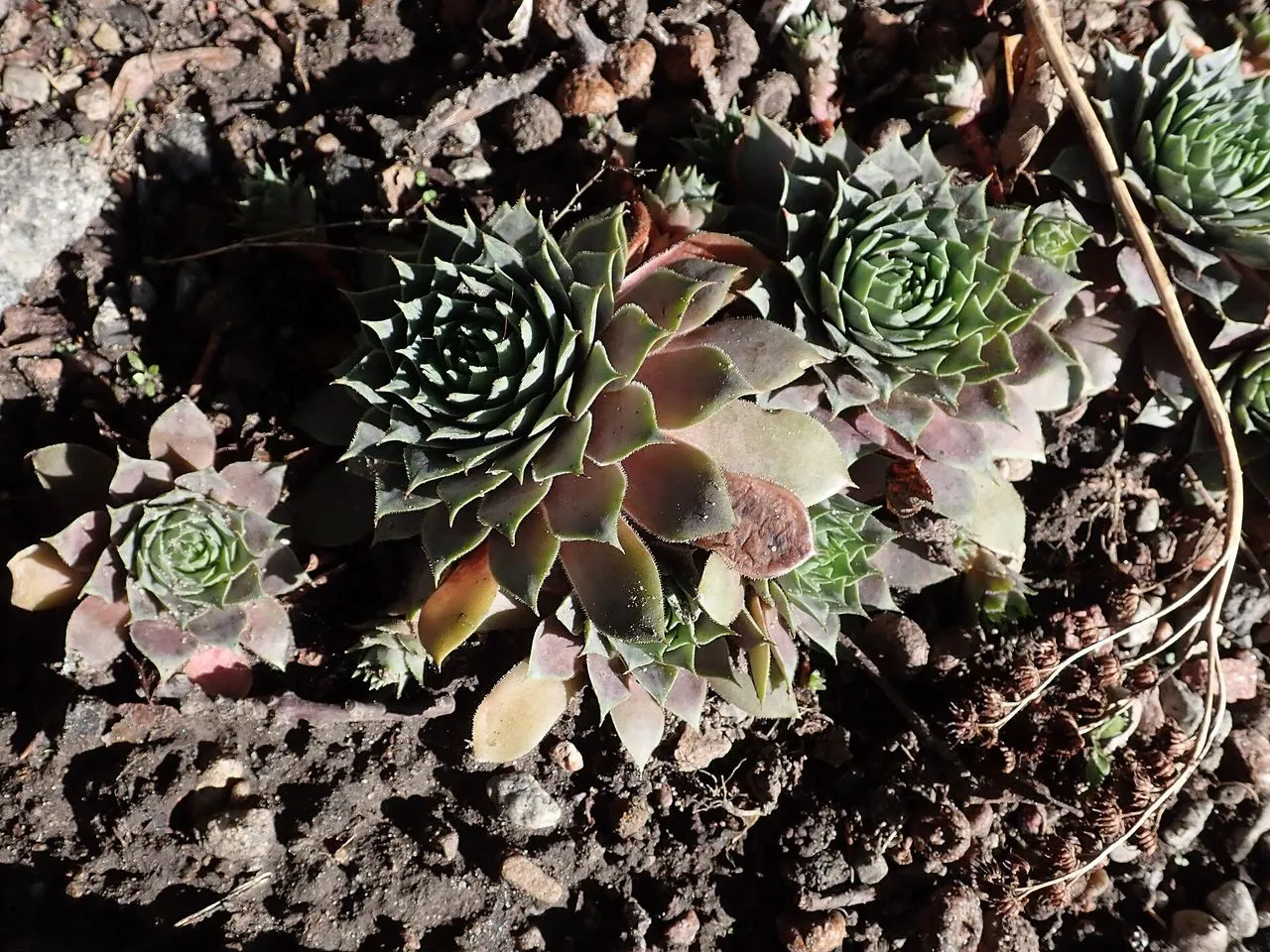
- Leaves. Obovate, 2.5–4 cm long, glabrous. The diagnostic character is the colour: leaves are coated in a thick pruinose wax that gives the plant a pale blue-silver appearance. Under the wax the leaf tissue is a mid green, occasionally with faint rose-pink tipping in cold weather.
- Colour stability. Because the blue is wax-based, the cultivar holds its appearance in conditions that would cause a red-pigmented cultivar to revert toward green. Summer-grown, winter-grown, container-grown, indoor-grown (short term) — the plant stays recognisably blue throughout.
- Inflorescence. Standard tectorum-group pink star-shaped 12-petalled flowers on a 25–35 cm scape. The scape and flowers are also wax-coated.
- Offsets. Freely produced on short stolons; chicks show wax from the first leaves and are blue from emergence.
Cultivation
'Pacific Blue Ice' follows the pillar defaults with one important handling note.
Do not rub the wax off. The pruinose coating is a physical layer of epidermal wax crystals. It is what makes the cultivar blue. Once rubbed off, it does not regenerate on that leaf — the tissue stays a dull green where you touched it until that leaf senesces and is replaced. Handle by the substrate or the base of the rosette, never by the leaves. This matters particularly at repotting, where new growers accidentally fingerprint their plants.
Otherwise cultivation is genus-generic. Full sun, gritty substrate, minimal water, no feed. Hardy in USDA zones 4–8, reliable to approximately −30 °C dry.
Position tip: the blue-silver colour pairs strikingly with red and gold cultivars, and a mixed trough of 'Pacific Blue Ice', 'Red Beauty', and 'Gold Nugget' is one of the classic Chick Charms-style mixed plantings precisely because the three cultivars cover the main Sempervivum colour families without fighting each other.
Propagation
Offset division. Chicks come true to parent clone. Handle the chicks by the stolon and the base, not by the leaves, to preserve the wax coating through transplanting. Establishment in 2–3 weeks.
Seed propagation is pointless for this cultivar. The wax-coating trait is quantitative and progeny will segregate widely; most seedlings will have partial or minimal wax.
Notes and Quirks
The wax coating has a practical function beyond aesthetics. It reduces water loss from the leaf surface, reflects UV, and sheds rain. A plant that is accidentally kept slightly wetter than ideal will do better if it is 'Pacific Blue Ice' than if it is an unwaxed cultivar of the same parentage, because the wax sheds water from the rosette surface.
The cultivar is occasionally compared to Echeveria species that also carry wax coatings (E. laui, E. cante), but the chemistries are different and the parallels are superficial. Sempervivum wax is more robust to brief handling than Echeveria wax in my experience, but both suffer permanent damage from repeated contact.
See also
- Sempervivum Chick Charms — the licensing series.
- Sempervivum 'Gold Nugget' — the gold companion in mixed plantings.
- Sempervivum 'Red Beauty' — the red counterpoint.
- Sempervivum 'Kalinda' — the pink-tipped complement for a blue-and-pink trough.
Frequently Asked Questions
Why is 'Pacific Blue Ice' blue?
A thick layer of epicuticular wax scatters light and gives the leaves a blue-silver appearance. The tissue underneath is mid green.
Does the blue colour change by season?
Only slightly. Because the colour is wax-based rather than anthocyanin-based, the cultivar remains recognisably blue through summer and winter.
How big does 'Pacific Blue Ice' get?
Mature rosettes are 6–10 cm across and freely produce wax-coated blue chicks.
Can I restore rubbed-off wax?
No. Wax removed by handling does not return on the same leaf; the mark disappears only when that leaf senesces.