| Question | Short Answer |
|---|---|
| Can an etiolated sempervivum shrink back to normal? | No. |
| How do I tell etiolation from flowering? | Etiolation has full-sized leaves along an elongated stem. |
| How much light prevents sempervivum etiolation? | Sempervivums need at least 6 hours of direct unfiltered sunlight per day. |
| How long does re-rooting a beheaded sempervivum take? | Roots emerge from the cut stem in 2–4 weeks after a 2–3 day dry callus period. |
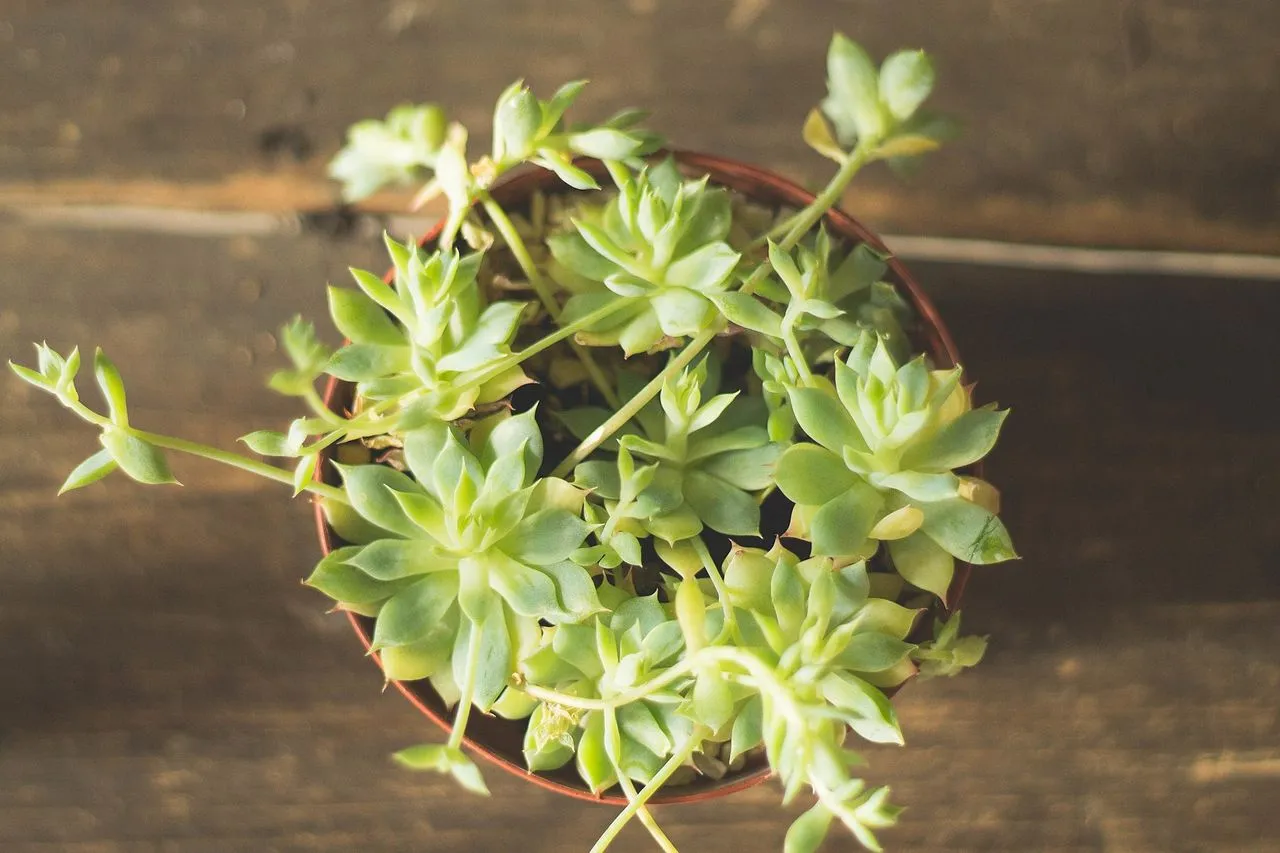
An etiolated sempervivum is a plant that has stretched vertically because it is not getting enough light. The tight symmetric rosette opens up, the internodes between leaves elongate, and new leaves emerge smaller and paler than the old ones. This is the second most common diagnostic confusion in the genus (the first being monocarpic flowering). This guide works through how to distinguish the two, whether recovery is possible, and what to do next.
Part of the Complete Sempervivum Guide.
Etiolation vs flowering
Both etiolation and monocarpic flowering cause the rosette to stretch upward. The mechanisms are different and the outcomes are different, so distinguishing them is essential before acting.
Etiolation. Light-driven. The apical meristem keeps producing normal-sized leaves, but the internodes (stem segments between leaves) lengthen. The result: a stretched rosette where individual leaves are still roughly the normal size and shape, but the stem between them is visible. Colour fades toward pale green and any red pigmentation disappears.
Flowering. Reproduction-driven. The apical meristem switches from making leaves to making a scape. The central leaves become progressively smaller, narrower, and more bract-like up the stem. A fleshy flower stalk develops, and eventually flower buds appear at the top. Red pigmentation may intensify during this phase.
The distinguishing sign is leaf size on the central stretched stem. Full-sized leaves on an elongated stem equals etiolation. Tiny narrow bract-like leaves on an elongated stem equals flowering.
If your plant is flowering, do not try to "fix" it. See why Sempervivum die for what is happening and what to do. The rest of this article addresses true etiolation.
Cause
Sempervivums need a minimum of 6 hours of direct unfiltered sunlight per day to keep a compact rosette. Anything less and the plant begins stretching. Common situations that produce etiolation:
- Indoor cultivation on a window sill. Even a south-facing window passes less than 50% of outdoor sunlight intensity, and filters most of the UV that drives pigmentation. Sempervivums are not houseplants.
- Outdoor planting in partial shade, or position that receives full sun only in mid-winter when the plant is dormant.
- A mature tree or shrub growing up over a formerly sunny planter.
- Dense overcrowding where neighbour rosettes shade the plant from the side.
Recovery
The critical point: stretched internodes do not un-stretch. Moving an etiolated plant back into full sun stops further stretching but does not restore the compact rosette that existed before. The tissue is what it is.
You have two options.
Option 1: Leave it alone
Move the plant into full sun and accept the stretched rosette. New leaves emerging from the top will come in tight and normal-sized. Over one or two seasons the plant will produce offsets on stolons from the base of the elongated stem, and each chick will be a properly compact new rosette. Within 2–3 years the visual mess resolves itself into a cluster of normal rosettes.
Option 2: Behead and re-root
The faster option. Use a clean sterile blade and cut the top of the rosette off the elongated stem, taking 1–2 cm of stem below the rosette. The parent stem, stripped of its top, will usually push out multiple new small rosettes along its length within a few weeks — a useful bonus.
Let the cut top callus in shade for 2–3 days, then place it on dry gritty substrate. Roots emerge from the cut stem within 2–4 weeks. Water lightly once visible roots appear. Establishment takes 3–4 weeks.
Do not plant the top directly into wet substrate. Sempervivum cuttings rot easily if the cut is not calloused.
Prevention
Move sempervivums outdoors as soon as the last frost passes. Any light-starvation damage during an indoor winter is preventable by shortening the indoor phase or by supplementing with a bright horticultural lamp (at least 10,000 lux at leaf level, 12 hours daily). Most indoor rooms are below 1,000 lux even in bright conditions.
If you cannot give a Sempervivum at least a sunny balcony through summer, do not keep the genus. There are tender succulents that genuinely thrive indoors; this is not one of them.
Notes
Etiolation is not permanent damage in the sense of killing the plant. An etiolated sempervivum is fully alive and capable of recovering to normal ornamental form given several years of better light. The damage is aesthetic and reversible at the colony level, not at the individual rosette level.
Do not confuse etiolation with simple winter dormancy. In cold months sempervivums pull their leaves tight inward and may look "shrunk" — this is a normal stress-protection response and is not the same as elongation.
See also
- Why is my Sempervivum dying? — the other main symptom-to-diagnosis guide.
- The Complete Sempervivum Guide — the full light, water, and position context.
- Sempervivum tectorum — the most light-tolerant species to restart with.
Frequently Asked Questions
Can an etiolated sempervivum shrink back to normal?
No. Stretched internodes do not un-stretch, but new growth and future offsets can be compact under full sun.
How do I tell etiolation from flowering?
Etiolation has full-sized leaves along an elongated stem. Flowering produces tiny narrow bract-like leaves and eventually flower buds.
How much light prevents sempervivum etiolation?
Sempervivums need at least 6 hours of direct unfiltered sunlight per day. Indoor windows usually filter too much intensity and UV.
How long does re-rooting a beheaded sempervivum take?
Roots emerge from the cut stem in 2–4 weeks after a 2–3 day dry callus period. Establishment usually takes 3–4 weeks.