| Question | Short Answer |
|---|---|
| What is the main identification point? | The Identification section separates Aloe bakeri by plant habit, leaf form, marginal teeth or surface markings, flowers, and lookalikes named in the article. |
| How should this aloe be watered? | Follow the Cultivation section rather than a fixed calendar. |
| How is it propagated? | Use the Propagation section. |
| What should buyers watch for? | Check the Notes and lookalike sections. |
Aloe bakeri Scott-Elliot (Baker's aloe) is a miniature aloe endemic to south-eastern Madagascar, where it grows on sandy soils in dry coastal scrub between sea level and 200 m elevation. Named for the British botanist John Gilbert Baker, who described many Madagascan plants in the late nineteenth century, the species has become a collector favourite for its compact habit and unusually elegant bicoloured flowers.
Part of the Complete Aloe Guide.
Identification
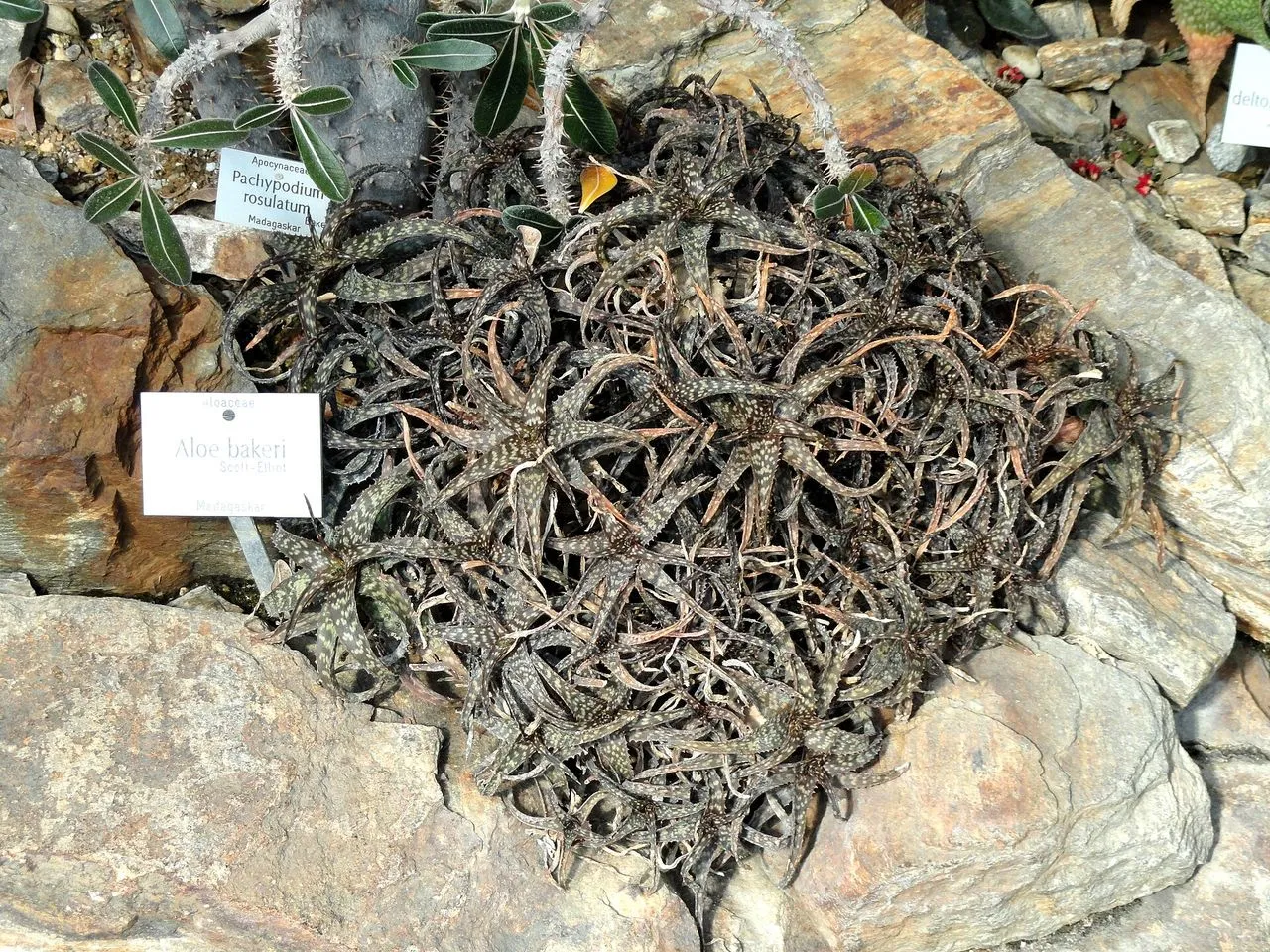
A small clump-forming aloe rarely exceeding 15 cm across in individual rosettes, though mature clumps spread to 30 cm or more. Rosettes carry 15 to 25 linear leaves 8 to 12 cm long and less than 1 cm wide, dark green flushing bronze to almost brown under sun and drought stress, with scattered small white spots along the surface. Leaf margins are lined with fine pale teeth. The narrow leaves and dense clumping habit give the plant a grass-like appearance that is unusual in the Madagascan aloes.
The inflorescence is diagnostic. A. bakeri produces a slender unbranched raceme 15 to 25 cm tall with small tubular flowers that are distinctly bicoloured: the lower two thirds are bright red, the distal third pale yellow, and the transition is sharp rather than graded. This bicolour pattern is shared with few other aloes and makes the species readily identifiable when in flower, typically in winter under cultivation.
Cultivation
A. bakeri diverges from the pillar's default in one important respect: it tolerates, and arguably prefers, more shade than most aloes. In habitat it grows under open scrub canopy and rarely receives direct midday sun. Under glass at temperate latitudes, filter the strongest hours or grow under 40% shade cloth; in unfiltered summer sun the leaves scorch and lose their bronze flush.
Substrate should be mineral-heavy but slightly more organic than for the harder Madagascan species, around 50% mineral and 50% loam-based compost. The species is shallow-rooted and benefits from wide shallow pans. Water moderately through the growing season (late spring through early autumn in northern-hemisphere cultivation) and reduce substantially through the cooler months. Unlike the harder Namibian aloes, A. bakeri dislikes going fully dry for extended periods; a light winter top-up every three to four weeks prevents root desiccation.
Minimum safe temperature is 8°C, and the species is reliably damaged below 5°C.
Propagation
Division of clumps is straightforward and the preferred route. Mature clumps produce abundant basal offsets with their own fibrous roots; separate individual rosettes at repotting, callus for two to three days, and pot into the mineral-organic mix. Offsets establish within three to four weeks.
Seed is viable between two genetically distinct plants and germinates readily on sterile mix, though seedlings are slow to reach flowering size, requiring four to five years.
Notes
A. bakeri is one of several Madagascan miniature aloes that entered wider cultivation through specialist collections in the mid-twentieth century, alongside Aloe descoingsii, Aloe parvula, and the hybrid A. 'Flamingo'. It hybridises readily with other miniatures, and material in trade under the name A. bakeri is sometimes a hybrid rather than the pure species; look for the sharply bicoloured flower and the relatively narrow leaves to confirm identity.
CITES Appendix II applies to this species along with other Madagascan aloes, so international trade requires export documentation. Reputable specialist nurseries propagate from division or seed; avoid any source claiming wild-collected origin, as habitat disturbance in south-eastern Madagascar is ongoing.
The species tolerates handling well and suits close-planted arrangements in shallow bowls alongside other miniature Madagascan aloes, provided the shade and temperature requirements are compatible.
See also
- Aloe albiflora
- Aloe albida
- Aloe argenticauda
- Aloe haworthioides — another small Madagascan aloe with frosted leaf surfaces, for comparison in collections.
Frequently Asked Questions
What is the main identification point?
The Identification section separates Aloe bakeri by plant habit, leaf form, marginal teeth or surface markings, flowers, and lookalikes named in the article.
How should this aloe be watered?
Follow the Cultivation section rather than a fixed calendar. The article gives drying depth, seasonal growth rhythm, and the wet-cold risk for this plant.
How is it propagated?
Use the Propagation section. The article states whether offsets, stem cuttings, or seed are practical, and notes that single-leaf cuttings do not work for aloes.
What should buyers watch for?
Check the Notes and lookalike sections. The article flags trade confusion, hybrid material, or conservation sourcing where those issues apply.