| Question | Short Answer |
|---|---|
| What is the main identification point? | The Identification section separates Aloe haworthioides by plant habit, leaf form, marginal teeth or surface markings, flowers, and lookalikes named in the article. |
| How should this aloe be watered? | Follow the Cultivation section rather than a fixed calendar. |
| How is it propagated? | Use the Propagation section. |
| What should buyers watch for? | Check the Notes and lookalike sections. |
Aloe haworthioides Baillon ex Baker, described in 1883 in the Journal of the Linnean Society, is one of the smallest aloes in cultivation. The French botanist Henri Baillon recognised the species in herbarium material from Madagascar, but it was John Gilbert Baker at Kew who formally published the name. The plant is endemic to the central highlands of Madagascar, growing on rocky outcrops between roughly 1,000 and 2,000 m, where it forms tight clumps of dense rosettes 5 to 8 cm tall. Narrow lance-shaped grey-green leaves carry abundant soft white hair-like marginal teeth and surface tubercles, the surface texture that gave the species its name and that marks it out instantly from its small-aloe neighbours.
Habitat is cool, rocky, and seasonally exposed. The Madagascan central highlands sit at 1,000 to 2,000 m on weathered granite and quartzite outcrops, with cooler nights and more reliable seasonal moisture than the dry Toliara plain that hosts A. rauhii further south. Rainfall is concentrated in a summer wet season from November to March, with a long cool dry winter from May to September; nighttime minima drop to 5 to 8 °C in winter, and strong sun alternates with frequent afternoon mist. A. haworthioides grows in shallow pockets of mineral substrate over rock, in light shade among grasses or in fully exposed cracks where root run is restricted. The species is included in CITES Appendix II along with all aloes other than A. vera, so international trade in cultivated material requires permits.
Part of the Complete Aloe Guide.
Identification
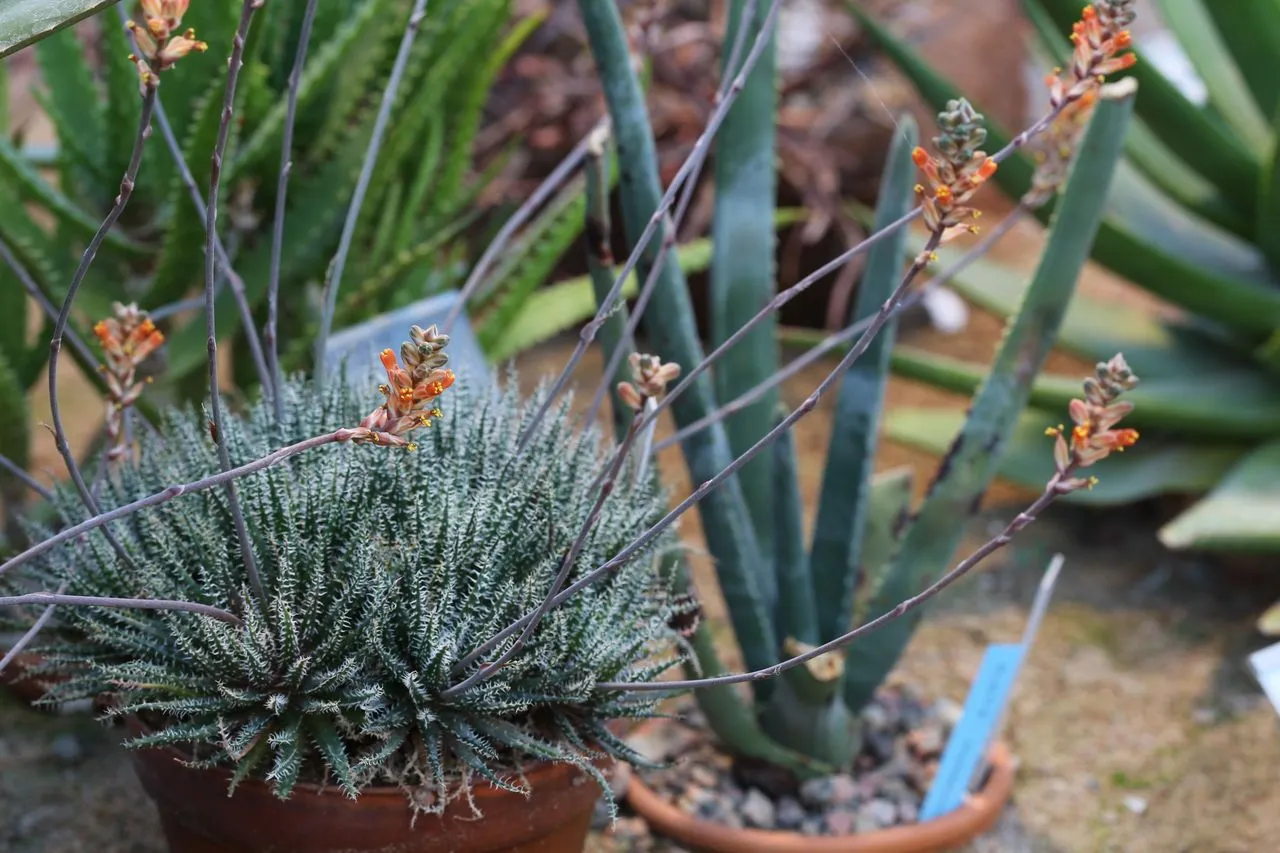
A. haworthioides is a true miniature. A solitary mature rosette rarely exceeds 5 to 8 cm tall and 4 to 6 cm across, with 30 to 50 narrow leaves stacked tightly in a flat-topped or slightly globose habit. Leaves are lance-shaped, 3 to 5 cm long and only 5 to 8 mm wide at the base, grey-green to olive-green, sometimes flushed paler under strong light. The diagnostic character is the marginal teeth: rather than the firm triangular teeth of most aloes, A. haworthioides carries fine, soft, almost hair-like teeth in dense fringes along both leaf margins. Run a finger along a leaf edge and the texture is filamentous rather than spiny. The leaf surface itself carries small raised white tubercles, denser and finer than those of A. rauhii, giving the leaf face a frosted look under a hand lens.
The species name reflects this surface character. To Baker and his contemporaries the dense fringes and tubercles were strongly reminiscent of the small Haworthia species circulating in nineteenth-century European collections, hence the epithet "haworthioides", literally "haworthia-like". The plant is nonetheless a true Aloe: each tubular flower carries nectar at the base of the perianth, the flowers are coral-pink in a simple raceme, and the inflorescence structure differs from anything in the Haworthia line of the family.
The species is a steady clumper. Numerous small offsets emerge directly from the parent rosette and root within weeks, building a tight cushion 6 to 12 cm across over 2 to 3 seasons. Inflorescences appear in spring, October to December in habitat (April to June in the northern hemisphere), as simple unbranched racemes 15 to 25 cm tall carrying coral-pink to salmon tubular flowers; the disproportion between the tiny rosette and the relatively tall raceme is striking on a flowering plant.
Three lookalikes recur in collections and in older literature.
Aloe rauhii, a Madagascan dwarf from the Toliara plain at 200 to 1,000 m, is larger overall (rosettes 8 to 12 cm tall) and its marginal teeth are firm and triangular rather than soft hair-like fringes. Surface tubercles on A. rauhii are also more discrete: individually visible beads against a green leaf face, where A. haworthioides tubercles are smaller and read as a continuous frost.
Aloe bakeri, another Madagascan dwarf from the Fort Dauphin region of the southeast, has narrower and longer leaves on a short but discernible stem rather than a ground-hugging rosette. The diagnostic difference is the surface pattern: A. bakeri leaves carry longitudinal pale and dark green striations rather than raised tubercles, and the marginal teeth are firm and triangular. If the leaf looks lined and feels smooth, it is A. bakeri; if it looks frosted and feels rough with hair-like edges, it is A. haworthioides.
Haworthiopsis species (the keeled-leaf segregate from Haworthia sensu stricto, including the former H. limifolia and H. attenuata) catch many beginners on first sight. Two genus-level characters settle the question. Haworthiopsis leaves are sharply keeled or three-ranked, never the simple lance-shaped form of small aloes; and Haworthiopsis flowers carry no nectar at the base of the perianth, with a slender wiry raceme of small white-and-green flowers very different from the coral-pink nectar-bearing tubular flowers of A. haworthioides.
Cultivation
A. haworthioides is one of the more challenging aloes for a beginner: small size and slow growth leave little margin for error, and a single bad winter can lose half a colony.
Light. Bright filtered light suits the species better than full noon sun. In habitat A. haworthioides grows in light shade among grasses and protected rock pockets; direct exposure to strong unfiltered summer light bleaches the leaf face and scorches the fine marginal teeth. A bright east-facing window or a south-facing window screened by sheer curtain is the working ideal indoors; under glass, 30 to 50 percent shade cloth from May to August keeps the rosette tight and the surface frosting visible. North of about 45° latitude a supplemental grow light prevents etiolation through dim months.
Water. Treat the species as a summer-rainfall grower with a long cool dry winter rest. In a 6 to 8 cm terracotta pot with a mineral mix, water deeply when the top 1 cm of substrate has fully dried, then drain freely. From late spring through early autumn that may mean every 7 to 10 days; through winter, water sparingly once every 4 to 6 weeks, enough to keep the smallest roots from desiccating. Wet roots at low temperatures are the dominant failure mode, and the small rosette has little reserve against rot at the leaf bases.
Substrate. A heavily mineral mix of about 75 percent inorganic to 25 percent organic suits A. haworthioides. A practical recipe is 50 percent pumice, 20 percent coarse perlite or lava grit at 2 to 4 mm, 5 percent quartz grit, and 25 percent sifted loam-based compost. The shallow rooting habit and small overall size mean a wide rather than deep pot, with a 1 cm mineral top dressing, keeps the leaf bases dry where new offsets emerge.
Temperature. Frost tolerance is limited. Keep the plant above about 3 °C and bone-dry through any cold spell; brief exposure to a degree or two cooler is tolerated by an established dry plant, but A. haworthioides is not frost-hardy in the way the South African Karoo aloes are. Wet cold below 5 °C damages tissue quickly. Above 35 °C in dry conditions the rosette closes inward and growth halts; recovery follows cooler nights.
Container. A wide shallow stoneware or terracotta pan suits the spreading clump better than an upright cylinder. A starter rosette fits a 6 cm pan; a settled colony of 10 to 20 rosettes wants 10 to 12 cm of width. Repot every 2 years and split the colony as offsets crowd the rim. Cultural baselines outlined in the beginner's guide apply, with the proviso that this species wants more shade, smaller pots, and warmer winter minima than most of its bench-mates.
Feeding is light. A quarter-strength balanced cactus fertiliser once or twice in the growing season is enough; heavier feeding produces softer leaves with reduced surface frosting.
Propagation
A. haworthioides propagates reliably from offsets, and division is by far the easiest route to new plants. Numerous small pups emerge from the parent rosette and root within 2 to 4 weeks of contact with mineral substrate. To divide a clump, lift the colony in early spring as growth resumes, tease the offsets apart with finger pressure or fine-pointed forceps (a knife is too coarse at this scale), let any cut surfaces callus for 2 to 3 days in dry shade, and pot the divisions individually into a sharply drained mineral mix. An 80 to 90 percent take rate is normal in a home setup with attentive watering.
Single-leaf cuttings do not work for this species. Seed is viable but slow, and given the hybridising tendency, seed from a mixed collection rarely comes true; hand-pollination between unrelated clones with the inflorescences bagged is the only route to reliably pure seed-grown plants. Fresh seed germinates at 20 to 25 °C on a sterile mineral surface with a thin grit dressing, starting within 3 to 5 weeks at a 40 to 60 percent rate, and seedlings reach division-sized rosettes only after 3 to 4 years.
Notes
Hybrid circulation in trade. A. haworthioides hybridises readily with A. rauhii, A. bakeri, and A. descoingsii, and a substantial proportion of nursery stock under the bare species name is in fact a hybrid. Pure plants stay under 8 cm, throw a single unbranched raceme, and grow at a measured pace; cultivars such as 'Donnie' flag mixed parentage rather than pure species material.
Pests. Mealybug occasionally hides between the densely packed leaves of an established colony, especially under glass with poor airflow. The small rosette size means a hand-lens check before winter is the most useful precaution; a colony missed for one month at this scale can take down half the plant. Any distorted cauliflower-like growth at a rosette centre points to aloe mite and the affected rosette should be destroyed away from the rest of the collection.
Conservation context. Wild populations on the Madagascan central highlands are scattered and locally vulnerable to habitat conversion and slash-and-burn agriculture, although the species is not formally Vulnerable on current IUCN assessments. Cultivated stock from offsets carries no conservation cost; field-collected material from Madagascar requires CITES paperwork and is best avoided in favour of nursery propagations.
See also
- The Complete Aloe Guide: genus-level cultivation principles and how the small Madagascan aloes fit alongside the larger South African species.
- Beginner's Guide to Succulents: light, water, and substrate fundamentals to settle before reading species-specific notes.
- Aloe rauhii — Madagascan dwarf with bead-like tubercles, compared in the identification section.
Frequently Asked Questions
What is the main identification point?
The Identification section separates Aloe haworthioides by plant habit, leaf form, marginal teeth or surface markings, flowers, and lookalikes named in the article.
How should this aloe be watered?
Follow the Cultivation section rather than a fixed calendar. The article gives drying depth, seasonal growth rhythm, and the wet-cold risk for this plant.
How is it propagated?
Use the Propagation section. The article states whether offsets, stem cuttings, or seed are practical, and notes that single-leaf cuttings do not work for aloes.
What should buyers watch for?
Check the Notes and lookalike sections. The article flags trade confusion, hybrid material, or conservation sourcing where those issues apply.