| Question | Short Answer |
|---|---|
| What is the main identification point? | The Identification section separates Aloe rauhii by plant habit, leaf form, marginal teeth or surface markings, flowers, and lookalikes named in the article. |
| How should this aloe be watered? | Follow the Cultivation section rather than a fixed calendar. |
| How is it propagated? | Use the Propagation section. |
| What should buyers watch for? | Check the Notes and lookalike sections. |
Aloe rauhii Reynolds, the snowflake aloe, was described in 1965 by the South African aloe specialist Gilbert Westacott Reynolds and named in honour of Werner Rauh, the Heidelberg-based cactus and succulent botanist whose Madagascan field collections supplied much of the type material for the dwarf aloes of the island. The species is a narrow-range endemic of southwestern Madagascar, restricted to the Toliara (Tuléar) region on dry deciduous bushveld between roughly 200 and 1,000 m. It is a true dwarf at 8 to 12 cm tall, with lance-shaped grey-green leaves carrying abundant raised white tubercles scattered across both surfaces, the surface pattern that earned the plant its common name.
Habitat is hot, dry, and seasonally extreme. The Toliara plain sits in the rain shadow of the Madagascan central highlands and receives most of its limited rainfall in a short summer wet season from December to March, with a long dry winter from April to November. A. rauhii grows on shallow, free-draining mineral substrates over limestone and sandstone, in light shade among low spiny scrub or in open rocky pockets. The species is assessed as Vulnerable on the IUCN Red List, primarily because of habitat loss to charcoal production and slash-and-burn agriculture across its small native range, with limited illegal collection adding pressure on accessible populations. CITES Appendix II covers all aloes (except A. vera), so international trade in cultivated material requires permits even where the plant itself is widely propagated.
Part of the Complete Aloe Guide.
Identification
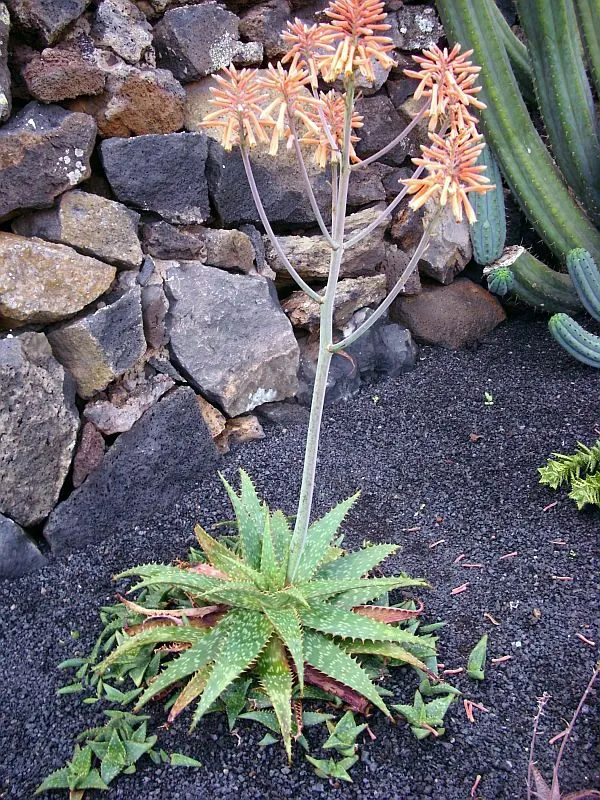
A. rauhii is small even by dwarf-aloe standards. A solitary mature rosette rarely exceeds 12 cm tall and 8 to 10 cm across, with 16 to 24 lance-shaped leaves stacked tightly in a low open rosette. Leaves are 5 to 8 cm long, grey-green to olive-green, sometimes flushed with red-brown along the margins under strong light. The leaf surface is the diagnostic feature: both faces carry numerous raised white tubercles, scattered fairly evenly but tending to align in irregular bands across the leaf face. Under a hand lens the tubercles look like small chalky beads sitting proud of the leaf cuticle, and the visual effect on a darker leaf is the snowfield-on-pasture pattern that gives the species its name. Marginal teeth are small, white, and triangular, set on a pale cartilaginous rim that runs the length of the leaf edge.
The species is a steady clumper. Basal offsets emerge from the parent rosette on short stolons and form a low cushion 15 to 25 cm across within a few seasons. Inflorescences appear in spring, October to December in habitat (the equivalent of April to June in the northern hemisphere), as simple unbranched racemes 20 to 30 cm tall carrying tubular coral-pink to red flowers. A branched panicle would point to a different aloe; A. rauhii raceme is always single.
Three close relatives recur in trade and in older literature, all small Madagascan or southern African dwarfs.
Aloe haworthioides is much smaller again, with mature rosettes rarely above 4 to 5 cm across, and its marginal teeth are fine, soft, and almost hair-like rather than the firm triangular teeth of A. rauhii. The tubercle pattern on A. haworthioides is denser and more uniform, giving the leaf surface a frosted appearance under a lens; A. rauhii tubercles are more scattered and read as discrete beads against bare green leaf.
Aloe bakeri is a similarly sized Madagascan dwarf from the Fort Dauphin region of the southeast. The two species are often confused at small size, but A. bakeri leaves are striated rather than tubercled, with longitudinal pale and dark green lines along the leaf face and no raised white markings. If the leaf surface feels smooth and looks lined, it is A. bakeri; if it feels rough and looks beaded, it is A. rauhii.
Aloe humilis is broader-leaved, larger overall (mature rosettes 10 to 15 cm tall and 10 to 12 cm across), and originates from the Karoo of South Africa, not Madagascar. Its leaves are strongly incurved with a thicker fleshy build, and although it also carries raised white tubercles, the tubercles are paired with a heavily toothed pale marginal rim that is far more prominent than the modest teeth of A. rauhii. Differences in leaf width and overall plant size separate the two on first sight in any reasonably mature specimen.
A practical complication: A. rauhii hybridises readily with other small aloes in cultivation, and a substantial proportion of nursery stock sold under the species name is in fact a hybrid. Hybrid plants tend to show denser surface tuberculation, faster growth, larger mature rosettes, or a branching inflorescence; pure A. rauhii stays compact, raises a single unbranched raceme, and grows at a measured pace. See the trade-circulation note below for cultivar names to watch for.
Cultivation
Light. Bright filtered light suits this species better than full noon sun. In habitat A. rauhii grows in light shade among low scrub, and direct exposure to strong unfiltered summer light will scorch the tubercles to brown and bleach the leaf face. A bright east-facing window or a south-facing window screened by sheer curtain is the working ideal indoors; under glass in a Mediterranean climate, dappled shade or 30 to 50 percent shade cloth from May to August keeps the rosette tight and the surface markings white. North of about 45° latitude a supplemental grow light through the dim months prevents the etiolation that opens the rosette and washes out the tubercle contrast.
Water. Treat the species as a summer-rainfall grower with a long dry winter rest. In a 10 cm terracotta pot with a mineral mix, water deeply when the top 2 cm of substrate has fully dried, then drain freely. From late spring through early autumn that may mean every 7 to 10 days; through winter, water sparingly once every 4 to 6 weeks, just enough to prevent the smallest roots from desiccating. The Madagascan dry-season dormancy is real, and a wet root mass at 10°C with stagnant air is the most common failure mode in temperate-glasshouse cultivation.
Substrate. A mineral-dominant mix of about 70 percent inorganic to 30 percent organic suits A. rauhii. A practical recipe is 40 percent pumice, 20 percent coarse perlite or lava grit at 3 to 6 mm, 10 percent quartz or limestone grit, and 30 percent sifted loam-based compost. The shallow rooting habit means a wide rather than deep pot, with a 1 to 2 cm mineral top dressing, keeps the leaf bases dry where new offsets emerge.
Temperature. Frost tolerance is limited. Aim to keep the plant above about 3°C dry; brief dips to a degree or two cooler are tolerated by an established, bone-dry plant, but A. rauhii is not frost-hardy in the way the South African Karoo aloes are. Wet cold below 5°C damages tissue quickly, and any winter cultivation in temperate climates needs glasshouse protection. Above 35°C in dry conditions the rosette closes and growth halts; the plant tolerates this for short periods but needs cooler nights to recover condition.
Container. A wide shallow stoneware or terracotta pan suits the spreading clump better than an upright cylinder. A starter rosette fits an 8 cm pan; an established colony of 6 to 10 rosettes wants 15 to 20 cm of width. Repot every 2 to 3 years into fresh mineral substrate and split the colony at the same time. Cultural baselines outlined in the beginner's guide apply directly, with the Madagascan twist that this species wants more shade and warmer winter minima than its South African bench-mates.
Feeding is light. A quarter-strength balanced cactus fertiliser once or twice in the active growing season is enough; heavier feeding produces softer leaves with reduced tuberculation.
Propagation
A. rauhii propagates reliably from offsets. Basal pups emerge from the parent rosette on short stolons and root within 2 to 4 weeks of contact with mineral substrate. To divide a clump, lift the colony in early spring as growth resumes, tease the offsets apart with finger pressure or a clean knife, let any cut surfaces callus for 3 to 5 days in dry shade, and pot the divisions individually into a sharply drained mineral mix. A 90 percent or higher take rate is normal in a home setup.
Single-leaf cuttings do not work for this species, as for the genus generally. Seed is viable but slow, and given the hybridising tendency, seed from a mixed collection is unlikely to come true. Hand-pollination between unrelated A. rauhii clones, with the inflorescences bagged to exclude bee visits to other aloes flowering at the same time, is the only way to raise reliably pure seed-grown plants. Fresh seed germinates at 22 to 26°C on a sterile mineral surface with a thin grit dressing; germination starts within 2 to 4 weeks at a 50 to 70 percent rate, and seedlings reach division-sized rosettes in about 2 to 3 years.
Notes
Hybrid circulation in trade. Cultivar names such as 'White Fox' and 'Snowflake' flag selected horticultural stock with mixed parentage, often involving A. haworthioides, A. bakeri, or A. descoingsii; plenty of unlabelled hybrids also circulate under the bare species name. For wild-type provenance, source from a specialist Madagascan-aloe grower or a recognised society sale.
Conservation context. The Vulnerable IUCN status reflects habitat loss across the Toliara region, where charcoal production and agricultural conversion have shrunk the dry-deciduous bushveld that A. rauhii depends on. Cultivated stock is far removed from wild populations and growing it from offsets carries no conservation cost, but any field-collected material from Madagascar requires CITES paperwork and is best avoided in favour of nursery propagations.
Pests. Mealybug occasionally hides between the lower leaves of an established colony, especially under glass with poor airflow. A hand-lens check before winter is the most useful precaution. Aloe mite is rarely reported on this species, but any distorted growth at the rosette centre should be removed and the affected plant destroyed away from the rest of the collection.
See also
- The Complete Aloe Guide: genus-level cultivation principles and how the small Madagascan aloes fit alongside the larger South African species.
- Beginner's Guide to Succulents: light, water, and substrate fundamentals to settle before reading species-specific notes.
- Aloe haworthioides — Madagascan dwarf with hair-like marginal teeth, compared in the identification section.
Frequently Asked Questions
What is the main identification point?
The Identification section separates Aloe rauhii by plant habit, leaf form, marginal teeth or surface markings, flowers, and lookalikes named in the article.
How should this aloe be watered?
Follow the Cultivation section rather than a fixed calendar. The article gives drying depth, seasonal growth rhythm, and the wet-cold risk for this plant.
How is it propagated?
Use the Propagation section. The article states whether offsets, stem cuttings, or seed are practical, and notes that single-leaf cuttings do not work for aloes.
What should buyers watch for?
Check the Notes and lookalike sections. The article flags trade confusion, hybrid material, or conservation sourcing where those issues apply.