| Question | Short Answer |
|---|---|
| What is the main identification point? | The Identification section separates Aloe deltoideodonta by plant habit, leaf form, marginal teeth or surface markings, flowers, and lookalikes named in the article. |
| How should this aloe be watered? | Follow the Cultivation section rather than a fixed calendar. |
| How is it propagated? | Use the Propagation section. |
| What should buyers watch for? | Check the Notes and lookalike sections. |
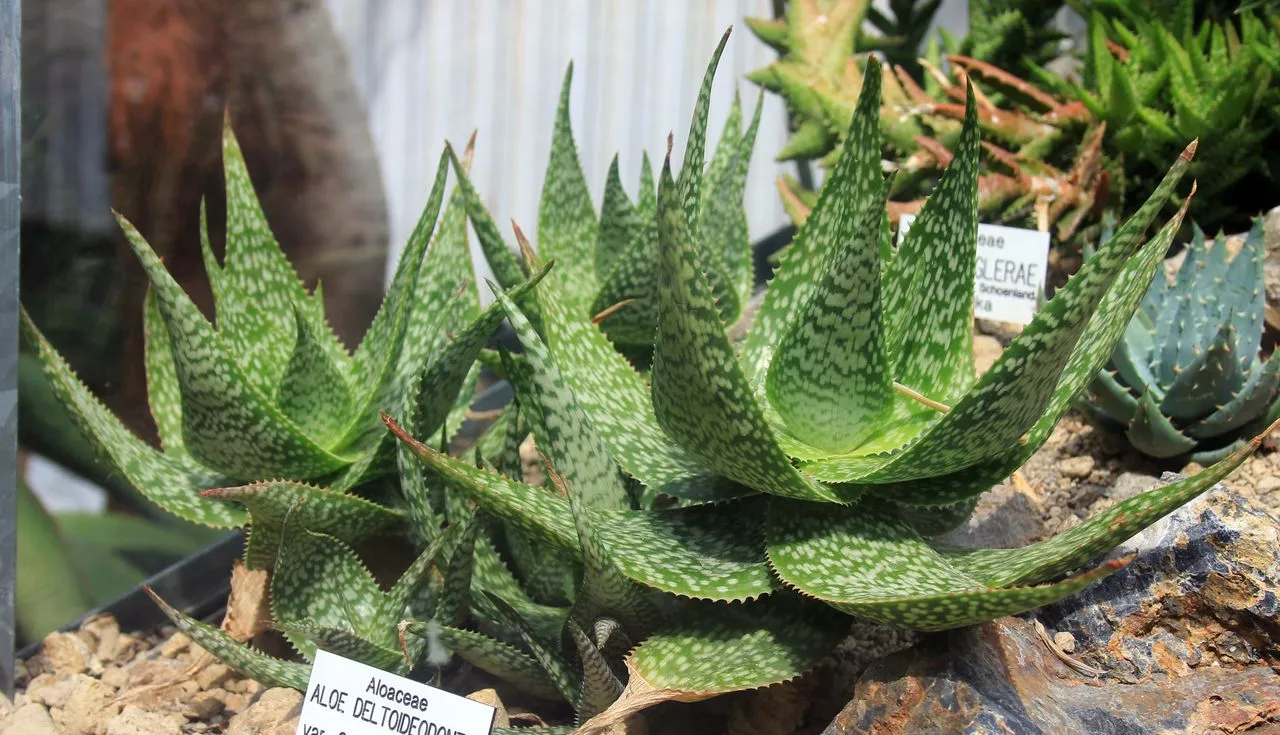
Aloe deltoideodonta Baillon ex Baker, published in 1883 by John Gilbert Baker at Kew on herbarium material from the French botanist Henri Baillon, is a stemless rosette aloe endemic to southern Madagascar. The type locality lies in the Toliara province on weathered granite and gneiss outcrops between roughly 100 and 1,000 m, where the species forms solitary or sparingly clumping rosettes 30 to 50 cm wide. The defining character is announced in the epithet itself: deltoideodonta means "triangle-toothed", and the broad blue-green to grey-green leaves carry strikingly large, blunt, white-cream triangular marginal teeth that read clearly across a metre of bench space.
The habitat is hot, seasonally dry, and exposed. The rocky outcrops of southern Toliara sit on shallow mineral substrate over crystalline rock, with surface temperatures climbing past 38 °C in the late dry season and nighttime minima around 8 to 12 °C in winter. Rainfall is concentrated in a short summer wet season from December to March, with an eight-month dry winter from April to November. A. deltoideodonta anchors into rock cracks and shallow pockets where root run is restricted and standing water is impossible. The Malagasy common name Vahombe translates roughly as "large aloe" and is applied locally to several aloe species of similar overall stature, so the name is no substitute for the Latin binomial when ordering nursery stock. Like all aloes other than A. vera, the species sits on CITES Appendix II, and cross-border trade in cultivated material requires permits; nursery-grown stock from European and South African specialist growers is now widely available.
Part of the Complete Aloe Guide.
Identification
A mature A. deltoideodonta is a stemless to very short-stemmed rosette 30 to 50 cm across, with 16 to 24 broad triangular leaves arranged in an open vase. Leaves run 20 to 30 cm long and 6 to 9 cm wide at the base, deltoid in outline (broadest near the insertion, tapering to a fine point), with a smooth concave upper surface and a flat to slightly convex underside. The leaf colour shifts with light: shaded plants hold a clean blue-green; full-sun plants flush grey-green to greyish-pink at the tips, sometimes with a slight purple bloom in winter cold.
The diagnostic field character is the marginal teeth. They are large, broad, firmly triangular, white to cream, set 8 to 14 mm apart along the leaf margin, and visible to the naked eye from across a greenhouse. The teeth sit hard and bone-coloured, contrasting sharply against the blue-green leaf face. A finger run along the margin meets a row of distinct points rather than the soft fringe of the small Aloe haworthioides or the fine close-set teeth of many South African dwarfs. Tooth size diminishes slightly toward the leaf tip and is most pronounced in the basal third of the leaf.
The species shows enough morphological scatter across its Toliara range that several local forms have circulated as botanical varieties:
- var. brevifolia carries shorter, denser leaves on a more compact rosette, often only 25 to 35 cm across, and is the form most often labelled "A. deltoideodonta" in European trade.
- var. candicans is paler and greener with more pronounced white margins, the marginal teeth running close to ivory and the leaf face flushing white-green under strong light.
- var. fallax is an intermediate, with leaf length toward the longer end of the species range and teeth slightly less prominent than in the type.
Modern taxonomic treatments fold these into the species under a single name, but the form labels persist in nursery catalogues, and a collector should expect this variation rather than a fixed phenotype.
Inflorescences appear in spring, October to December in habitat or April to June in the northern hemisphere, as simple unbranched racemes 60 to 90 cm tall carrying coral-orange tubular flowers in a dense terminal cluster. The peduncle rises stiffly above the rosette and the flower colour holds for two to three weeks.
Three lookalikes recur in collections.
Aloe albiflora, from the Toliara coastal plain, is markedly smaller (rosettes 8 to 12 cm wide), forms tight clumps of grass-like leaves, and carries pure white flowers on a short slender raceme. Flower colour alone is diagnostic: any white-flowered Madagascan aloe is A. albiflora, not A. deltoideodonta.
Aloe bakeri, from the Fort Dauphin region of southeast Madagascar, is a much smaller species with short, dense, longitudinally striated leaves on a discernible short stem rather than the open broad-leaved ground-hugging rosette of A. deltoideodonta. The leaves of A. bakeri feel smooth and carry pale and dark green stripes; A. deltoideodonta leaves are unstriped and carry the diagnostic large white teeth.
Aloe divaricata is closer in overall scale but spreads its leaves outward and downward in a far more divaricate habit, with smaller and more closely set marginal teeth and a branched rather than simple inflorescence. If the rosette opens flat or droops at the tips and the flower spike forks, the plant is A. divaricata; the upright vase and unbranched raceme of A. deltoideodonta settle the question.
Cultivation
A. deltoideodonta is one of the more forgiving mid-sized Madagascan aloes for a temperate-climate grower with frost-free winter shelter.
Light. Full sun for at least 5 to 6 hours a day suits the species, with a south or south-west exposure under glass or a brightly lit south-facing window indoors. Pale candicans-type forms tolerate slightly more sun than the bluer typical form before showing leaf-tip stress. Plants held in continuous low light keep flatter, greener leaves and the marginal teeth lose contrast; a summer outside in a sheltered courtyard restores both.
Water. Treat the species as a summer-rainfall grower with a long winter dry rest. From late spring through early autumn, water deeply when the top 3 cm of substrate has dried, then drain freely; that may mean every 10 to 14 days for a 25 cm pot in warm growing weather. From mid-autumn cut watering back sharply, and through winter give only one light watering every 6 to 8 weeks, enough to prevent fine-root desiccation. Wet roots below 8 °C are the main failure mode in cool greenhouses.
Substrate. A heavily mineral mix of about 70 percent inorganic to 30 percent organic suits the species. A working recipe is 40 percent pumice, 20 percent coarse perlite or lava grit at 3 to 6 mm, 10 percent quartz grit, and 30 percent sifted loam-based compost. A 1 to 2 cm mineral top dressing keeps the leaf bases dry and discourages mealybug.
Temperature. Frost limit is around 3 °C with the substrate fully dry; brief exposure to a degree or two cooler is tolerated by an established dry plant, but A. deltoideodonta is not frost-hardy in any useful sense. A wet plant at 5 °C rots quickly. Above 38 °C in dry conditions the rosette closes inward and growth halts; recovery follows cooler nights and a deep watering.
Container. A sturdy terracotta or glazed stoneware pot 20 to 30 cm wide suits a mature rosette, with proportional depth (the species roots deeper than the smaller Madagascan dwarfs). Repot every 3 to 4 years in early spring as the rootball fills the pot. The cultural baselines of the beginner's guide apply, with the proviso that this species wants more sun and a shorter, drier winter than most of the South African aloes on the same bench.
Feeding is light: a quarter-strength balanced cactus fertiliser once or twice in the growing season is enough.
Propagation
A. deltoideodonta propagates from offsets and from seed, with offsets the more reliable route in cultivation.
A settled plant produces basal offsets sparingly, typically one or two per season once the rosette reaches 20 cm or more across. Lift the parent in early spring as growth resumes, separate offsets with a clean knife where they branch from the parent rootstock, callus the cut surfaces 4 to 7 days in dry shade, and pot into the same mineral mix as the parent. An 80 to 90 percent take rate is normal at 22 to 26 °C with restrained watering for the first three weeks. Single-leaf cuttings do not root for this species.
Seed is viable and germinates readily, but the species hybridises freely with other Madagascan aloes in mixed collections and seed from open-pollinated plants rarely comes true to type. Hand-pollination between unrelated clones with the inflorescences bagged is the only route to reliably pure species seed. Fresh seed germinates at 22 to 26 °C on a sterile mineral surface in 2 to 4 weeks at a 50 to 70 percent rate, and seedlings reach a marketable 8 to 10 cm rosette only after 3 to 4 years.
Notes
Varietal labelling. Stock sold under the bare species name in European trade is most often var. brevifolia; the longer-leaved typical form and the paler var. candicans require seeking out specialist Madagascan-aloe nurseries. A collector who wants a specific phenotype should ask for the form name rather than trusting that "A. deltoideodonta" denotes a fixed appearance.
Pests. Mealybug occasionally hides between the leaf bases, especially under glass with poor airflow; the broad open rosette makes inspection straightforward and a quarterly hand-lens check is enough. Aloe mite damage, which deforms growing points into cauliflower-like masses, affects this species occasionally and any affected rosette should be destroyed away from the rest of the collection.
Conservation context. Wild populations on the Toliara outcrops are scattered and locally affected by habitat conversion and charcoal production, although the species is not currently formally Vulnerable on IUCN assessments. CITES Appendix II covers all aloes other than A. vera, so cross-border movement requires paperwork. Nursery-grown stock from offsets carries no conservation cost; field-collected material is best avoided.
See also
- The Complete Aloe Guide: genus-level cultivation principles and how the broad-leaved Madagascan aloes fit alongside their South African and Arabian relatives.
- Beginner's Guide to Succulents: light, water, and substrate fundamentals to settle before reading species-specific notes.
- Aloe bakeri — smaller Madagascan species compared in the identification section.
Aloe deltoideodonta care essentials
Give Aloe deltoideodonta bright light, fast-draining mineral soil, and a pot with a drainage hole. Water deeply only when the mix has dried, then let extra water leave the pot instead of sitting around the roots.
Common stress signs
Stretching, pale growth, or leaning usually points to insufficient light. Soft, translucent, or collapsing leaves point more toward overwatering or cold wet soil, so pause watering and check the roots before the problem spreads.
FAQ: can Aloe deltoideodonta take direct sun?
It can handle some direct sun when acclimated, but sudden harsh afternoon sun may scorch leaves. Increase light gradually, especially for plants grown indoors, recently shipped, or moved from shade.
Frequently Asked Questions
What is the main identification point?
The Identification section separates Aloe deltoideodonta by plant habit, leaf form, marginal teeth or surface markings, flowers, and lookalikes named in the article.
How should this aloe be watered?
Follow the Cultivation section rather than a fixed calendar. The article gives drying depth, seasonal growth rhythm, and the wet-cold risk for this plant.
How is it propagated?
Use the Propagation section. The article states whether offsets, stem cuttings, or seed are practical, and notes that single-leaf cuttings do not work for aloes.
What should buyers watch for?
Check the Notes and lookalike sections. The article flags trade confusion, hybrid material, or conservation sourcing where those issues apply.