| Question | Short Answer |
|---|---|
| What is the main identification point? | The Identification section separates Aloidendron dichotomum by plant habit, leaf form, marginal teeth or surface markings, flowers, and lookalikes named in the article. |
| How should this aloe be watered? | Follow the Cultivation section rather than a fixed calendar. |
| How is it propagated? | Use the Propagation section. |
| What should buyers watch for? | Check the Notes and lookalike sections. |
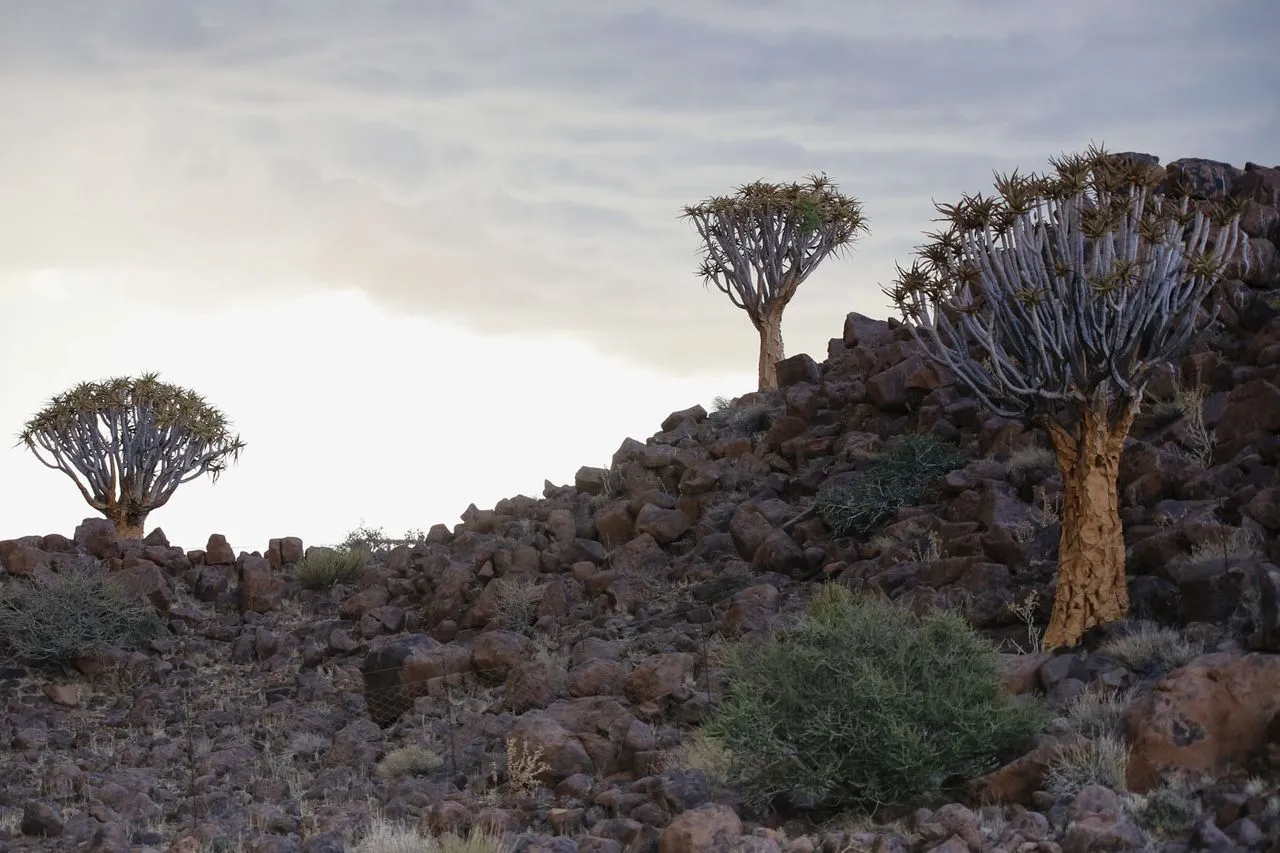
Aloidendron dichotomum, the quiver tree, is the South African and Namibian tree aloe long grown and labelled as Aloe dichotoma Thunb., a name published by Carl Peter Thunberg in 1786. Klopper and Gideon F. Smith transferred it to Aloidendron in 2013 when the large tree aloes were segregated from narrow Aloe. It is native to the Northern Cape of South Africa and southern Namibia, mostly on quartzite and dolerite slopes at 200 to 1,400 m, and it is recognised by a stout trunk, repeated Y-fork branching, smooth golden-yellow bark that flakes in plates, and terminal rosettes of narrow blue-green leaves.
In habitat, A. dichotomum stands in open, stony country with high light, low rainfall, and a wide daily temperature swing. The roots anchor into mineral seams and fractured rock, not into a rich garden loam. Mature trees can reach 7 to 9 m, but that scale hides how slowly the plant builds itself. Seedlings may add only 1 to 3 cm per year, and juveniles often manage 5 to 10 cm per year under good cultivation. The IUCN Red List treats the species as Vulnerable, with a well-documented climate-driven range shift: northern populations are declining while recruitment has been recorded farther south. It is also protected under CITES Appendix II, so a plant with no provenance is not a bargain. It is a conservation risk.
Part of the Complete Aloe Guide.
Identification
The name "quiver tree" comes from the San and !Kung practice of hollowing out dead branches to make quivers for arrows. That cultural history is attached to mature trees, not to the slow potted seedlings usually seen in collections. A young plant can look like an ordinary narrow-leaved aloe for years before it begins to show height, bark, or a divided crown.
The trunk is the feature to learn on older plants. It is pale yellow to golden, smooth from a distance, and divided into thin plate-like flakes that reflect strong sun. This reflective bark is not decorative excess; it reduces stem heat in exposed desert light. Branching is dichotomous, meaning a growing point divides into two similar arms. After repeated divisions, an old tree forms a clean, forked silhouette rather than a congested shrub.
Each branch tip carries a rosette of firm, narrow, grey-green to blue-green leaves. The leaves are usually held upright to slightly spreading, with small marginal teeth and a dry terminal point. They are not arranged in a flat fan. That separates A. dichotomum from Kumara plicatilis, still often sold under the older name Aloe plicatilis. K. plicatilis carries strap-shaped leaves in two opposing ranks, like an opened hand fan, while A. dichotomum keeps radial rosettes at the branch tips.
The other common confusion is Aloidendron ramosissimum, usually seen in older books and labels as Aloe ramosissima. It is smaller, more shrub-like, and more densely multi-branched from low on the plant. Some treatments have lumped it as a subspecies or close variant of A. dichotomum, but in cultivation the habit is a useful separator: A. ramosissimum reads as a many-stemmed shrub, while A. dichotomum eventually reads as a tree with a trunk and high Y-forks.
Flowering occurs in winter in southern Africa, often June to July. Mature branch tips produce upright racemes of yellow tubular flowers. Potted plants flower rarely unless they are old, strongly lit, and seasonally grown. A 20 cm seedling that has never flowered is normal. A specimen bought for quick winter bloom will disappoint you.
Cultivation
Light. Give direct sun, not filtered houseplant brightness. Outdoors in a dry climate, full sun is appropriate once the plant has been acclimated. In a greenhouse, use maximum light with aggressive ventilation so leaf and bark temperatures do not build under glass. Indoors, a south-facing window or a strong grow light is a minimum for seedlings; a dim shelf produces soft, stretched growth that cannot mature into the correct form. If you are still learning succulent light and watering basics, the general failure patterns in the beginner's guide apply here, but this species has far less tolerance for a damp organic root ball.
Water. Treat water as a seasonal tool, not as a weekly habit. During active warm growth, water thoroughly only after the entire pot has dried, then let the mix drain at once. In a 10 to 12 cm terracotta pot with a mineral substrate, a seedling may need water every 10 to 20 days in bright summer conditions. In a larger pot or during cool weather, the interval can be much longer. The useful cue is not the calendar; it is a dry pot, firm leaves, and warm enough nights for roots to function.
Winter is where many cultivated quiver trees are lost. Keep the plant completely dry through cold winter periods, especially if nights fall below 7°C. A. dichotomum can tolerate light frost to about -3°C when bone-dry, but the same temperature with moisture around the roots or crown is much more dangerous. Brief dry frost may mark leaf tips. Wet cold can collapse the stem base.
Substrate. Use a mineral mix above 80 percent mineral by volume. A practical recipe is 45 percent pumice, 25 percent lava grit or expanded shale, 15 percent coarse quartz or granite grit at 3 to 8 mm, 10 percent coarse sand, and no more than 5 percent sifted loam or mature compost. The small organic fraction is there to hold a little nutrient, not to keep the root zone damp. If water does not pass through the pot within seconds, the mix is too fine.
Container. Use terracotta only for ordinary collection plants. Plastic keeps the root ball wet for too long, especially in winter, and glazed ceramic removes much of the drying advantage. Start seedlings in narrow 7 to 9 cm terracotta pots, then move up one size only when roots bind the mineral mix. Overpotting a 5 cm plant into a deep decorative container is a common way to kill it. Set the stem base slightly above the grit top-dressing so water cannot sit against the neck.
Temperature. Warm days and cool nights suit the species. It does not need tropical heat. Growth is slow but steady when days are bright and nights are mild, roughly 10 to 25°C. In summer heat above 35°C, provide airflow and avoid watering late in the day if the pot is still hot. In winter, combine cold with dryness. The frost figure, about -3°C for a dry established plant, should be read as a short exposure tolerance, not as permission to leave potted seedlings in freezing rain.
Feeding should be lean. Use a low-nitrogen cactus fertiliser at one-quarter strength once in late spring, or not at all if you repot every few years into a fresh mineral mix with a small loam fraction. Fast, soft growth is a liability in this species because the stem must harden slowly.
Propagation
Seed is the normal and ethical method. Buy seed or seedlings from cultivated parent plants, with documentation when plants cross borders. CITES Appendix II allows regulated trade, but it does not make field collection acceptable. Never buy an old, bare-rooted quiver tree described as "collected" or "habitat specimen." A mature plant represents decades of growth, and removal usually destroys both the individual and local recruitment structure.
Fresh seed germinates best in a sterile mineral surface mix at 20 to 24°C, with bright shade and moving air. Sow on the surface, cover with 1 to 2 mm of fine grit, and keep the medium lightly moist until germination. Seedlings often appear in 2 to 6 weeks. Once the first leaves stand upright, reduce humidity gradually and shift toward the dry-wet rhythm used for adults, but at smaller intervals because tiny pots dry quickly.
First-year losses are usually from stale humidity or cold damp conditions, not from drought. A cautious target is 50 to 70 percent survival from fresh seed in a home collection. Growth then becomes slow. A seedling may still be under 5 cm after two years, and a recognisable juvenile stem can take many more. The distinctive tree form is a 30 to 50 year project, not a short-term display.
Cuttings are rarely a good route. Branch cuttings from old plants can root under specialist conditions, but taking them damages the form and invites rot at the wound. Leaf cuttings do not work. Offsets are not a normal feature of the species.
Notes
Taxonomy on labels. Many gardens, nurseries, and older books still use Aloe dichotoma. That label usually indicates the same plant under the older broad Aloe concept, not a different species. Current taxonomy places it in Aloidendron, the tree aloe segregate genus, so a careful label may read Aloidendron dichotomum, syn. Aloe dichotoma. Both names remain understandable in horticultural use, but Aloidendron is the current placement.
Conservation and climate. The Vulnerable status is not only a collecting problem. Long-term monitoring has shown poor recruitment and mortality in hotter northern parts of the range, alongside better recruitment farther south. That is one reason cultivated seed-grown plants matter. They reduce pressure on wild populations and preserve genetic material without removing old trees from quartzite and dolerite slopes.
Pests. Scale insects can settle on young stems, and mealybug may hide at the leaf bases of seedlings kept too protected. Treat early with physical removal and improved airflow. Avoid oil sprays in full sun, since the leaves and pale bark can mark badly under intense light.
Collection value. A. dichotomum is best understood as a long-term collection plant. If you want a fast architectural aloe, choose another species. If you can provide sun, terracotta, a mineral substrate, dry winters, and patience measured in decades, the plant becomes more interesting each year.
See also
- The Complete Aloe Guide: taxonomy, cultivation ranges, and how tree aloes fit beside ordinary rosette aloes.
- Beginner's Guide to Succulents: watering, light, and substrate habits to master before attempting slow arid tree aloes.
- Aloe plicatilis — fan aloe: another slow-growing tree-aloe with unusual branching form, for comparison.
Frequently Asked Questions
What is the main identification point?
The Identification section separates Aloidendron dichotomum by plant habit, leaf form, marginal teeth or surface markings, flowers, and lookalikes named in the article.
How should this aloe be watered?
Follow the Cultivation section rather than a fixed calendar. The article gives drying depth, seasonal growth rhythm, and the wet-cold risk for this plant.
How is it propagated?
Use the Propagation section. The article states whether offsets, stem cuttings, or seed are practical, and notes that single-leaf cuttings do not work for aloes.
What should buyers watch for?
Check the Notes and lookalike sections. The article flags trade confusion, hybrid material, or conservation sourcing where those issues apply.