| Question | Short Answer |
|---|---|
| What is the main identification point? | The Identification section separates Kumara plicatilis by plant habit, leaf form, marginal teeth or surface markings, flowers, and lookalikes named in the article. |
| How should this aloe be watered? | Follow the Cultivation section rather than a fixed calendar. |
| How is it propagated? | Use the Propagation section. |
| What should buyers watch for? | Check the Notes and lookalike sections. |
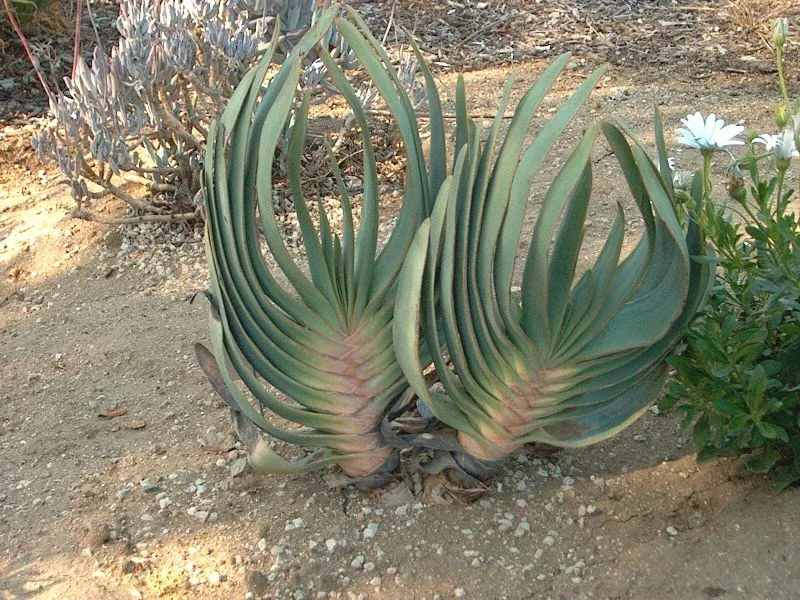
Kumara plicatilis, the fan aloe, is the Western Cape tree succulent long known in cultivation as Aloe plicatilis Burm.f., a name published in the 18th century and still common on nursery labels. The reinstatement of Kumara Medik. followed the phylogenetic work of Grace and colleagues in 2013, with the fan aloes treated outside narrow Aloe from 2014 onward. It is a fynbos endemic of South Africa's Western Cape mountains, usually on rocky sandstone slopes from roughly 150 to 1,000 m, and it is diagnosed at a glance by strap-shaped grey-green leaves held in two opposing rows like open fans, not in a circular rosette.
In habitat, this is not a desert aloe. It grows in Mediterranean-climate fynbos, where winters are cool and wet, summers are dry, and fire, wind, and shallow acidic sandstone soils shape the vegetation. Old plants form woody, dichotomously branching trunks and can reach 3 to 5 m in sheltered ravines or on south-facing slopes. The lower leaves dry and persist as a brown skirt beneath the active fans, reducing sun exposure on young stems and giving mature plants a shaggy outline. Wild populations are local rather than broad-ranging, and habitat loss, inappropriate fire intervals, and illegal collecting all matter more than casual garden pruning.
Part of the Complete Aloe Guide.
Identification
The leaf arrangement is the point to learn first. Each branch tip carries a flattened fan of 10 to 16 leaves, arranged distichously in two opposing ranks. Look down onto the growing point and you will not see the spiral rosette pattern of Aloe arborescens, Aloe ferox, or most other cultivated aloes. You see a left-right stack, like pages opened around a hinge. That single feature separates K. plicatilis from almost every ordinary aloe on a sales bench.
Leaves are strap-shaped, smooth, and grey-green to blue-green, usually 20 to 30 cm long on cultivated plants and broader on old garden specimens. The margins are either toothless or carry only tiny cartilaginous teeth near the tip, so the plant lacks the prickly outline people expect from the genus Aloe. The leaf ends are rounded or slightly blunt, often with a faint reddish margin in strong light. Young plants may look like a single fan for years before the stem begins to branch.
The trunk becomes woody with age. Branching is dichotomous, meaning a growing point divides into two, then those branches can divide again. A mature plant therefore develops a candelabra-like crown of repeated fans rather than a mass of offsets from the base. In a pot, expect a slow 60 to 120 cm specimen after many years. In a mild coastal garden with winter rain and dry summer air, old plants can become small trees.
Flowering occurs in winter, usually from late winter into early spring in Mediterranean climates. Each fan can send up an unbranched raceme carrying tubular salmon-red to coral-red flowers. The inflorescence is less massive than the branching flower spikes of many tree aloes, but it is cleanly displayed above the fan and is useful for confirming identity. The flowers are built for bird pollination, with narrow tubes and strong colour rather than scent.
The closest confusion in older horticultural writing is not a lookalike leaf form but a name problem. Many plants are still sold as Aloe plicatilis. That is the same species under the older broad-aloe treatment, not a separate plant. Kumara haemanthifolia, the other species in the genus, also has distichous leaves, but it is a much smaller stemless plant from high sandstone seeps, with broader, softer leaves and no tree-forming habit.
Cultivation
Light. Give high light without trapping the plant in summer heat. Outdoors in a coastal Mediterranean climate, full sun is suitable if the roots stay cool and the plant is not wedged against a south-facing wall. In hotter inland gardens, morning sun and bright afternoon shade keep the fans firm without bleaching the leaf edges. Indoors, a south-east or unobstructed east window is the safer choice; a hot west window can push the leaf temperature above 35°C even when the room feels moderate.
Water. Match the Western Cape rhythm. Active root growth is strongest in cool weather, especially from autumn through spring when nights are below about 16°C and days sit near 12 to 22°C. In a 20 cm terracotta pot, water thoroughly when the top 4 cm of substrate is dry and the lower mix is only faintly damp. In winter growth this may be every 10 to 18 days. In summer, reduce sharply. If the plant is not extending leaves and nights remain above 20°C, a light drink every 4 to 6 weeks is safer than routine weekly watering.
This reversal catches growers who treat it like a summer-growing aloe. Warm wet roots during summer dormancy are the common failure. A thirsty plant in summer will show slight leaf folding and firmer colour, but a rotting plant loses leaf tension from the base upward and may smell sour at the crown. When in doubt during heat, withhold water until the evening temperatures fall.
Substrate. Use a mineral, acidic to neutral mix that drains fast but does not become dust-dry within hours. A practical container recipe is 50% pumice or lava grit, 20% coarse quartz or granite grit at 3 to 6 mm, 20% loam-based compost, and 10% coarse sand. Avoid peat-heavy cactus compost, which shrinks away from the pot wall when dry and then stays wet in a central plug after watering. For the drainage physics behind this, see Succulent Soil & Substrate.
Temperature. Established, dry plants tolerate brief cold to about -4°C (25°F), and light frost often causes only reddened tips if the substrate is dry. Wet cold is more dangerous than dry cold. Protect potted plants from prolonged rain if temperatures sit near freezing for several nights. Heat is the quieter stress: repeated days above 32°C with warm nights can stall roots and make the lower leaves drop earlier than normal.
Container. Choose a deep, heavy terracotta or stoneware pot once the trunk begins to rise. A young fan can start in a 10 to 12 cm pot, but a branching plant needs root stability more than extra compost. Move from 15 cm to 20 cm, then to 25 cm only when roots hold the mix together. Overpotting into a large wet tub slows growth and invites basal rot. Set the trunk base slightly above the mineral top-dressing so the old leaf skirt stays dry.
Feeding should be modest. Use a low-nitrogen succulent fertiliser at quarter strength once in autumn and once in late winter. Heavy nitrogen produces soft elongated leaves that tear in wind and lose the tight fan. If your plant is outdoors in lean mineral soil, a thin annual dressing of composted bark fines around, not against, the trunk is usually enough.
Propagation
Seed is the cleanest method for maintaining normal form. Fresh seed germinates in 2 to 5 weeks at 18 to 22°C on a sterile mineral mix, lightly covered with 2 mm of grit. Keep the pot evenly moist in bright shade until the first true leaves stand upright, then increase airflow. Seedlings often make a simple two-ranked fan from the beginning, but trunking and branching are slow. A 5 cm seedling may need three to five years before it looks like a miniature tree.
Cuttings are possible but slower and less forgiving than with Aloe arborescens. Take only firm branch tips with several leaves and a short woody stem section, preferably in late spring after active winter growth. Let the cut dry in shade for 10 to 14 days, then set it upright in nearly dry pumice-rich mix. Roots may appear in 6 to 12 weeks at 18 to 24°C. Do not seal the cutting in a humid propagator; stagnant moisture around the leaf bases is exactly what the species dislikes.
Offsets are not a normal propagation route because the plant branches above ground rather than pupping freely from the base. Leaf cuttings do not work. Like other aloes and aloe relatives, a detached leaf lacks the axillary bud needed to form a new shoot.
If you hand-pollinate two unrelated plants, wait until the capsules are dry and beginning to split before collecting seed. Sow promptly. Old seed can still germinate, but rates fall quickly if it has been stored warm. In a home collection, 50 to 70 percent germination from fresh seed is a good result; the harder part is keeping seedlings cool and bright through their first summer dormancy.
Notes
Taxonomy on labels. A label reading Aloe plicatilis is not a red flag by itself. Many specialist nurseries keep the older name because collectors know it. The useful label gives both names, for example Kumara plicatilis syn. Aloe plicatilis, and states whether the plant is seed-grown or cutting-grown.
Seasonal leaf loss. Lower leaves drying into a skirt is normal, especially before and during the dry summer. Do not peel them off while they still grip the stem. They protect the bark from sun and mechanical damage, and forced removal can open small wounds. Remove only fully loose, papery leaves if mealybug inspection requires access.
Pests. Mealybug hides under the dried lower leaves and at branch forks. Inspect before autumn watering resumes, because colonies expand quickly once the plant starts active growth. Scale can also settle on the woody stems. Aloe mite is less often seen on this species than on heavily grown hybrid aloes, but distorted flower stalks or warted new growth should be isolated immediately.
Pet safety. Treat it as you would other aloes. The leaves contain bitter latex compounds as well as gel, and chewing can cause vomiting or diarrhoea in pets. The plant is usually too woody and fibrous to tempt animals, but trimmings should not go into a rabbit or tortoise pen.
See also
- The Complete Aloe Guide: taxonomy, cultivation ranges, and how the old broad Aloe concept was split.
- Succulent Soil & Substrate: mineral mix design for plants that need fast drainage without a wet organic core.
- Aloe dichotoma — quiver tree: another slow-growing tree-aloe with distinctive dichotomous branching, for comparison.
Frequently Asked Questions
What is the main identification point?
The Identification section separates Kumara plicatilis by plant habit, leaf form, marginal teeth or surface markings, flowers, and lookalikes named in the article.
How should this aloe be watered?
Follow the Cultivation section rather than a fixed calendar. The article gives drying depth, seasonal growth rhythm, and the wet-cold risk for this plant.
How is it propagated?
Use the Propagation section. The article states whether offsets, stem cuttings, or seed are practical, and notes that single-leaf cuttings do not work for aloes.
What should buyers watch for?
Check the Notes and lookalike sections. The article flags trade confusion, hybrid material, or conservation sourcing where those issues apply.