| Question | Short Answer |
|---|---|
| What is the main identification point? | The Identification section separates Aloe juvenna by plant habit, leaf form, marginal teeth or surface markings, flowers, and lookalikes named in the article. |
| How should this aloe be watered? | Follow the Cultivation section rather than a fixed calendar. |
| How is it propagated? | Use the Propagation section. |
| What should buyers watch for? | Check the Notes and lookalike sections. |
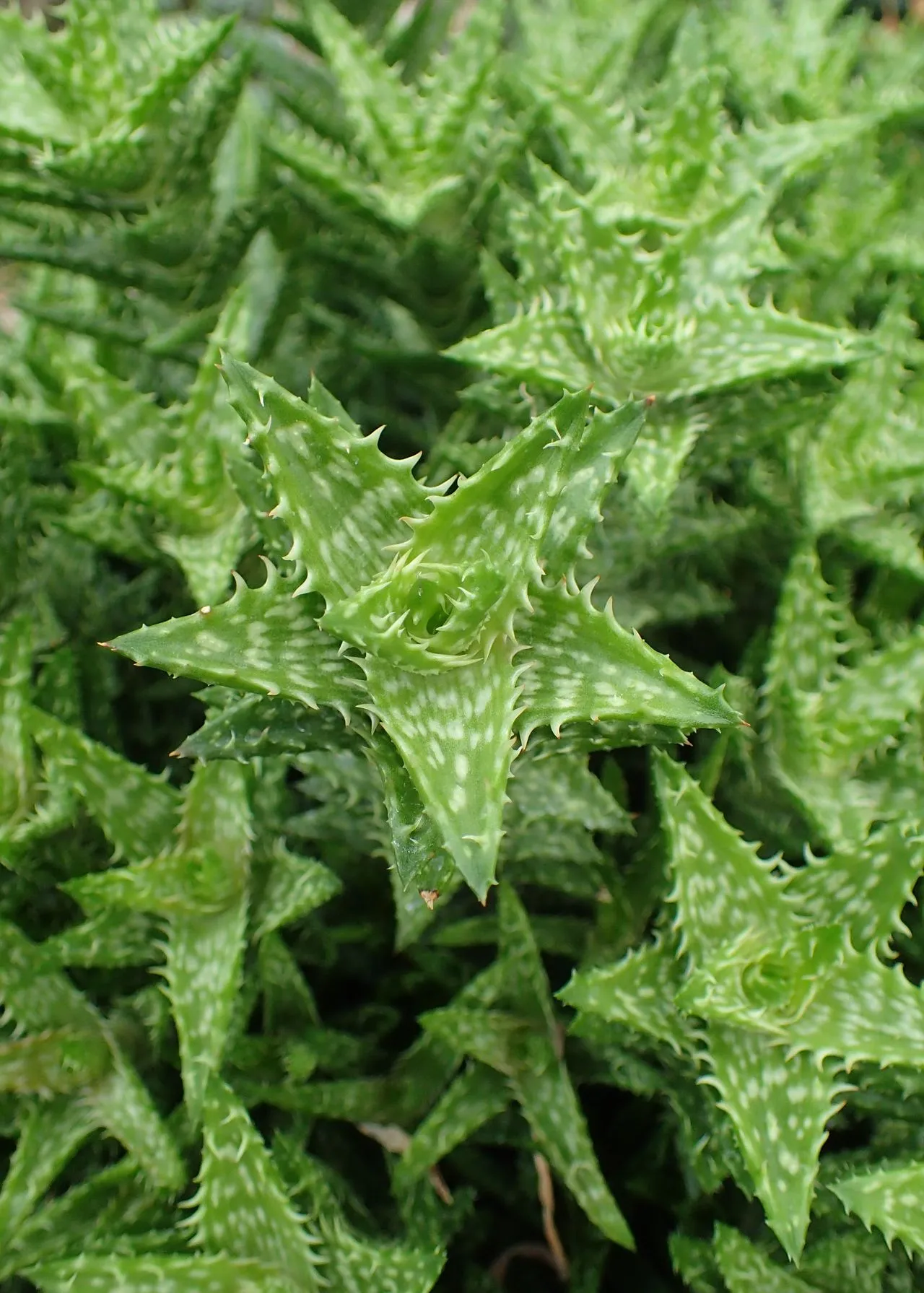
Aloe juvenna Brandham & S.Carter, the tiger tooth aloe, was formally described in 1979 by Peter Brandham and Susan Carter Holmes from material long circulating in horticultural collections under various names. The species is a narrow-range Kenyan endemic, restricted in the wild to rocky slopes around Mt Kulal in the northern Kenyan highlands at roughly 1,200 to 1,600 m. The diagnostic feature is unmistakable once seen: triangular green to bronze-green leaves 6 to 12 cm long, edged with prominent pure-white triangular teeth that stand sharply against the leaf surface and give the plant its common name.
Habitat is dry, exposed, and seasonally cool. Mt Kulal is an isolated forested volcano rising above the arid Chalbi basin, and A. juvenna sits on the lower drier slopes rather than in the mist forest at the summit. Wild populations are localised, fragmented across a small area, and exposed to grazing pressure from goats. Despite the apparent restriction in the wild, the species has been in horticultural circulation since at least the 1930s, well before its botanical description, which is why a name from 1979 attaches to a plant most older succulent growers had been growing for decades. The genus is listed on CITES Appendix II, which controls international trade for all aloes except A. vera.
Part of the Complete Aloe Guide.
Identification
A. juvenna is a stem-forming aloe, not a basal rosette. Mature stems reach 30 to 50 cm tall and lean or sprawl as they extend, supporting narrow rosettes 8 to 12 cm across at the apex. Older plants build dense clumps via stoloniferous offsets that root where they touch substrate, so a single starter rosette becomes a small thicket of leaning stems within three or four growing seasons. The leaves themselves are triangular, slightly recurved, 6 to 12 cm long, and arranged in tight overlapping spirals that hide most of the stem from view.
Leaf colour is the second useful character. In moderate light the leaves are a clean mid-green to slightly bronze-green; in strong direct sun they flush a deeper red-brown along the upper surface and at the leaf tips, which is a normal stress response and not a sign of distress. The marginal teeth are the giveaway: pure white, triangular, regularly spaced, and standing visibly clear of the leaf surface rather than blending into a coloured rim. There are usually a handful of similar white teeth scattered on the upper leaf face near the base, and sometimes a few on the underside, which add to the speckled appearance of an established rosette.
Flowering is uncommon in cultivation but occurs in late winter on healthy outdoor plants. The inflorescence is a simple unbranched raceme 30 to 40 cm tall, carrying coral-orange tubular flowers from a single stem. A branched candelabra panicle would point to a different aloe entirely.
Three lookalikes regularly cause confusion. Aloe aculeata is much taller (rosettes to 1 m), solitary or sparsely clumping, and the entire leaf surface is covered in raised reddish-brown tubercles that feel rough under the hand; the teeth are dark and the plant is unmistakably more robust. Aloe brevifolia is shorter, fully stemless, builds a wide low mat of basal rosettes rather than upright stems, and its marginal teeth are smaller and paler against blue-green leaves. Aloe squarrosa from Socotra is the most often confused: it has a similar size and stem-forming habit, but its leaves recurve sharply downward in a zigzag pattern, the teeth are smaller, and the leaf colour holds a colder green without the red-bronze stress flush.
Cultivation
Light. Give bright direct sun in the open garden once acclimated. Strong light keeps internodes short, holds the rosettes tight at the stem apex, and develops the red-bronze leaf flush that distinguishes a sun-grown plant from a shade-grown stretched one. In a south-facing window, 6 to 8 hours of direct light is the working minimum; less than that produces visibly elongated stems with thinner leaves spaced wider apart, and the plant loses most of its visual interest within one growing season. North of about 45° latitude, a supplemental grow light through the dim months keeps growth hardened.
Water. Treat A. juvenna as a warm-season grower with a winter slowdown. In a 14 to 18 cm terracotta pot with a mineral mix, water deeply when the top 2 to 3 cm of substrate has fully dried, then drain freely. From late spring through early autumn that may mean every 7 to 10 days; in cool winters above 5°C, intervals stretch to 3 weeks or longer. The species tolerates extended drought but resents stagnant moisture at the leaf bases of clumped stems, where damp axils combined with poor airflow are the most common failure point in collection plants.
Substrate. A mineral-dominant mix of about 70 percent inorganic to 30 percent organic suits this species. A practical recipe is 40 percent pumice, 20 percent coarse perlite or lava grit at 3 to 6 mm, 10 percent quartz or granite grit, and 30 percent sifted loam-based compost. The clumping stem habit means the rooting zone stays relatively shallow but expands laterally as offsets establish, so a wider rather than deeper pot, with a 1 to 2 cm mineral top dressing, keeps the lower stem and offset bases dry where they are most vulnerable to rot.
Temperature. Frost tolerance is limited. A bone-dry established plant takes brief exposure to about 3°C without lasting damage, with the lower leaves marking first if temperatures drop further. Below freezing the species is not reliable; it is a better candidate for a cool greenhouse or porch over winter than for unprotected outdoor planting outside USDA zone 10. Wet cold is again the failure mode, and the leaning stem habit means water can collect in leaf axils and freeze if the plant is left outside in a cold rain. Above 35°C in dry summer heat, growth pauses and the rosettes tighten visibly.
Container. Use a wide stoneware or terracotta pot, 14 to 18 cm for a single-stem starter and 22 to 28 cm for a clumped colony of 5 to 10 stems. Repot every 2 to 3 years into fresh mineral substrate, refresh the top dressing annually, and lift any leaning stems back into vertical orientation at the same time. The cultural baselines outlined in the beginner's guide apply directly here; A. juvenna is not a difficult species once drainage and light are correct.
Feeding is light. A quarter-strength balanced cactus fertiliser once or twice through the warm growing season is enough. Heavier feeding produces soft, pale, widely spaced leaves that flop on weak stems and never colour up properly even in full sun.
Propagation
A. juvenna is among the easiest aloes to propagate vegetatively. Stem cuttings strike with high reliability: take a cutting 10 to 15 cm long with at least one rosette at the apex, strip the lower 2 cm of leaves, let the cut surface callus for 5 to 7 days in dry shade, and pot into a sharply drained mineral mix. Roots usually appear within 3 to 5 weeks at 20 to 26°C, and a 90 percent or higher take rate is normal in a home setup.
Stoloniferous offsets that have already self-rooted at the base of the parent clump can be lifted, separated with a clean cut, and potted directly without callusing. These establish almost immediately and reach a presentable rosette within one growing season. The whole-clump habit makes A. juvenna effectively self-multiplying once a starter plant is settled.
Single-leaf cuttings do not work for this species, as for the genus generally; aloes do not regenerate from leaf tissue. Seed is technically possible if the plant flowers and is hand-pollinated against an unrelated clone, but seedlings are slow (3 to 5 years to a recognisable rosette) and produce no advantage over cuttings unless deliberate cross-breeding is the goal.
Notes
Trade substitution. A. juvenna is one of the most consistently mislabelled aloes in commercial circulation. The same plant is regularly sold as Aloe squarrosa (a genuinely different Socotran species with sharply recurved zigzag leaves) and as Aloe zanzibarica (a name now treated as a synonym of A. juvenna by most authorities, but still used as if it were a distinct taxon). True A. juvenna has straighter upright stems, pure-white teeth that stand proud of the leaf surface, and the red-bronze sun flush. If a plant labelled "A. squarrosa" has those features and lacks the strong leaf recurvature, it is almost certainly A. juvenna under the wrong name. The mislabelling rarely matters for cultivation, since both grow similarly, but it does matter for anyone collecting Socotran endemics or trying to maintain accurate seed lists.
Pests. Mealybug occasionally settles deep in the leaf axils of established clumps, where chemical access is poor and a hand-lens inspection before winter is the most useful precaution. Aloe mite is rarely reported on this species but, as for any aloe, distorted cauliflower-like growth at a stem apex should be removed and the affected stem destroyed away from the rest of the collection.
Pet and child safety. The white teeth are sharp enough to scratch on contact and the leaf tips are firm. The species is not seriously hazardous, but it is not a sensible plant at face height where children or cats brush past it. The aloe-typical sap chemistry should not be eaten.
See also
- The Complete Aloe Guide: genus-level cultivation principles and how stem-forming Kenyan aloes fit alongside the South African majority.
- Beginner's Guide to Succulents: light, water, and substrate fundamentals to settle before reading species-specific notes.
- Aloe nobilis — another stem-forming clumping aloe with prominent marginal teeth, compared in the identification section.
Frequently Asked Questions
What is the main identification point?
The Identification section separates Aloe juvenna by plant habit, leaf form, marginal teeth or surface markings, flowers, and lookalikes named in the article.
How should this aloe be watered?
Follow the Cultivation section rather than a fixed calendar. The article gives drying depth, seasonal growth rhythm, and the wet-cold risk for this plant.
How is it propagated?
Use the Propagation section. The article states whether offsets, stem cuttings, or seed are practical, and notes that single-leaf cuttings do not work for aloes.
What should buyers watch for?
Check the Notes and lookalike sections. The article flags trade confusion, hybrid material, or conservation sourcing where those issues apply.