| Question | Short Answer |
|---|---|
| What is the main identification point? | The Identification section separates Aloe polyphylla by plant habit, leaf form, marginal teeth or surface markings, flowers, and lookalikes named in the article. |
| How should this aloe be watered? | Follow the Cultivation section rather than a fixed calendar. |
| How is it propagated? | Use the Propagation section. |
| What should buyers watch for? | Check the Notes and lookalike sections. |
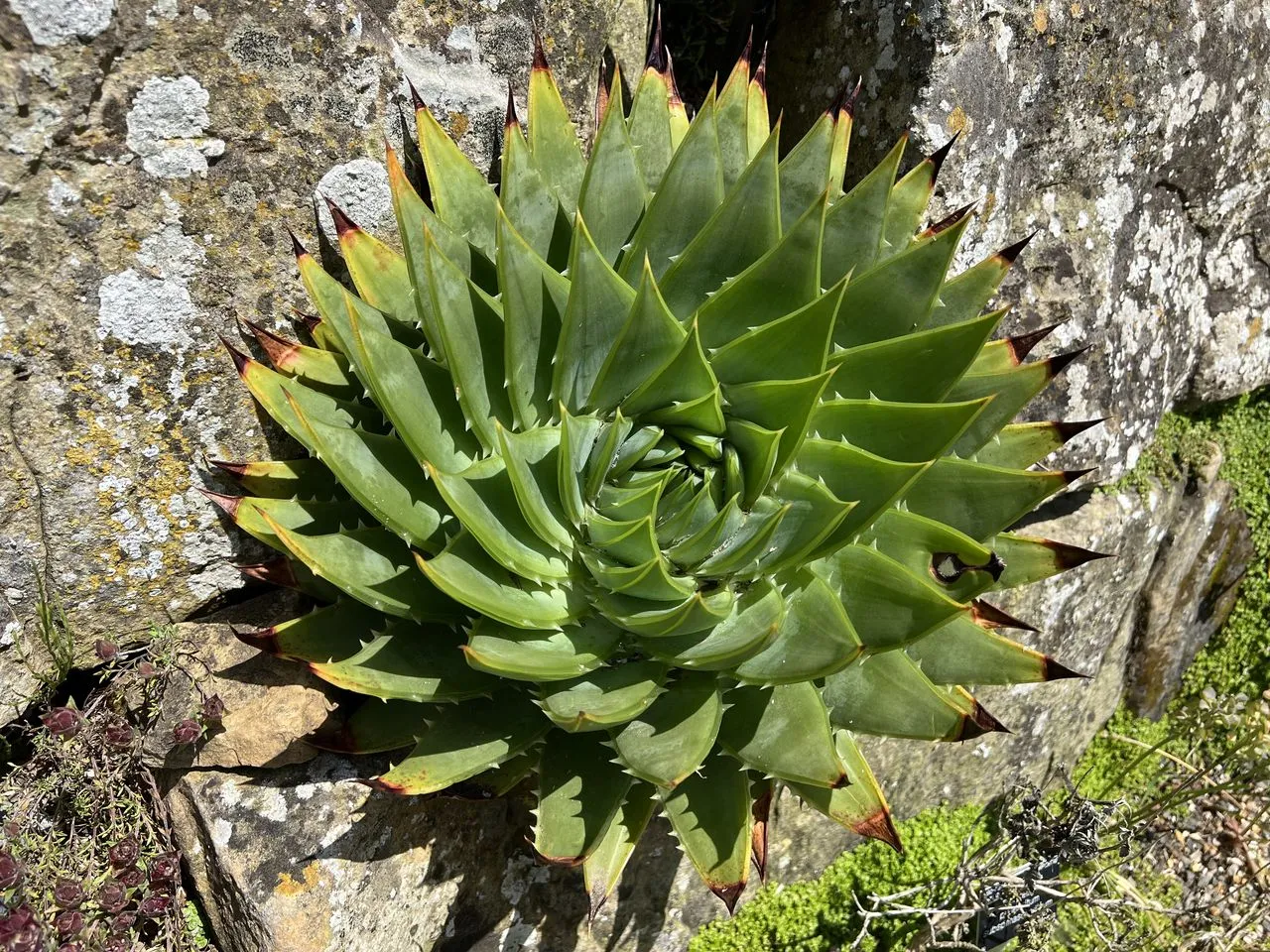
Aloe polyphylla Schönland ex Pillans, the spiral aloe, traces back to Selmar Schönland's 1905 Lesotho material and was later validly published under Neville Stuart Pillans. It is a high-altitude endemic of the Lesotho Drakensberg and Maloti ranges, usually recorded on wet basalt cliffs and steep grassy slopes between about 2,000 and 2,700 m. Its defining character is the dense, ground-level rosette of pale grey-green stiff leaves arranged in a near-mathematical spiral, clockwise or anticlockwise in roughly equal numbers, with dark marginal teeth and a cold mountain temperament unlike most cultivated aloes.
In habitat, A. polyphylla grows where snowmelt, mist, summer storms, and rapid drainage occur together. Roots push into gravelly basalt seams rather than deep desert sand. The air is cool, the nights are cold, and the plant is rarely exposed to long hot spells. It is listed on CITES Appendix I, the strictest CITES category, because wild plants and seed were heavily removed for international horticulture and because its entire natural range is small. Appendix I does not mean every plant in cultivation is illegal. It means international trade in wild-collected material is effectively prohibited, and legal nursery plants must be seed-grown or otherwise documented from authorised stock. If a seller cannot explain provenance, walk away.
Part of the Complete Aloe Guide.
Identification
The mature rosette is usually 40 to 60 cm across in cultivation, broader in old, well-sited plants outdoors. It remains stemless and solitary, with 100 or more triangular leaves packed into five visible ranks that create the famous Fibonacci spiral. The direction is not a cultivar trait. Seed batches usually produce clockwise and anticlockwise spirals at close to a 1:1 ratio, so paying a premium for one direction over the other is horticultural theatre.
Young plants are less obliging. Seedlings and small juveniles form ordinary-looking green rosettes for several years, and the spiral may not become obvious until year four or five. A 6 cm plant sold as "not spiralling yet" is not automatically misidentified. A 25 cm plant with no developing rank pattern deserves more suspicion.
Leaves are stiff, slightly incurved, and pale grey-green to glaucous green, with darker triangular teeth along the margins and a small dark terminal point. The leaf surface is not heavily spotted or tuberculate. Compared with Aloe aculeata, which has conspicuous prickles scattered over the leaf faces, A. polyphylla keeps its armour mostly on the margins. Compared with Aloe aristata (now usually treated as Aristaloe aristata), it is much larger, flatter, paler, and lacks the soft white thread-like markings common in that species.
Flowering is uncommon in pots and slow even in favourable cool gardens. A mature rosette may produce a stout branched inflorescence with salmon-pink to red tubular flowers, sometimes orange-red in strong light. The species is often described as monocarpic: the flowering rosette can decline after seed set rather than returning to regular annual bloom. In cultivation, many plants never reach the size and seasonal rhythm needed to test this properly. Do not buy this aloe for flowers. Buy it only if you can provide the climate the leaves require.
Cultivation
Light. Give very bright light with protection from hot glasshouse peaks. Outdoors in a cool maritime or upland climate, full sun is acceptable if roots remain cool and the plant has wind movement. In warmer inland climates, morning sun and bright afternoon shade are safer. Indoors, an unobstructed east or south-east window is better than a hot west-facing window that bakes the rosette at 32°C. Etiolated plants open out, lose the tight spiral, and become more rot-prone because the centre traps water.
Water. The rhythm is the opposite of many desert succulents. In habitat, winter and spring moisture from snowmelt and rain moves through the root zone quickly, while summer remains cool rather than scorching. For a potted plant, water thoroughly when the top 3 cm is dry but the lower root ball still feels faintly cool, then let excess drain immediately. In a 15 cm terracotta pot under 15 to 22°C conditions, that may mean every 7 to 10 days during active cool growth. In hot weather above 27°C, reduce water rather than increase it. Warm wet roots are how many cultivated plants are lost.
Substrate. Use a free-draining gravel substrate, not a standard aloe mix rich in compost. A practical recipe is 60% pumice or lava grit, 20% granite or basalt grit at 3 to 6 mm, 10% coarse sand, and 10% loam-based compost. The mix should wet evenly and drain within minutes, with no peat layer staying soggy around the neck. For the broader principles behind mineral substrates, see Succulent Soil & Substrate, but push this species further toward mineral content than you would for Aloe arborescens or Aloe vera.
Temperature. This is the non-negotiable part. Optimum growth occurs around 15 to 22°C. Brief dry frost to about −10°C is tolerated by established plants, especially if the crown is not sitting in water and the root zone drains freely. Sustained temperatures above 30°C are dangerous. The plant does not respond like a heat-loving aloe that can be watered through stress. Above 30°C for several days, root function slows, the centre tightens, and rot often follows the next watering. In warm Mediterranean collections I have seen better survival from withholding water during heat waves, moving the pot into bright shade, and resuming light watering only when nights fall below 18°C.
Container. Use a wide, shallow terracotta or stoneware pot with generous drainage holes. A juvenile can start in a 9 to 12 cm pot, but once the rosette reaches 15 cm across it appreciates a wider container that keeps the root run cool and stable. Do not bury the neck. Set the rosette slightly proud of the surface and top-dress with angular grit so water moves away from the leaf bases. In climates with wet summers, a raised alpine bed or trough often works better than a conventional succulent bench.
The usual failure is treating A. polyphylla like a handsome version of an ordinary aloe: hot greenhouse, lean water in winter, more water in summer, and a compost-heavy mix. That recipe suits neither its roots nor its mountain biology. Think of it as an alpine succulent from wet basalt, not a desert rosette.
Propagation
Seed is the ethical and practical route. Because the species is CITES Appendix I, seed should come from documented cultivated parents and licensed nurseries. International movement may require permits even when the seed is nursery-produced, depending on country and paperwork category. For the private grower, the safest rule is to buy established seed-grown plants from a nursery that states its stock origin, not anonymous imported plants or suspiciously cheap bare-root rosettes.
Fresh seed germinates best at cool to mild temperatures, roughly 16 to 22°C. Sow on the surface of a sterile mineral mix with a thin grit dressing, keep evenly moist rather than saturated, and provide bright shade with constant airflow. Germination often begins in 2 to 4 weeks if seed is fresh. Warm propagators set to 26 to 28°C, useful for many aloes, are too hot for this species and reduce results.
Seedlings resent stagnant humidity after germination. Once the first leaves are visible, crack the cover or remove it over several days. Keep the mix lightly moist while roots establish, but never let algae or liverwort form across the surface. A 40 to 60 percent first-year survival rate is respectable in a home collection; higher losses usually trace to warmth, stale air, or overly organic compost.
Offsets are rare and should not be expected. Cutting the rosette is not a normal propagation method and risks destroying a protected plant. Tissue-cultured plants occasionally appear in specialist trade, but seed-grown stock is preferable for genetic diversity and conservation value.
Notes
CITES and buying ethics. Appendix I exists because the species became desirable before cultivated supply caught up. Removing a mature rosette from a Lesotho slope is not a harmless collector's shortcut; it removes decades of growth from a narrow endemic population and usually kills the plant during transport anyway. Ethical plants are seed-grown, labelled as cultivated, and sold by nurseries willing to discuss permits or parent stock. If a plant is advertised as "wild form" or "collected old specimen," treat that as a warning, not a selling point.
Pests. Mealybug can hide between the tight lower leaves, especially where old grit and dried leaf bases collect. Inspect with a hand lens before winter because chemical access into the rosette is poor once colonies settle deep in the leaf axils. Aloe mite is less commonly reported on this species than on many warmer-growing aloes, but any distorted, cauliflower-like growth around the centre should be removed from the collection immediately and assessed away from other plants.
Outdoor siting. The best cultivated specimens I have seen were not in hot succulent houses. They were in cool coastal gardens, alpine troughs, or botanic garden rockwork where water drains fast and summer nights stay low. If your July nights remain above 22°C for weeks, this is a specialist plant rather than a windowsill aloe.
See also
- The Complete Aloe Guide: genus-level cultivation principles and the temperature differences that make high-altitude aloes unusual.
- Succulent Soil & Substrate: mineral mix design, drainage physics, and why a gritty top layer does not fix a wet root ball.
- Aloe striatula — the cold-hardiest aloe for open-ground temperate planting, a contrast to this alpine specialist.
Frequently Asked Questions
What is the main identification point?
The Identification section separates Aloe polyphylla by plant habit, leaf form, marginal teeth or surface markings, flowers, and lookalikes named in the article.
How should this aloe be watered?
Follow the Cultivation section rather than a fixed calendar. The article gives drying depth, seasonal growth rhythm, and the wet-cold risk for this plant.
How is it propagated?
Use the Propagation section. The article states whether offsets, stem cuttings, or seed are practical, and notes that single-leaf cuttings do not work for aloes.
What should buyers watch for?
Check the Notes and lookalike sections. The article flags trade confusion, hybrid material, or conservation sourcing where those issues apply.