Quick Answer
The short answer: The reliable test is the flower - Aloe has tubular nectar-bearing flowers (red, orange, yellow), while Haworthia has small white-and-green striped flowers with little nectar.
Best first step: If not flowering, check leaf surface - Haworthia has translucent windows at leaf tips or pearly tubercles in bands; Aloe has firm marginal teeth and spots, never windows.
Avoid: Relying on size alone - both have dwarf species, but Aloe can become tree-sized while Haworthia stays small (max 25cm).
A reader at a market stall holds up a small spotted rosette and asks what it is. Both Aloe and Haworthia look similar at the dwarf end of the succulent bench, and the same plant turns up under both names depending on which catalogue you read. The single most reliable separator is the flower: tubular and nectar-bearing in Aloe, small and green-and-white striped with almost no nectar in Haworthia. When the plant is not in bloom, leaf-surface texture and the leaf margin get you nearly all of the way there. Here is the rest of the picture.
Both genera sit in the family Asphodelaceae, subfamily Asphodeloideae, and they overlap broadly in growth form (rosette of fleshy leaves) and origin (southern Africa in the broad sense, with Madagascar for some aloes). Modern taxonomy has fragmented both groups. Manning, Boatwright, Daru, Maurin, and Van Der Bank (2014) split Aloe sensu lato into six genera (Aloe sensu stricto, Aloidendron for the tree species, Kumara, Aloiampelos for the climbing aloes, Aristaloe, and Gonialoe), and split Haworthia sensu lato into three (Haworthia sensu stricto, Haworthiopsis, and Tulista). For practical identification, "Aloe vs Haworthia" is therefore really "the Aloe-group vs the Haworthia-group", and a few small species sit awkwardly on the line between the two.
At a glance
| Character | Aloe-group | Haworthia-group |
|---|---|---|
| Adult size | 5 cm dwarf to 10 m tree | 5 to 25 cm dwarf only |
| Flower shape | Tubular, nectar-bearing | Small, irregular, low nectar |
| Flower colour | Red, orange, yellow, coral | White with green or brown stripes |
| Pollinator | Sunbirds, sugarbirds | Bees and small flies |
| Inflorescence | Stout raceme or branched panicle | Slender wiry raceme |
| Leaf keel (underside) | Rare and weak | Strong central keel in many Haworthiopsis |
| Leaf surface markings | Spots, stripes, marginal teeth | Translucent windows (true Haworthia) or pearly tubercles in transverse bands (Haworthiopsis) |
| Marginal teeth | Firm, triangular, often pigmented | Soft tubercles, hair-like fringe, or smooth |
| Native range | Africa, Arabia, Madagascar | South Africa, Namibia, Eswatini, southern Mozambique |
Key separators in the field
1. Flower structure. This is the certain test, and it is worth waiting for an unidentified plant to bloom rather than committing to a name from leaves alone. Aloe flowers are tubular, 15 to 50 mm long depending on species, and carry nectar at the base of the perianth as a pollination reward for sunbirds and sugarbirds. The colour palette runs through coral, scarlet, orange, and yellow, with occasional pale green or near-white in a few highland species. The inflorescence is a stout raceme or a branched panicle, and the flowers hang in dense ranks with the perianth closed at the tip. Haworthia and its segregate genera, by contrast, carry small irregular flowers 6 to 15 mm long, white with a green or brownish midstripe down each tepal, two-lipped at the mouth, on a slender wiry raceme that often shows only a handful of open flowers at any one time. Nectar volume is minimal, and pollination is by bees and small flies. A coral tubular flower is an Aloe; a white-and-green striped two-lipped flower on a thin stem is a Haworthia.
2. Leaf keel. Turn the leaf over and look at the underside. Most Haworthiopsis species (the rough-leaved former haworthias: H. attenuata, H. fasciata, H. coarctata, H. limifolia, H. reinwardtii) carry a strong central keel running down the leaf back, often raised enough to feel as a clear ridge between thumb and finger. True Haworthia species (H. cooperi, H. cymbiformis, H. retusa) usually lack a sharp keel, but their leaves are often boat-shaped or trough-like in cross-section. Aloe leaves are typically flat or shallowly channelled on the upper surface and convex underneath without a defined raised midrib. A pronounced keel ridge on the back of a small succulent leaf is a strong vote for Haworthiopsis.
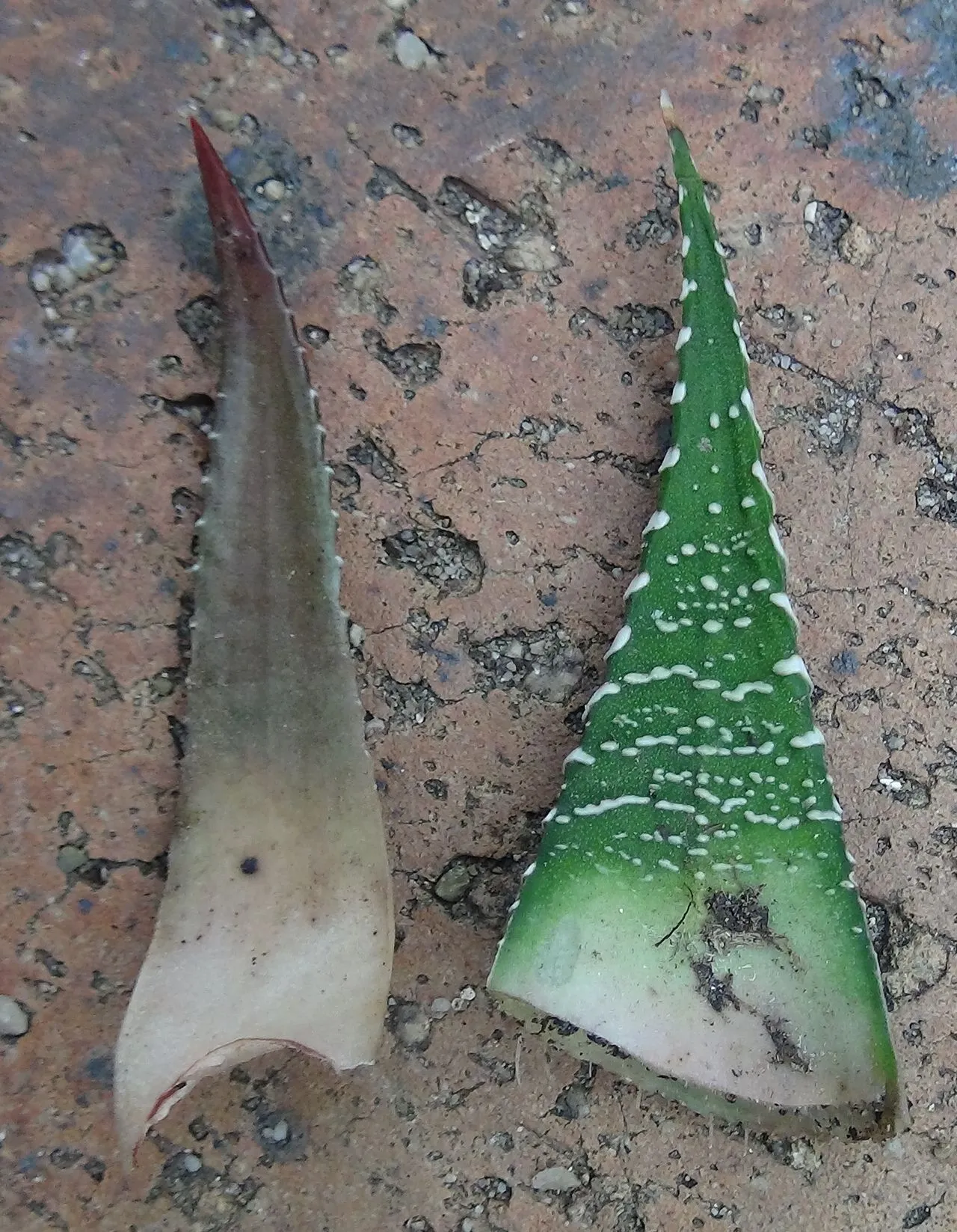
3. Leaf-surface markings. This is where the small dwarfs sort themselves out fastest. True Haworthia species carry translucent window panels at the leaf tips: small clear or whitish patches that admit light to the chlorenchyma below, an adaptation to growing partly buried in habitat. Hold a leaf of H. cuspidata or H. cooperi up to the light and the tip glows like a frosted lens. Haworthiopsis species (H. attenuata, H. coarctata) carry pearly white tubercles arranged in transverse bands across the leaf surface, the source of common names like "zebra plant". Aloe leaves carry spots, longitudinal stripes, or marginal teeth, but never the clear window structure of true Haworthia, and only rarely the regular transverse banding of pearly tubercles. If you can see translucent panels in the leaf tip, the plant is a true Haworthia; if there are dense bands of white tubercles down the leaf back, it is Haworthiopsis.
4. Marginal teeth. Run a finger along the leaf margin. Aloe leaves usually carry firm triangular teeth or short spines, often pigmented red or brown, set at regular intervals along the margin. The teeth are stiff enough to scratch skin in the larger species. Haworthia and Haworthiopsis margins, by contrast, carry soft white tubercles, a hair-like fringe of fine teeth, or no teeth at all. Pressing the margin of a Haworthia leaf produces no scratch sensation. The major exception is Aristaloe aristata (formerly Aloe aristata), which carries soft white teeth and looks Haworthia-like at first glance; the test there is the flower, which is unmistakably tubular and coral-pink.
5. Adult size. Aloe sensu lato spans the entire range from 5 cm dwarfs (A. descoingsii, A. haworthioides, A. rauhii, A. bakeri from Madagascar) to 10 m trees (Aloidendron barberae, Aloidendron dichotomum). The Haworthia-group is dwarf-only: even the largest species, Tulista pumila (formerly H. maxima or H. pumila), tops out near 25 cm, and most are in the 5 to 15 cm range. If a settled adult plant is more than about 30 cm tall, it is in the Aloe-group. If it is a 5 cm rosette, it could be either, and the other separators above apply.
Edge cases and look-alikes
A handful of species deliberately sit on the line and trip up beginners.
Aristaloe aristata, the lace aloe, has dark green leaves covered in soft white tubercles and edged with hair-like white teeth, the surface texture and margin pattern most people associate with a Haworthia. Manning et al. (2014) split it into its own monotypic genus on the basis of flower morphology and DNA. The field test is the inflorescence: a stout raceme of orange-red tubular flowers with abundant nectar, all the way Aloe despite the leaf appearance.
Tulista pumila is the largest plant in the Haworthia-group, with rosettes 15 to 25 cm across and stiff, fleshy, pearly-tubercled leaves that look Aloe-sized at first glance. The flowers settle it: small, irregular, low-nectar, white with green stripes, on a slender raceme. Tulista is sister to Haworthia sensu stricto in current phylogenies, not to Aloe.
Haworthia truncata has stubby, square-tipped, almost geometric leaves on a half-buried rosette. The leaf form is unusual enough that it confuses people coming from a typical aloe-shaped expectation, and the leaf-tip windows are extreme in this species, often making up the entire upper face of each leaf. Flowers are typical Haworthia.
Gasteria is a separate but closely related genus in the same subfamily. Gasteria carries distichous (two-ranked) tongue-shaped leaves rather than the spiral rosette of Aloe or Haworthia, at least in juvenile stages; many species become rosette-like with age, but the seedling two-ranked habit is diagnostic. Flowers are pink-and-green pouched (the genus name comes from the gastric-shaped perianth), distinct from both groups. If a fleshy succulent throws leaves opposite each other rather than spiralling, think Gasteria before Aloe or Haworthia.
Bulbine sometimes turns up mis-shelved with the aloes for its leaf habit; the slimy leaf sap and the yellow star-shaped flowers with hairy stamens settle it within seconds.
When the two get confused in trade
Garden-centre and online-seller mislabelling is the practical reason most readers end up with this question in the first place. Three patterns recur often enough to flag.
Aloe juvenna, the tiger-tooth aloe (a small East African Aloe with sharp triangular cream teeth on a stacked rosette), is regularly sold as "Haworthia juvenna" in chain stores. There is no Haworthia juvenna: the name is invented in retail. The marginal teeth are firm and triangular, the leaves are softer and more open than any Haworthiopsis, and the eventual flower (orange tubular) settles it. Treat the plant as an Aloe in cultivation: more sun, longer dry interval at the leaf bases than any Haworthia will tolerate.
Haworthiopsis attenuata, the zebra plant, is the inverse case: sometimes sold as "Aloe attenuata" or "miniature aloe vera". The transverse white tubercular bands and the soft margins make this an obvious Haworthiopsis once the markers register. Cultivation differs: zebra plants want shade or filtered light and steadier moisture than a true Aloe, and a south-facing windowsill at noon will scorch the surface tubercles flat within a week.
Aristaloe aristata circulates under all three of "Aloe aristata", the invented "Haworthia aristata", and the current "Aristaloe aristata", depending on how recent the supplier's catalogue is. Treat it as an aloe for cultivation: it tolerates more sun, more cold, and drier roots than a Haworthia, and flowers as a typical small Aloe.
The reliable rule for any nursery acquisition is this. If the plant is in flower, the flower decides. If it is not, leaf-keel and surface pattern decide. If those still do not, hold a leaf to the light. A leaf that glows at the tip is a true Haworthia; a leaf with banded pearly tubercles on a strongly keeled back is Haworthiopsis; a leaf with firm pigmented marginal teeth and no surface windows is Aloe (or Aristaloe if those teeth are soft and white).
Cultural follow-on for both groups is covered in the beginner's guide; the short version is that most aloes want more direct sun and a longer dry interval than most haworthias, so getting the genus right at the point of purchase saves a season of bleached leaves or rotted bases.
See also
- Beginner's Guide to Succulents: light, water, and substrate fundamentals that apply to both genera.
- The Complete Aloe Guide: genus-level cultivation principles for the Aloe-group from Madagascan dwarfs to South African tree aloes.
- The Complete Haworthia Guide: cultivation and identification across true Haworthia, Haworthiopsis, and Tulista.
- Indoor succulent care: the light, water, and seasonal framework that applies to both Aloe and Haworthia indoors
FAQ
How do I tell them apart if not flowering?
Check the leaf keel (underside). Haworthiopsis species have a strong central keel you can feel. Also check surface - Haworthia has translucent window panels; Haworthiopsis has pearly tubercles in bands.
What's the difference in care?
Aloe wants more sun and longer dry intervals. Haworthia (especially windowed species) wants shade/filtered light and steadier moisture. Get this wrong and leaves scorch or rot.
Is there a plant that looks like Haworthia but isn't?
Yes - Aristaloe aristata (lace aloe) has soft white teeth and tubercles like Haworthia, but its coral tubular flowers reveal it's actually an Aloe.
Can Haworthia grow outdoors?
Only in frost-free conditions. Most Haworthia are tender below 5°C. Aloe species vary - some are frost-hardy, most are not.
Frequently Asked Questions
What is the first step for aloe vs haworthia: how to tell the two apart?
Start by matching the symptom to the plant, substrate, light, and season before changing watering or treatment.
What should be avoided?
Avoid changing several variables at once; correct the limiting factor and observe the plant before escalating.
Which care factor matters most?
Match the plant to its light, substrate, pot size, and season. Most succulent failures trace to a mismatch between drying speed and the plant's current growth rate.
When should the plant be checked again?
Recheck after one to two weeks unless tissue is actively collapsing. Stable firmness and new growth are better signs than a fixed calendar interval.