Quick Answer
The short answer: Most succulents (Echeveria, Sedum, Sempervivum, Crassula) root fine without hormone - 90% don't need it. Hormone helps woody cactus stems (Cereus, Trichocereus), stressed cuttings, and difficult Adromischus/Tylecodon.
Best first step: Skip hormone for soft Echeveria/Sedum leaves. Use 0.3-0.8% IBA powder only for mature columnar cacti.
Avoid: Dipping fresh wet cuts (wastes hormone, adds rot risk), using on leaves (no benefit), overdosing (suppresses root growth).
Rooting hormone is one of those products that gets recommended automatically every time someone asks how to propagate a succulent, and that recommendation is wrong roughly 90% of the time. The bottle on the garden-centre shelf contains synthetic auxin, the same class of growth regulator a plant produces internally to direct root initiation, but the species that fill most collections root reliably from a callused cutting without any external auxin at all. Where the hormone earns its place is a narrow band of woody-stemmed cacti and a few difficult Crassulaceae. Here is the rest of the picture.
Part of the Beginner's Guide to Succulents.
What rooting hormone is
Rooting hormone is a commercial preparation of synthetic auxin, almost always indole-3-butyric acid (IBA), occasionally naphthylacetic acid (NAA), and very rarely indole-3-acetic acid (IAA, the natural plant auxin, which degrades quickly under light and is not stable enough for shelf use). The active ingredient sits in a carrier: talc for powders, a methylcellulose or alcohol gel, or a water-miscible concentrate for liquids.
The molecular function is straightforward. Auxin in plant tissue is what tells parenchyma cells near a wound to dedifferentiate and form adventitious root primordia. A cutting already produces some auxin endogenously at the cut site, sourced from the apical meristem and transported downward. External IBA dust on the wound raises the local auxin concentration and pushes more cells over the threshold for root initiation than would otherwise cross it. That is the entire mechanism. The hormone does not feed the cutting, does not protect it from rot, and does not wake up a dead leaf. It only does one thing, and only at one stage.
Why most succulents don't need it
Most succulents in cultivation root from cuttings at a rate that does not leave room for improvement. Soft Echeveria (DC.) Lem., Sedum L., Crassula L., and Pachyphytum Link, Klotzsch & Otto routinely deliver more than 90% rooting from leaf or stem cuttings on plain pumice with no auxin treatment whatsoever. Sempervivum L. and Haworthia Duval propagate via stoloniferous offsets that arrive pre-rooted from the parent plant. Aloe juvenna Brandham & S.Carter and similar offsetting aloes detach with a partial root system already in place.
In side-by-side trials reported by both small nurseries and university extension propagation studies, a callused Echeveria agavoides (Lem.) Walp. cutting dipped in 0.1% IBA powder and an untreated callused cutting taken from the same plant on the same day root within one week of each other and at the same final percentage. The treated cuttings sometimes show one or two extra root initials, never enough to change the practical outcome. What does change root success in this group is callus quality, substrate aeration, and ambient temperature, none of which the hormone influences.
The biological reason is plain. These genera have evolved to propagate vegetatively in their native ranges; falling leaves in Echeveria root in situ on rocky scree, Sedum fragments scatter and root in gravel pockets, Sempervivum offsets walk away from the mother on stolons. Endogenous auxin levels at the wound or detachment surface are already sufficient. Adding more does nothing useful, and at higher doses it can suppress callus expansion, which is where the trouble starts.
When it actually helps
There are three situations where an IBA application repays the effort.
Woody, lignified cactus stems. Mature Cereus Mill., Trichocereus Riccob. (now mostly returned to Echinopsis Zucc. in current taxonomy, though the gardening trade keeps the older name), Selenicereus (A.Berger) Britton & Rose, and similar columnars develop a thick lignified outer layer with the years. A cut through that layer exposes very little active parenchyma and a great deal of woody tissue, in which root primordia do not form. Untreated cuttings of these plants do eventually root, but the wait can stretch past six weeks, with rot risk climbing in parallel. A 0.3 to 0.8% IBA dust applied to a properly callused cut typically pulls first roots forward to three or four weeks, and the increased number of initials gives the cutting a more secure root system once those roots reach substrate.
Aged or stressed cuttings. A piece of stem that has spent two months on a shelf in a paper bag, or a cutting taken from a plant that has been fighting Pythium or sun damage, has lower endogenous auxin reserves than a fresh, vigorous piece. In that situation, an external dose at the callused base lifts the cutting back into a useful range. This is a salvage application, not a routine one.
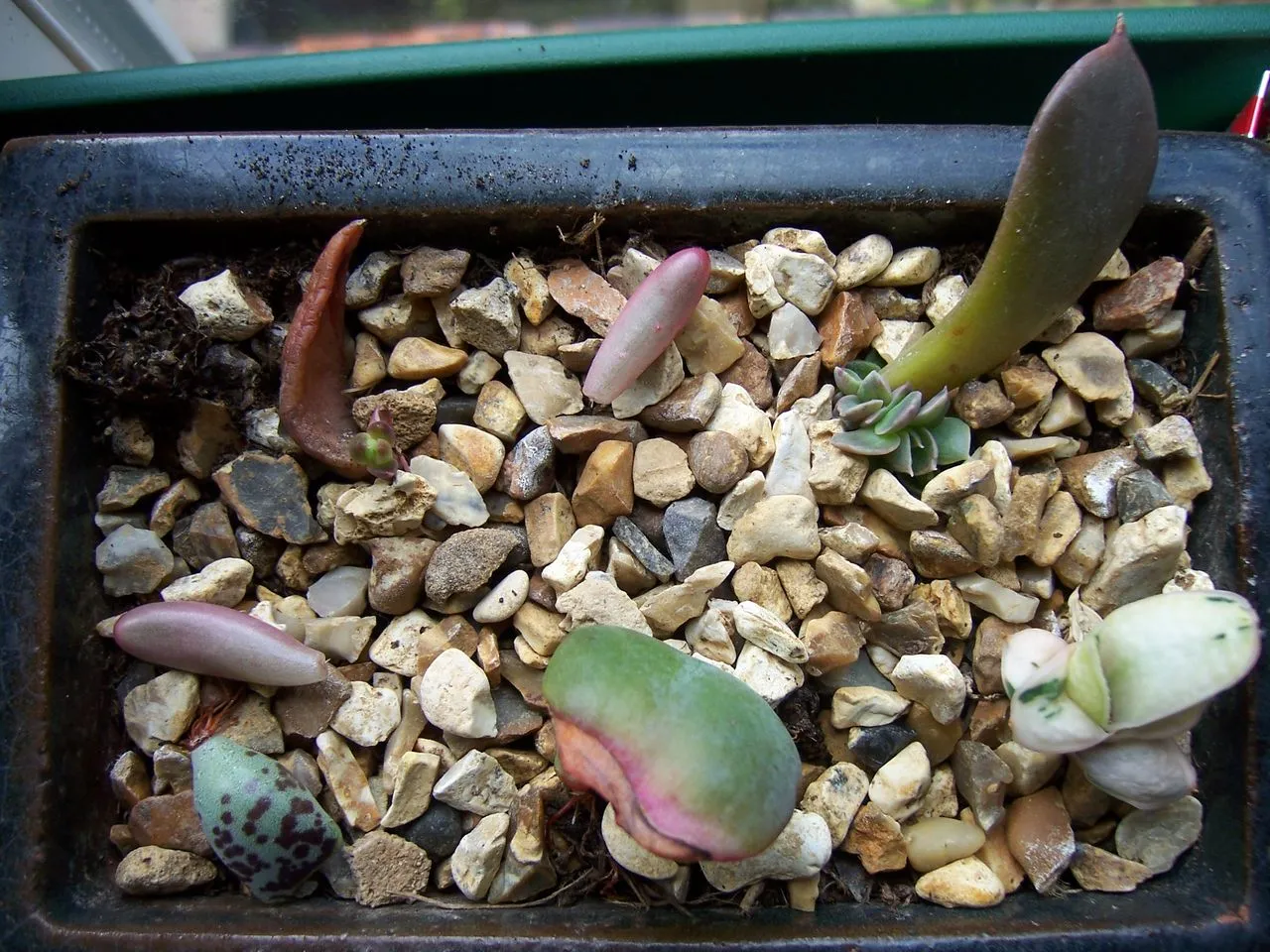
A few difficult Crassulaceae. Adromischus Lem. and Tylecodon Toelken include species that root reluctantly from leaves or short stem cuttings even under good conditions. Reports across collectors are inconsistent: some species respond clearly to 0.1% IBA, others not at all, and the response varies by clone within a species. Treat hormone use here as worth trying when leaf propagation has stalled, with the understanding that it does not guarantee anything.
Powder vs gel vs liquid
All three preparations deliver the same active ingredient at different concentrations and via different physical carriers. The form matters less than matching the concentration to the tissue.
| Form | Typical IBA concentration | Best for |
|---|---|---|
| Powder (talc) | 0.1% | Soft Crassulaceae, Adromischus, Tylecodon, where a low dose is sufficient |
| Gel | 0.1 to 0.3% | Vertical or curved surfaces where powder falls off; small cactus offsets |
| Liquid concentrate | 0.3 to 0.8% (diluted to use) | Mature Cereus, Trichocereus, Selenicereus; large woody cuttings |
Powder is the most common product on shelves and the most useful for the small fraction of routine succulent work that wants a hormone at all. Gel reduces waste and resists shedding from a textured cut surface, but is more expensive per gram of IBA. Liquid concentrate, sold as 'Dip 'N Grow' or similar formulations, is the choice for woody cactus material, because the higher dose actually moves the timing on lignified tissue, where 0.1% powder would have no measurable effect.
Concentration is a true ceiling, not a target. Above roughly 1% IBA, root initials form abnormally, the cutting can produce thick stunted callus instead of fine root hairs, and overall rooting success drops. More is not better.
How to apply correctly
Application is short and unforgiving in its details.
- Take the cutting and callus it normally. A wet, freshly cut surface does not hold powder; the talc rinses off as the wound weeps cell sap, and the wet contact between hormone-laden talc and exposed parenchyma is itself a rot risk. Wait until the cut is dry, matte, and slightly inset, the standard signs of a sealed callus.
- Pour a small amount of hormone into a separate dish. Never dip the cut directly into the bottle or jar. Skin oils, sap residue, and substrate fragments contaminate the entire stock and can introduce bacterial spoilage.
- Dust the callused base. Roll the cut surface lightly through the powder, or paint a thin gel layer along the cut edge. The aim is full contact, not a thick crust.
- Tap off excess. This step matters and is often skipped. A heavy coating physically inhibits callus expansion as the wound continues to differentiate, and visibly reduces root emergence relative to a thin even dusting. Tap firmly enough that loose powder falls off; what stays is what you want.
- Discard the residue in the dish. Do not pour leftover hormone back into the original container. Throw out anything that contacted the cutting.
- Pot or place per the species protocol. From this point, treat the cutting exactly as you would an untreated callused cutting of the same species, with the same substrate, watering, and temperature.
What to avoid
A short list covers the recurring failures.
- Dipping a wet, fresh cut. This is the single most common error. Hormone applied to a fresh wound rinses off in sap, achieves nothing, and adds a wet contact-rot risk. Always callus first, then apply.
- Dipping into the original container. Cross-contamination shortens shelf life of the entire stock and can transfer pathogens between cuttings. Pour out a working amount and discard the residue.
- Overdosing. A heavy crust of powder, or a high-concentration liquid where a low dose is appropriate, suppresses callus expansion and reduces rooting. Match the concentration to the tissue.
- Treating leaves of soft Echeveria and Sedum. No measurable benefit, a small but real downside if you crust the leaf base, and a waste of the bottle. Skip the hormone for this group.
- Honey and cinnamon as substitutes. Both compounds appear regularly in propagation guides as a 'natural' alternative. They are antifungals, useful in their own narrow lane for suppressing surface pathogens, and they do not contain auxin in any biologically active form. They cannot replace IBA where IBA is genuinely needed (woody cactus stems), and they are unnecessary where IBA is not (most soft succulents). Treat them as fungicides if you want to use them, not as hormones.
- Expecting hormone to rescue a poor cutting. A bruised, partly rotted, or insufficiently mature cutting will not root regardless of what is on the cut. Hormone amplifies a cutting's own readiness; it does not create readiness.
- Storing hormone past its useful life. Powdered IBA preparations degrade over 18 to 24 months once opened, faster in warm or humid storage. A bottle that has lived in a propagation shed for five summers is not delivering the dose printed on the label.
The two-line rule that covers most decisions: skip rooting hormone for the 90% of succulent propagation that does not need it, and dose it correctly for the 10% that does. Doing both at once is what using rooting hormone properly actually means.
See also
- A Beginner's Guide to Succulents: the surrounding decisions about substrate, callus timing, and watering that determine whether rooting succeeds at all
- Callusing: Why Cuttings Need Time on the Counter: the prior step that has to be complete before any hormone application
- Leaf Propagation: Step-by-Step for Crassulaceae: the soft-tissue propagation route where hormone is unnecessary
- Stem Cuttings: Reliable Propagation for Soft and Woody Stems: the full stem cutting workflow in which hormone is one optional step
FAQ
Does hormone help Echeveria leaves root faster?
No measurable benefit. Treated and untreated callused leaves root at the same rate and percentage. Save the hormone for where it actually helps.
What's the correct concentration for cactus?
Use 0.3-0.8% IBA for woody columnar cacti (Cereus, Trichocereus). Soft cacti don't need it. Too high (>1%) suppresses rooting.
Should I use honey or cinnamon instead?
No - they're antifungals, not auxins. They can't replace IBA for woody cactus. Skip them and use proper hormone if needed.
What's the most common mistake with rooting hormone?
Dipping a fresh wet cut instead of waiting for a callus first. Wet cuts rinse off the powder and create rot risk.
Frequently Asked Questions
What is the first step for rooting hormone: when it helps succulents and when it doesn't?
Start by matching the symptom to the plant, substrate, light, and season before changing watering or treatment.
What should be avoided?
Avoid changing several variables at once; correct the limiting factor and observe the plant before escalating.
Which care factor matters most?
Match the plant to its light, substrate, pot size, and season. Most succulent failures trace to a mismatch between drying speed and the plant's current growth rate.
When should the plant be checked again?
Recheck after one to two weeks unless tissue is actively collapsing. Stable firmness and new growth are better signs than a fixed calendar interval.