Quick Answer
The short answer: String of pearls is now correctly called Curio rowleyanus, not Senecio rowleyanus. The taxonomic split happened in 2018 when Kew moved succulent senecios into the genus Curio.
Best first step: Search for both names when buying - nurseries still use the old Senecio labels, while specialist sellers use Curio.
Avoid: Worrying that care changes with the name - the plant's needs are identical regardless of what you call it.
A reader bringing home a string of pearls discovers the label reads Curio rowleyanus, but the care book on the shelf still calls it Senecio rowleyanus. The two names refer to the same plant. Molecular phylogenetic work in the 2000s, partly summarised by the tribal review of Pelser et al. (2007), confirmed that the succulent species long held in Senecio form a distinct lineage from the herbaceous senecios proper. Kew's Plants of the World Online accepted the segregate genus Curio P.V.Heath (1997) in 2018, and the major taxonomic aggregators have followed that lead since. In trade, both names remain valid and you should search either when buying; the same plant turns up under both, often at different prices from different sellers. Here is the rest of the picture.
At a glance
| Character | Senecio (sensu stricto) | Curio P.V.Heath (1997) |
|---|---|---|
| Habit | Mostly herbaceous, soft-leaved | Succulent, fleshy stems and leaves |
| Examples | S. cineraria, S. vulgaris | C. rowleyanus, C. articulatus |
| Size of genus | More than 1,000 species worldwide | Roughly 18 to 22 species |
| Native range | Worldwide | Mostly southern and eastern Africa |
| Trade location | Garden centres, herb and bedding sections | Succulent and houseplant aisles |
| Care profile | Variable, often moist soil | Mineral substrate, dry interval |
What changed and when
Senecio L. (1753) is one of the largest plant genera in existence, with more than 1,000 accepted species sprawling across Asteraceae. That breadth has long been suspect to taxonomists, and molecular work over two decades has steadily fragmented the group. The tribal review by Pelser, Nordenstam, Kadereit, and Watson (2007) recovered multiple separate lineages within Senecio sensu lato, and the southern African succulent clade emerged in their analysis as distinct from true Senecio. Paul V. Heath had already published the genus name Curio in 1997 for exactly this clade, on the basis of the involucre morphology and the discoid (rayless or reduced-ray) flowerheads characteristic of the succulent species.
The genus Curio sat as an accepted-but-rarely-used segregate in most checklists for two decades. Kew's Plants of the World Online (POWO) shifted its accepted-name pointers from Senecio to Curio for the succulent species in 2018, citing the accumulated phylogenetic evidence. Within roughly twelve months, World Flora Online, the GBIF backbone taxonomy, and most regional African floras had aligned with the change. The result is that a plant once cataloged everywhere as Senecio rowleyanus is now cataloged everywhere as Curio rowleyanus, with the older name retained as a synonym in good standing.
A complication: a handful of authors have used different segregate names for parts of the same group. Kleinia is the most common of these, traditionally reserved for the African pencil-stemmed species (K. neriifolia, K. anteuphorbium) but occasionally extended to species that other authors place in Curio. You will see Kleinia rowleyana on a few older seed lists for the same plant most modern catalogues call Curio rowleyanus. The split is partial and ongoing, and a few boundary species still move between Senecio and Curio depending on which database you check.
Species transition list
The succulent species formerly placed in Senecio and now treated under Curio include:
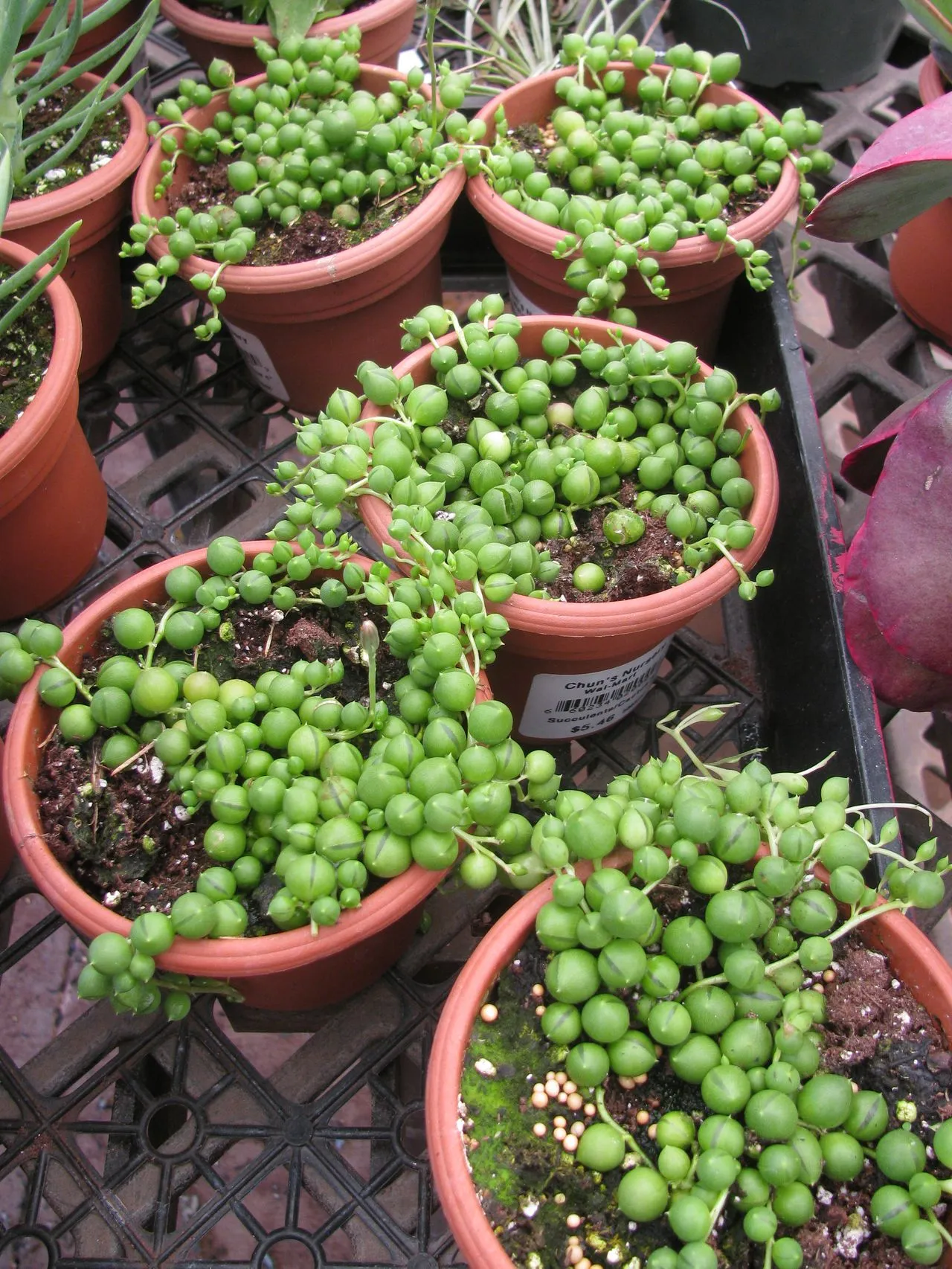
- Curio rowleyanus (string of pearls), formerly Senecio rowleyanus. The familiar trailing houseplant with bead-shaped leaves and translucent epidermal windows running down each leaf.
- Curio articulatus (candle plant, hot-dog cactus), formerly Senecio articulatus. Segmented blue-grey jointed stems that drop, callus, and re-root readily.
- Curio radicans (string of bananas, fishhook senecio), formerly Senecio radicans. Trailing stems with curved, banana-shaped leaves; vigorous and fast-growing in cultivation.
- Curio ficoides (skyscraper senecio, blue chalk fingers), formerly Senecio ficoides. Upright clumping habit with erect finger-shaped grey-blue leaves to about 30 cm.
- Curio herreianus (string of beads, string of watermelon, gooseberry plant), formerly Senecio herreianus. Larger, ovoid-to-elliptical leaves with longitudinal pinstripe windows; close to C. rowleyanus but coarser.
- Curio mandraliscae (blue chalksticks), formerly Senecio mandraliscae. Low-spreading ground-cover with upright pencil-thick blue leaves; widely planted as a landscape succulent in Mediterranean climates and California.
Other species that moved with the same split include Curio talinoides (formerly S. talinoides, the blue chalk fingers complex), Curio acaulis, Curio crassulifolius, and Curio repens. Curio as currently circumscribed contains roughly 18 to 22 species, almost all from southern and eastern Africa, ranging from low ground-covers to upright pencil-stemmed shrublets a few decimetres tall.
What still belongs in Senecio
Senecio sensu stricto remains vast, and the large majority of its species were never touched by the succulent split because they were never succulent in the first place. The familiar non-succulent senecios stay where they were:
- Senecio cineraria, silver ragwort or dusty miller. Herbaceous Mediterranean perennial with felted silver-grey leaves; a common bedding plant in cool-season displays.
- Senecio vulgaris, common groundsel. Ubiquitous garden weed across temperate Europe and naturalised across most of the world; soft-leaved, with bright yellow rayless flowerheads.
- Senecio jacobaea (placed by some authors in Jacobaea vulgaris), ragwort. Toxic to livestock, regulated as a noxious weed in the United Kingdom, Australia, and several other jurisdictions.
- Senecio macroglossus, the Natal ivy or wax vine. A climbing species occasionally confused with true ivy; borderline succulent, and a few authors have moved it into Curio, but most current databases retain it in Senecio.
A few species sit on the boundary. Senecio herreianus is the most contested: POWO and most aggregators (post-Kew 2018) treat it as Curio herreianus, but a small number of regional treatments and older horticultural references retain it under Senecio. Varietal forms such as S. herreianus var. limpopoensis in legacy literature still trail the original genus name. Expect minor disagreement on a handful of species; the major changes are settled.
What this means for the home grower
Practically, nothing about cultivation changes when a name moves from Senecio to Curio. Your string of pearls in its hanging basket has the same light needs, the same dry interval, the same propagation behaviour, and the same vulnerability to root rot under cold wet substrate. A Curio rowleyanus under bright filtered light, with the mineral substrate run nearly dry between waterings, behaves exactly the way Senecio rowleyanus did under those conditions in the 1980s. The new name is a phylogenetic statement, not a horticultural one. For substrate preparation and watering routines applicable to the Curio group, see succulent soil and substrate.
What does change is search behaviour at point of purchase. Most nurseries, particularly older retail chains and high-volume operations, still print labels with Senecio names because their plant tags were templated years ago, and the supply chain runs from grower to wholesaler to retailer over several seasons. Specialist succulent growers, online sellers updated since 2018, and almost all botanic garden labels now use Curio. Search both names when buying. Typing "Senecio rowleyanus" and "Curio rowleyanus" into the same online marketplace returns the same plant, often listed by different sellers at different prices, and the Senecio name still carries higher search volume in retail listings.
Care literature is split similarly. A book published before 2018 will refer to "Senecio rowleyanus", "Senecio radicans", and so on throughout, and the cultivation advice in those books remains correct. Articles published from 2019 onward increasingly use Curio as the primary name with the Senecio name in parentheses as a synonym. Both conventions are acceptable; neither is wrong.
For your own records, listing a plant in a personal collection as Curio rowleyanus (syn. Senecio rowleyanus) is the most future-proof format. It signals the current accepted name, retains the legacy name for search and cross-reference, and matches the style now used by Kew, the Royal Botanic Garden Edinburgh, and most academic herbarium databases.
When you might still see Senecio for these plants
Three contexts keep Senecio names in active circulation for the succulent species, and none of them is an error:
- Older cultivation literature. Books and articles written before the Kew 2018 acceptance use Senecio throughout. The text is still correct; only the genus has been renamed. A 1985 monograph on succulent senecios remains a useful reference if you mentally substitute Curio on first read.
- Trade labels. Nurseries take time to retemplate plant tags. A label printed in 2017 may still be in circulation in stock today, and growers who template their own tags often only update when they reprint. The same plant turns up under both genera in the same shop.
- Common-name search marketing. "Senecio string of pearls" remains a stronger search term than "Curio string of pearls" by a wide margin, and sellers index for what buyers actually type. This will likely shift over the next decade as the Curio name accumulates SEO weight, but for now the legacy name dominates online retail.
None of these makes Senecio wrong for these plants. Both names point at the same taxon, and a synonym in good standing is taxonomically valid. The taxonomic preference is Curio; the trade preference is, for now, still Senecio. The careful answer to "which name should I use" is: use Curio when writing for a botanically-aware audience, use Senecio when you want to be found by buyers, and write both if you want both at once.
See also
- Beginner's Guide to Succulents: light, water, and substrate fundamentals that apply across the Curio group in cultivation.
- Indoor Succulent Care — positioning and light for trailing Curio species in the home.
- Mealybug Identification — foliar pests common to string-form succulents including Curio rowleyanus.
- Quarantine New Arrivals — the inspection routine before introducing any new Curio to a collection.
FAQ
Does the name change mean I need to change how I care for my string of pearls?
No. The plant's light, water, and substrate needs remain identical. The name change is purely taxonomic, not horticultural.
Are both Senecio and Curio names valid for the same plant?
Yes. Both are accepted synonyms in trade. Search "Senecio rowleyanus" and "Curio rowleyanus" when buying - you'll find the same plant under both names, often at different prices.
Why do some nurseries still use the old Senecio name?
Nurseries update plant tags slowly. Many still use pre-2018 templates. The supply chain from grower to wholesaler to retailer spans multiple seasons, so older labels remain in circulation.
What about Kleinia - is that related?
Kleinia is a separate segregate genus sometimes used for pencil-stemmed African species. Some older lists may show "Kleinia rowleyana" but this is now considered incorrect - the correct name is Curio rowleyanus.
Frequently Asked Questions
What is the first step for senecio vs curio: a nomenclature update for trailing succulents?
Start by matching the symptom to the plant, substrate, light, and season before changing watering or treatment.
What should be avoided?
Avoid changing several variables at once; correct the limiting factor and observe the plant before escalating.
Which care factor matters most?
Match the plant to its light, substrate, pot size, and season. Most succulent failures trace to a mismatch between drying speed and the plant's current growth rate.
When should the plant be checked again?
Recheck after one to two weeks unless tissue is actively collapsing. Stable firmness and new growth are better signs than a fixed calendar interval.