| Question | Short Answer |
|---|---|
| Is Jovibarba allionii the same as Sempervivum allionii? | Yes in practical horticulture. |
| How large does Jovibarba allionii grow? | Mature rosettes are 2–4 cm wide, making it smaller than most common Sempervivum cultivars. |
| How hardy is Jovibarba allionii? | It is reliable to about −25 °C when dry. |
| How do you propagate Jovibarba allionii? | Use detached rolling chicks. |
Jovibarba allionii is a tight-rosette alpine succulent of the European mountain belt, first described in 1831 by Mertens and Koch as Sempervivum allionii and later transferred to the segregate genus Jovibarba by D.A. Webb in 1963. Its native range covers the Italian and French Alps and the Pyrenees, where it colonises rocky outcrops between 1,500 and 2,800 metres on both calcareous and siliceous substrates. The diagnostic feature is the flower: pale yellow, tube-shaped, with petals held nearly closed and partly fused at the base, in clear contrast to the open star-shaped flowers of true Sempervivum.
Part of the Complete Sempervivum Guide.
Jovibarba and Sempervivum: a contested split
The genus Jovibarba was segregated from Sempervivum by Webb on the strength of three reproductive characters. Where Sempervivum carries open six-petalled star-shaped flowers and produces chicks on stolons that stay anchored, Jovibarba carries six- to seven-petalled tube-shaped flowers with petals partly fused, and several of its species produce chicks that abscise spontaneously and roll free of the parent rosette. The split is recognised by the Royal Horticultural Society and underpins the current UK and Dutch trade nomenclature. Other authorities, including some recent molecular treatments, sink Jovibarba back into Sempervivum on the grounds that the genetic distance between the two groups is small. The practical consequence for growers is straightforward: the same plant turns up labelled both Jovibarba allionii and Sempervivum allionii depending on the supplier, and either label refers to the same species.
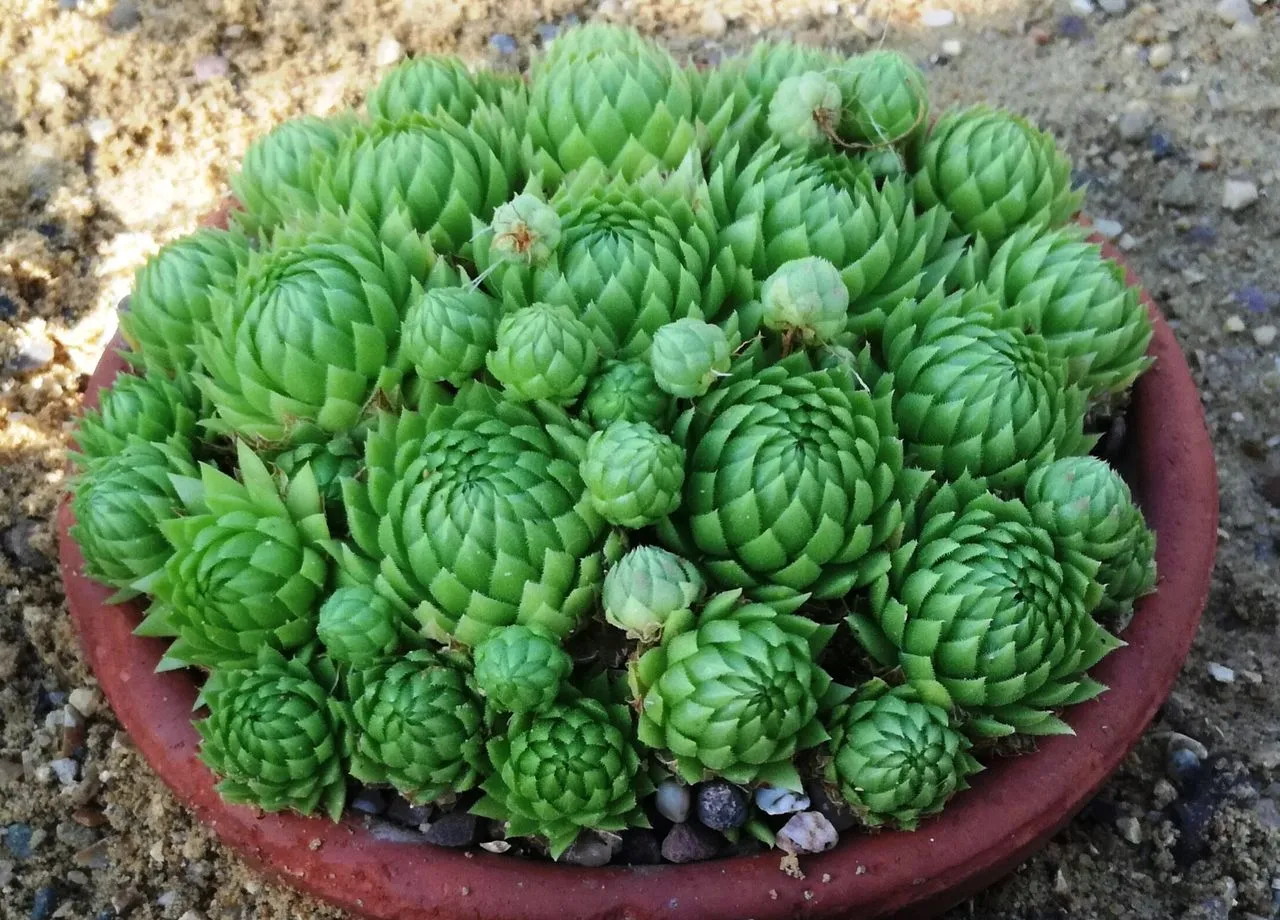
The "rolling hens-and-chicks" common name is the most useful field shorthand for the segregate genus. On a Sempervivum the chicks remain anchored on short stolons and form a static colony around the mother. On J. allionii the offset attaches by a brittle stolon that snaps under its own weight as the chick swells, releasing a tightly closed ball of leaves that rolls a few centimetres before settling and rooting. In the wild on a sloping alpine scree this produces a slow downhill drift of clones; in cultivation it produces a low expanding mat that fills cracks rather than a tidy fixed cushion.
Identification
A mature rosette of J. allionii sits at 2 to 4 cm wide, near the small end of the genus and substantially below the typical Sempervivum size. Leaves are narrow, finely pointed, 1.0 to 1.5 cm long, and pack tightly into a near-spherical closed rosette through the dry season. Foliage colour runs from a clear yellow-green through grey-green depending on substrate and sun load, and the leaf tips flush red-purple under summer drought stress. The whole rosette is fine-textured and slightly tacky to the touch from glandular hairs along the leaf margins.
Flowering scapes appear on established rosettes in mid to late summer. The scape rises 8 to 15 cm and carries pale yellow flowers in tight terminal cymes. Each flower is 1 to 1.5 cm long, tube-shaped, with petals held forward and partly fused, never opening flat. This is the single most reliable character separating Jovibarba from Sempervivum in the field. If a rosette is in flower with open six-petalled stars, it is a Sempervivum; pale yellow tubular flowers held nearly closed are J. allionii or one of its sister Jovibarba species.
Three lookalikes regularly cause confusion in trade.
Jovibarba globifera, formerly Sempervivum globiferum, is the closest sibling. Same segregate genus, same tube-shaped flower, but rosettes are noticeably larger at 4 to 8 cm and the leaves are broader and more spatulate. If a rosette is wider than 4 cm and the leaves are clearly broad rather than narrow-pointed, you are looking at J. globifera, not J. allionii.
Sempervivum tectorum, the type species of the original genus, is far larger (rosettes 8 to 15 cm), with broad triangular leaves and open star-shaped pink to red-purple flowers on a 20 to 40 cm scape. The size and the flower form together rule out confusion once a flowering rosette is present.
Sempervivum arachnoideum matches J. allionii on rosette size but carries diagnostic white trichome webbing between the leaf tips and produces star-shaped pink flowers. J. allionii never webs and its flowers are yellow and tubular.
Cultivation
Light. Full direct sun, 6 hours minimum, is needed to keep the rosette tightly closed and to push the leaf tips into their summer red-purple flush. Below that threshold the rosette opens, the leaves elongate and pale, and offset production slows. South or southwest exposure outdoors works well. The species performs poorly indoors because most of the UV that drives the leaf-tip pigmentation is filtered out by window glass.
Substrate. Use the sharply drained alpine mix described in the complete Sempervivum guide: about 60 percent pumice or 3 to 6 mm horticultural grit, 20 percent coarse sand, and 20 percent loam-based compost. J. allionii accepts both calcareous and slightly acid substrates, reflecting its natural range across limestone and granitic alpine geology. Top-dress with 1 to 2 cm of grit to keep the lower leaves dry and to give detached chicks somewhere clean to root.
Water. In containers, water thoroughly when the top 3 cm of substrate reads dry on a moisture probe, then leave alone until the substrate is dry again. In active spring and autumn growth that pattern lands at roughly once every 7 to 10 days; in summer high-temperature dormancy and through winter, water minimally or not at all. The failure mode is winter wet, never winter cold. A plant stable at minus 25 °C in dry snow will rot at plus 2 °C in saturated compost.
Temperature. Fully temperate-hardy. Reliable to about minus 25 °C bone-dry, consistent with the species' natural altitudinal range up to 2,800 metres in the Alps, where mid-winter air temperatures regularly drop into the minus 20s under dry snow cover. Summer heat above 30 °C triggers a tight rosette closure that is normal and not a sign of distress.
Pot and placement. A 9 to 12 cm shallow pan suits a single mature rosette and the first generation of free-rolling chicks. Larger troughs, paving cracks, and dry-stone walls hold a colony cleanly for years. The species is well suited to small alpine troughs because the diminutive rosette and rolling-chick habit fill a vertical face evenly without crowding.
Propagation
Vegetative, by detached chicks. J. allionii makes propagation almost effortless: free-rolling chicks land on the substrate, root in 3 to 6 weeks, and establish into mature rosettes within a single growing season. Active intervention is rarely needed; pick up the loose chicks, press them firmly onto fresh grit-topped substrate, and water lightly once.
If you want to accelerate the process, sever the brittle stolon yourself with sterile scissors once the chick swells and shows the first hint of detachment. No callusing period is required because the abscission zone is structurally designed to break, and the wound seals within hours.
Seed propagation is possible but rarely worthwhile in cultivation. Seed germinates well on a moist grit surface in spring at 15 to 20 °C, but seedlings take 2 to 3 years to reach a flowering-size rosette, where a detached chick reaches the same point in a single season.
Notes
J. allionii is not widely stocked in mainstream chain-store trade because the rosette is too small to make a saleable single-pot specimen at supermarket pot sizes. It is, however, a fixture of specialist alpine nurseries across the UK, Germany, and the Netherlands, and it is one of the more reliable additions to a true alpine trough for growers who want the rolling-chick habit on display. The beginner's guide to succulents covers the cross-genus basics on light, water, and the common early mistakes that affect Jovibarba and Sempervivum alike.
Pests and disease follow the houseleek pattern. Root mealybug is the commonest hidden problem in pot-grown stock. Rust (Endophyllum sempervivi) infects Jovibarba as readily as Sempervivum and is unrecoverable when it does appear; the affected plant must be destroyed rather than treated.
Trade nomenclature remains unsettled. UK alpine nurseries have used Jovibarba for decades and will not switch back without stronger phylogenetic evidence than is currently published. Continental European nurseries are more variable, and a plant labelled Sempervivum allionii on an Italian or French list is the same species as one labelled Jovibarba allionii in a UK catalogue. Buy on the basis of rosette size, leaf form, and flower shape rather than on the genus name on the label.
See also
- The Complete Sempervivum Guide, the genus pillar covering taxonomy, cultivation, and propagation, including the wider treatment of Jovibarba segregates.
- Beginner's guide to succulents, for cross-genus basics on light, water, and the common early mistakes new growers make with houseleeks.
Frequently Asked Questions
Is Jovibarba allionii the same as Sempervivum allionii?
Yes in practical horticulture. Suppliers use both names depending on whether they recognise Jovibarba as a segregate genus.
How large does Jovibarba allionii grow?
Mature rosettes are 2–4 cm wide, making it smaller than most common Sempervivum cultivars.
How hardy is Jovibarba allionii?
It is reliable to about −25 °C when dry. Winter wet in saturated compost is the serious failure mode.
How do you propagate Jovibarba allionii?
Use detached rolling chicks. They root in 3–6 weeks and can reach mature size within a single growing season.