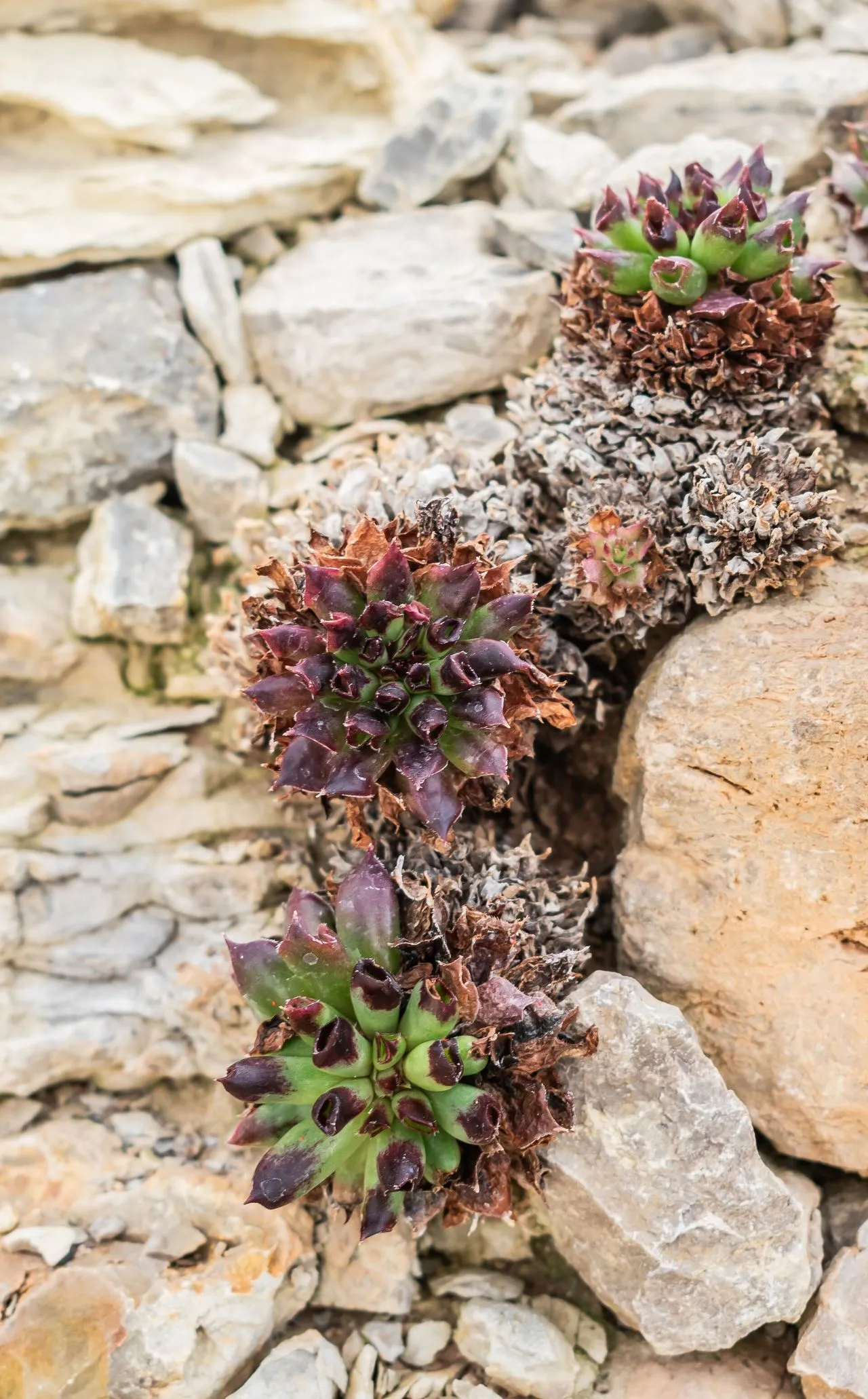
Soft leaves in Sempervivum are one of the most consistently misdiagnosed symptoms in the genus, because the same visible presentation — a leaf that yields to gentle pressure — can result from two physiologically opposite conditions: a plant that has had too little water, or a plant that has had too much. Correct diagnosis dictates correct treatment. An incorrect treatment makes either problem significantly worse. A drought-stressed plant that is not watered will continue desiccating; a rotting plant that receives more water accelerates the pathogen's access to healthy tissue.
Part of the Complete Sempervivum Guide.
Drought-softening: too little water
Sempervivum stores water in its fleshy leaves, and when the root zone has been dry long enough that the plant exhausts its root-absorbed supply, it begins drawing on that stored leaf water. As the leaf cells lose turgor, the leaves become pliable and soft rather than firm. At this stage the plant is functioning correctly — it is using its reserves as intended — but those reserves are finite, and extended drought beyond this point leads to visible wilting, shrivelling, and eventually desiccation of the leaf cells.
Drought-soft leaves have three characteristics that distinguish them from rot-soft leaves:
Texture: Rubbery, pliable, and slightly spongy. They flex without releasing liquid and return approximately to their shape if bent carefully. Think of a semi-deflated balloon rather than a wet sponge. The surface of the leaf remains smooth and intact; it has not broken down.
Distribution: The softening affects the outer leaves first, working inward as drought deepens. The innermost leaves, closest to the growing point, remain firmer longest because the plant prioritises water delivery to the meristem. If the outermost two or three whorls are soft but the centre is still firm, this pattern is consistent with drought.
Smell: None, or the normal faint earthy smell of the substrate. There is no sourness, fermentation, or putrefaction. If any sour smell is present at the rosette centre or base, drought is not the primary cause.
The substrate will also be dry to the touch at 4 cm depth or more, and there will typically be a clear drought history — no rain or supplemental watering for three or more weeks in a container, or a documented dry spell in ground-planted mats.
Treatment is a single, deep watering. Pour until water exits the drainage holes or the soil at 10 cm depth is visibly moist. Do not water again until the top 3–4 cm are dry. The leaves will firm up progressively over 24–48 hours as root water uptake resumes.
Over-watering before rot sets in
Before rot is established, a consistently over-watered Sempervivum shows leaves that are unusually swollen, over-turgid, and translucent around the edges — the reverse presentation of drought, with too much water in the leaf cells causing the cells to swell toward their structural capacity. These leaves may feel slightly squishy or over-pressured rather than pliable, and the leaf tissue can appear almost water-bloated, especially near the tips. The leaves may also crack at the tips if pressure continues to build.
At this stage the plant is not yet rotting, but the roots are operating at the limit of their oxygen supply in saturated substrate. Continued waterlogging allows anaerobic pathogens to begin colonising the root zone. The correct response is to stop watering completely and allow the substrate to dry out fully before the next watering event. Move containers to a position with more airflow to accelerate substrate drying. Do not fertilise — a plant under water stress cannot metabolise nutrients, and fertiliser salts can further stress already-damaged roots.
Crown rot: soft at the centre
Crown rot begins at the growing point of the rosette — the tightly packed central leaves — and progresses outward and downward. The mechanism is fungal, most often Botrytis cinerea (grey mould) or Fusarium species, triggered by warm, humid conditions that keep the rosette centre wet for extended periods. By the time crown rot is visible from outside the rosette, it is typically already well-established at the centre — the tight geometry of the rosette conceals the early damage behind layers of apparently healthy outer leaves.
To check for crown rot, use two fingers to gently part the innermost leaves. If the inner tissue is brown, wet, or slimy, and produces a sour or musty smell at close range, crown rot is active. The outer leaves may still appear firm, green, and healthy, giving a false impression of a plant in good condition.
Crown rot in an individual rosette is almost never recoverable once the growing point is destroyed. The rosette should be removed cleanly with a sterile blade at the stolon connection and the affected material disposed of — not composted. Assess the surrounding area: press the centres of adjacent chicks. If those centres are firm, the chicks have escaped the infection and should be separated, allowed to dry for 2–3 days, and replanted in fresh, well-draining substrate in a position with better airflow. See Sempervivum rotting in summer for the full diagnostic and treatment protocol for crown rot, including the specific conditions that favour it.
Root rot: soft at the base
Root rot presents differently from crown rot. The first visible sign above ground is that the rosette leaves become soft, lose turgor, and may yellow — symptoms that can initially resemble drought, because the root rot is preventing normal water uptake even if the soil is moist or wet. The critical diagnostic feature is that the base of the rosette, at the soil line, becomes brown, dark, and mushy before the crown does.
To check: unpot the plant or carefully clear soil from around the base of the rosette stem. Healthy Sempervivum stems are pale, firm, and slightly woody at the base. Root rot presents as dark brown to black, soft, and wet tissue at the stem base and on the roots. The smell originates from the root zone and the stem base rather than the crown, and will be sour or faintly putrid even if the above-ground leaves look merely soft rather than dead.
Once root rot has reached the stem base of the main rosette, that rosette is unrecoverable. Remove it and inspect surrounding chicks by pressing their crowns — firm centres indicate the chicks have escaped. Separate healthy chicks, allow the stolon attachment point to dry for 2–3 days, and replant in fresh, very gritty substrate. The step-by-step root inspection and recovery procedure is in root rot diagnosis.
Localised softening: mechanical damage or mealybug
Localised soft spots — a single leaf or a cluster of leaves on one side of the rosette — that do not follow either the crown-outward (rot) or outer-inward (drought) distribution pattern usually indicate one of two things: mechanical bruising from an impact, or mealybug feeding.
Mealybugs remove cell sap from individual leaves over an extended period, causing targeted softening and yellowing in a pattern that does not correspond to the expected spatial spread of rot or drought. The softening often appears in the leaf axils where mealybugs are feeding rather than at the crown or base. Check the leaf axils at the base of any softened leaf for white, cottony mealybug tufts. If present, treat with 70% isopropyl alcohol on a cotton swab applied directly to each visible insect, and check the root ball for root mealybug if the softening is widespread without any aerial insects being found.
How to identify the cause
| Feature | Drought | Crown rot | Root rot |
|---|---|---|---|
| Leaf texture | Pliable, rubbery, no liquid | Mushy, slimy, releases liquid | Soft and yellowing |
| Smell | None | Sour at rosette centre | Sour at stem base and roots |
| First area affected | Outer leaves, working inward | Rosette centre, working outward | Stem base, then root zone |
| Soil condition | Dry | Normal or moist | Wet or compacted |
| Recovers with watering | Yes, within 48 hours | No — watering accelerates rot | No — watering accelerates rot |
Risk and severity
Drought softening is low risk if caught before leaves begin to wrinkle and thin to a papery texture. Water once and the plant recovers fully within a few days. Drought pushed to the extreme — leaves visibly papery and the plant not responding to watering — may indicate secondary root damage or root mealybug interfering with uptake, and requires unpotting to diagnose.
Crown rot is an emergency. In summer warmth, a rosette that produces a faint sour smell at 08:00 can be fully liquefied by 18:00. Do not delay assessment. The window for saving surrounding chicks from a crown-rotting mother is measured in hours during warm weather, not days.
Root rot is slightly slower-moving but irreversible in the affected rosette. The priority is stopping the spread to surrounding chicks by removing the affected plant and improving drainage before the next rain event or watering.
Over-watering without established rot is the most recoverable scenario: stop watering, improve drainage and airflow, and the plant will normalise over 10–14 days with no further intervention.
Solutions
Drought
Water once, deeply, until water exits the drainage holes or the soil at 10 cm depth is moist. Do not water again until the top 3–4 cm of substrate are fully dry. If the plant does not firm up within 48 hours despite moist soil, unpot and inspect the roots for damage or root mealybug.
Crown rot
Remove the affected rosette cleanly with a sterile blade at the stolon connection. Bag the material and dispose of it — do not compost. Allow the wound area to air-dry for 24 hours. Assess adjacent chicks by pressing their crowns — firm crowns indicate the chicks are unaffected. Separate healthy chicks, dry the attachment point for 2–3 days, and replant in fresh substrate in a position with significantly better airflow. Apply a coarse grit top-dressing of 2–3 cm depth around the base of each replanted chick to keep the crown dry after rain.
Root rot
Unpot the plant or excavate the stem base. Cut all dark, wet roots and stem tissue back to firm pale tissue with a sterile blade. Dust the cut surface lightly with powdered cinnamon or horticultural sulphur as a desiccant fungicide. Allow to dry, bare-root, in shade with good airflow for 5–7 days. Repot in fresh, very gritty substrate — at least 60% inorganic material by volume. Water minimally for the first 3–4 weeks to allow new root development without re-creating saturated conditions. Follow the detailed protocol in root rot diagnosis.
Over-watering (pre-rot)
Stop all supplemental watering. Move containers to an open, breezy position to accelerate substrate drying. Do not water again until the substrate is fully dry to at least 5 cm depth. If improvement is not visible within two weeks, unpot and inspect the roots before deciding on further treatment.
Prevention
Substrate composition: Use a gritty mix with at least 50–60% inorganic material — pumice, perlite, or coarse horticultural grit. The finished substrate should drain within seconds of watering. Fine-textured potting compost retains too much moisture at the root zone for Sempervivum and is the primary substrate-related cause of root rot.
Watering discipline: In containers, water only when the top 3–4 cm of substrate are fully dry. In the ground, established Sempervivum mats in temperate climates need no supplemental watering outside of prolonged summer drought. In autumn, allow the substrate to become drier than in the growing season — the plants are entering dormancy and need significantly less water than in spring and early summer.
Grit top-dressing: A 2 cm layer of sharp horticultural grit around each rosette base keeps the lowest leaves dry after rain and improves airflow at crown level — the two factors that most directly prevent crown rot. See Sempervivum turning brown for how a grit collar also prevents the brown lower-leaf discolouration from soil splash that is sometimes mistaken for disease.
Autumn and winter management: Reduce watering in September and October. Move container plants under an open shelter to keep crowns dry during winter wet spells. The plants do not need warmth — they need a dry crown. A Sempervivum at −20 °C in dry conditions is safer than one at +2 °C in wet compost.
See also
- Sempervivum rotting in summer — the full crown rot and root rot diagnostic for warm-season rotting with humidity as the primary driver.
- Root rot diagnosis — the root-by-root assessment and recovery procedure applicable to Sempervivum and other succulent genera.
- Why is my Sempervivum dying? — the three-cause diagnostic for a plant that has collapsed, covering monocarpy, winter rot, and rust alongside pathological rot.
Frequently Asked Questions
Why are my Sempervivum leaves soft and squishy?
Squishy or mushy leaves that release liquid when pressed indicate rot — either crown rot from sustained humidity at the rosette centre, or root rot from a waterlogged root zone. Remove affected tissue immediately, allow the area to dry thoroughly, and correct the drainage or airflow problem before replanting.
Why are my Sempervivum leaves soft but not mushy?
Soft but pliable, rubbery leaves without mushiness or liquid indicate drought stress. The plant has been mobilising stored water from the leaf cells. Water once thoroughly and the leaves will firm up within 24-48 hours as root uptake resumes.
Can a Sempervivum recover from soft mushy leaves?
It depends on how far the rot has progressed. Mushy tissue confined to one or two outer leaves can be removed and the plant often survives. If the centre of the rosette is mushy, the growing point is lost and the rosette is unrecoverable — but surrounding chicks with firm centres usually survive if separated promptly.
Is it normal for Sempervivum to have soft lower leaves?
Old lower leaves naturally dry out and become papery as the plant sheds them in normal senescence — they do not go soft. Softening lower leaves almost always indicate drought stress (outer leaf ring) or rot at the base of the stem. Inspect the stem base closely for dark discolouration.