| Question | Short Answer |
|---|---|
| Why are Sempervivum 'Oddity' leaves tubular? | The cultivar carries a stable developmental mutation in leaf patterning, so each blade rolls inward along its length. |
| Is 'Oddity' a cristate sempervivum? | No. |
| Does 'Oddity' need special care? | Only water management differs. |
| Can Sempervivum 'Oddity' be grown from seed? | No if you want the named form. |
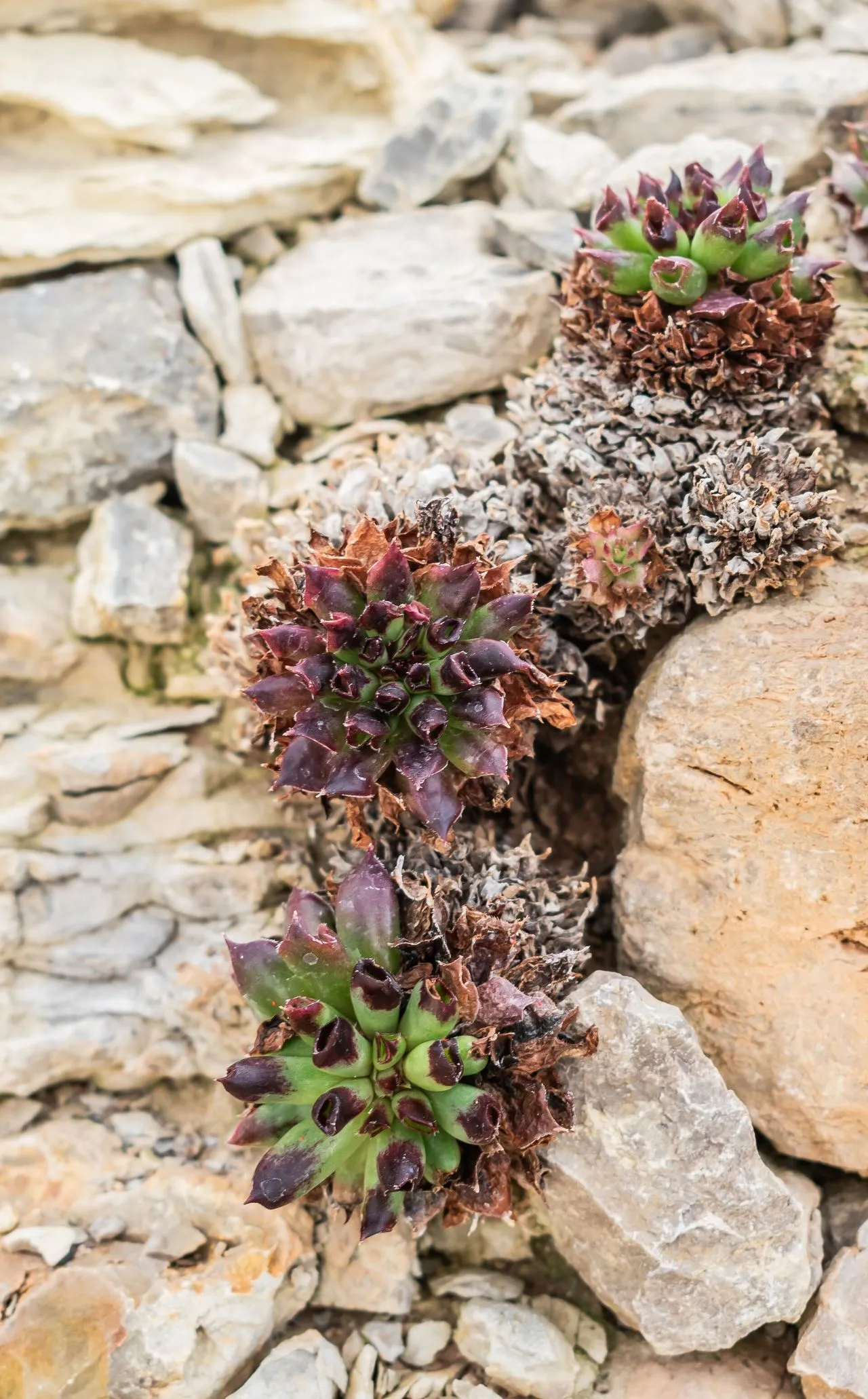
Sempervivum 'Oddity' is a novelty cultivar famous for its leaf morphology: the leaves roll inward along their length, forming open tubes rather than the flat blades that typify the genus. The cultivar originated in the mid-twentieth century as a spontaneous mutation in a cultivated collection, and has been vegetatively propagated from the original clone ever since.
Part of the Complete Sempervivum Guide.
The rolled-leaf trait is a developmental mutation in the leaf adaxial/abaxial patterning: the two sides of the leaf grow at different rates, curling the blade upward along its midrib. The mutation is stable in vegetative propagation but does not breed true from seed.
Identification
- Rosettes. 6–10 cm across at maturity, open and slightly cupped.
- Leaves. The diagnostic character. Each leaf is tubular, 2–4 cm long, with the blade rolled inward so that only the underside is visible from above; each leaf tip often has a small red spot at the open end of the tube. The overall look is of a cluster of short green fingers or a sea-anemone rather than a flat rosette.
- Colour. Light to mid-green, with red-brown tips particularly pronounced in cold weather. The plant does not develop the all-over red pigmentation of selections like 'Red Beauty'; its visual interest is structural, not chromatic.
- Inflorescence. Typical tectorum-group pink 12-petalled star flowers on a 20–30 cm scape. The scape leaves are also tubular, which is a pleasant confirmation of the stability of the trait.
- Offsets. Produced on short stolons in the genus norm; chicks develop the tubular leaves from their first few whorls.
Cultivation
Cultivation follows the pillar defaults with no meaningful adjustment. 'Oddity' takes full sun, gritty substrate, minimal water, cold winters. Hardy in USDA zones 4–8.
The one practical caution: the tubular leaves catch water. In wet weather each leaf-tube can hold a droplet for hours, and in poorly drained conditions the trapped water invites rot at the leaf base. Plant on a slope or top-dress heavily with grit, and avoid overhead watering. In maritime climates, a tilted planter works better than a flat one.
Do not feed. Nitrogen produces vigorous soft growth that loses some of the tube structure; lean substrate keeps the rolling effect tight and pronounced.
Propagation
Offset division only. The tubular-leaf trait is a stable clonal characteristic but does not segregate predictably in seed. Any seed-grown progeny will revert overwhelmingly to normal flat-leaved rosettes within a generation or two.
The chicks are easy to see around the mother precisely because the tubular leaf structure leaves gaps between the leaves and open sight lines down to the base of the rosette — unlike dense flat-leaved cultivars where the chicks can hide for weeks. Cut the stolon, lift, replant.
Notes and Quirks
'Oddity' is almost always bought for the novelty of the leaf form. In a mixed trough it is eye-catching as a contrast against flat-rosetted neighbours; on its own it photographs as a strange compact green mass rather than a conventionally beautiful rosette.
The cultivar is occasionally confused with monstrose or cristate forms of other sempervivums, but the mechanism is different: cristate plants have a disrupted apical meristem producing fan-shaped growth, while 'Oddity' has normal apical meristem function with malformed individual leaves. The practical effect is that 'Oddity' stays healthy and normally vigorous, while true cristates tend to be weaker and slower than the parent species.
Similar leaf-rolling mutations have appeared in other Sempervivum cultivars since, including several Eastern European selections traded as "Quills" or "Tubes", but the original 'Oddity' remains the most widely propagated.
See also
- Sempervivum tectorum — the underlying species.
- Sempervivum Chick Charms — a commercial series with other structurally unusual selections.
- The Complete Sempervivum Guide — the genus overview.
- Red Beauty Sempervivum — the all-over red-pigmented counterpart for chromatic contrast in a mixed planting.
Frequently Asked Questions
Why are Sempervivum 'Oddity' leaves tubular?
The cultivar carries a stable developmental mutation in leaf patterning, so each blade rolls inward along its length.
Is 'Oddity' a cristate sempervivum?
No. The apical meristem is normal; the individual leaves are malformed into tubes. Cristates have disrupted fan-shaped meristem growth.
Does 'Oddity' need special care?
Only water management differs. The leaf tubes catch droplets, so sloped planting and heavy grit top-dressing reduce rot risk.
Can Sempervivum 'Oddity' be grown from seed?
No if you want the named form. The tubular trait is clonal and seed-grown progeny usually return to flat rosettes.