| Question | Short Answer |
|---|---|
| Is Agave celsii the accepted name? | No. |
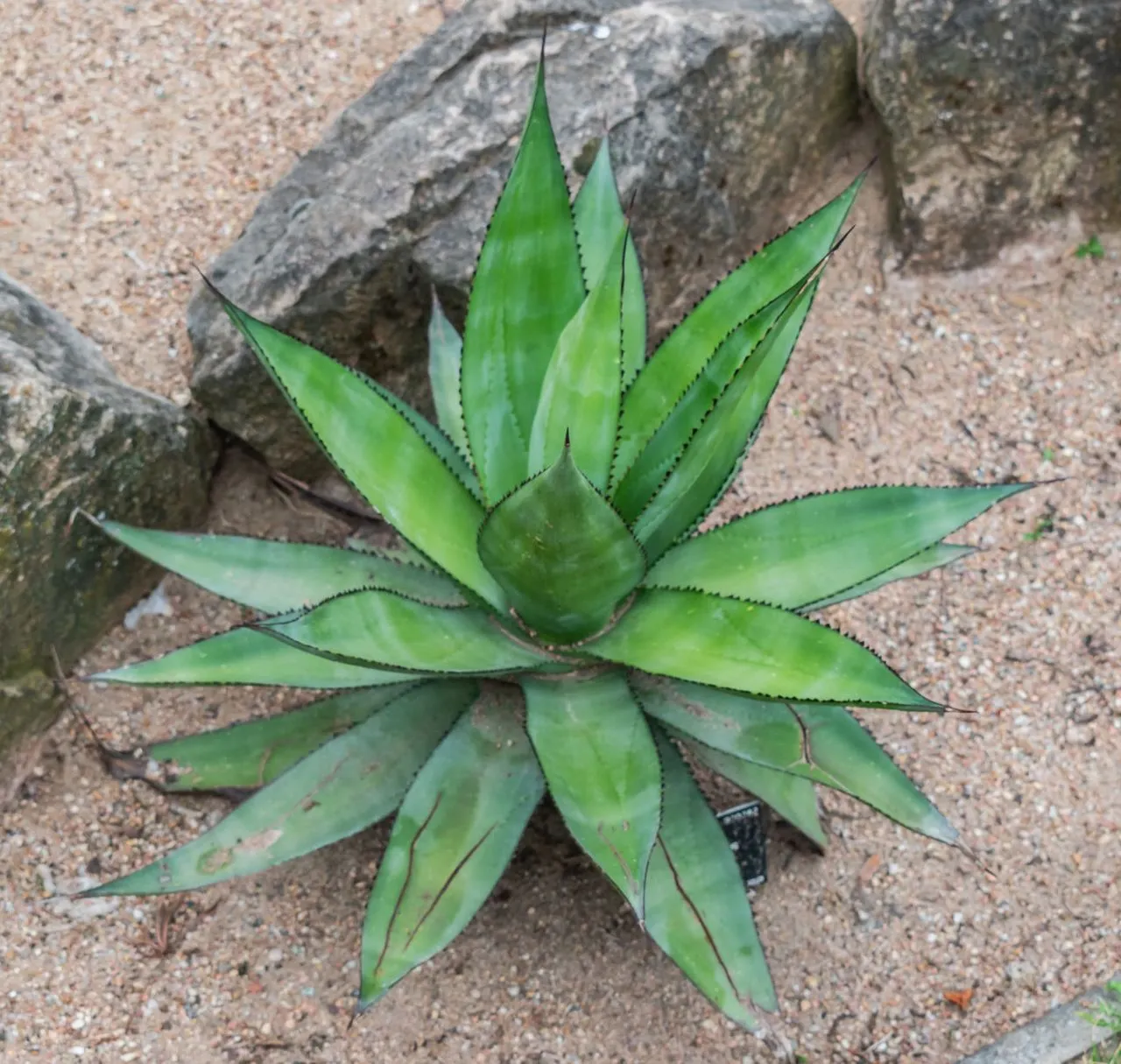
| How do you identify Agave mitis? | Look for a 60–80 cm open rosette, broad pale green to glaucous leaves, soft marginal teeth, and a short blunt terminal point. |
| How cold-hardy is Agave mitis? | A dry, established plant can survive brief drops to about −4 to −6 °C. |
| How do you propagate Agave mitis? | Offsets are the practical method. |
Agave mitis Martius, the soft agave or maguey de manso, was formally described in 1848 by Carl Friedrich Philipp von Martius, the German botanist whose Brazilian work dominated nineteenth-century plant taxonomy. The species is native to central and eastern Mexico, in particular the limestone country of Hidalgo, Querétaro, San Luis Potosí, and Tamaulipas, where rosettes grow on calcareous slopes between roughly 800 and 2,400 m. The defining features are an open rosette of broad, soft, pale green to glaucous leaves, fine soft marginal teeth, and a short, blunt terminal point that lacks the rigid spine carried by almost every other agave on a similar bench.
In habitat, A. mitis belongs to limestone ledges, cliff faces, and steep scree under thorn forest or oak woodland, where rooting space is shallow and rainwater leaves the crown quickly. The substrate is alkaline to strongly alkaline, the canopy above is partial rather than dense, and dry seasons are pronounced enough to drive a slow, conservative growth rhythm. Despite the wide elevation band, individual populations are localised. The plant rarely forms continuous stands; it sits in pockets along a fissure line or in the lee of a rock outcrop. The species is broadly considered Least Concern in regional assessments, though limestone habitat loss and extraction pressure on individual populations are real local concerns.
Part of the Complete Agave Guide.
Taxonomy note: Agave celsii is Agave mitis
The synonymy here is the practical issue. Hooker described Agave celsii in 1856 from a cultivated plant at Kew, almost a decade after Martius had published Agave mitis in 1848. Under the botanical rule of priority, the earlier validly published name wins, so A. mitis is the accepted scientific name and A. celsii is treated as a synonym. The catch is that horticulture lagged behind taxonomy by more than a century, and "Agave celsii" persisted in nursery catalogues, garden labels, and reference books well into the 2000s. You will still see both names in trade today, sometimes on the same plant.
Two infraspecific name fragments add minor confusion. The names "var. albidior" (paler, more glaucous form) and "var. mitis" (the type form) circulate in collections. Both sit under A. mitis in current usage. If you receive a plant labelled Agave celsii, you almost certainly have A. mitis; the rosette traits below are how to confirm it.
Identification
A mature A. mitis forms an open, somewhat lax rosette typically 60-80 cm wide. The leaves are broad, fleshy, and lanceolate, usually 35-55 cm long and 8-12 cm wide near the base, narrowing toward the tip. Colour is pale green to glaucous green, often with a faint waxy bloom in strong light, and individual clones can sit anywhere along that range without leaving the species. A loose central spear sits above the rosette plane at any given time, with older leaves curving outward and downward as new ones rise.
Two leaf details settle the ID. First, the margins carry small, soft, pale teeth set on a very fine raised edge. The teeth are easily compressed by a fingernail and are nothing like the rigid brown hooks that characterise large landscape agaves. Second, and unusually for the genus, the terminal point is not a true rigid spine. It is a short, soft, often paler tip that may extend the leaf by a centimetre or two but does not puncture skin. This single trait, a blunt or near-spineless apex, is the most useful character for separating A. mitis from the dozens of broad-leaved agaves it shares a bench with.
Flowering is monocarpic and rare in cultivation. After many years, an individual rosette sends up a slender racemose panicle, typically 3-5 m tall, carrying greenish-yellow tubular flowers along the upper portion. The shape matters here: this is a straight unbranched rod with flowers held closely along it, not the heavy candelabra panicle of Agave salmiana or Agave americana. The flowering rosette dies after fruiting, but well-grown clumps with offsets continue.
Three lookalikes account for most trade confusion. Agave attenuata, the foxtail agave, can look related at a glance but lacks marginal teeth entirely, reads a clear paler yellow-green, and develops a long visible trunk under older rosettes. Agave bracteosa, the squid agave, also lacks a sharp terminal spine but carries narrow, recurved, strap-like leaves that sit nothing like the broad lanceolate leaves of A. mitis. Agave ovatifolia, the whale's tongue agave, can be confused on size and broad leaves alone but is decisively heavier, much more glaucous blue, with prominent rigid terminal spines and a wider mature rosette to about 1.5 m. If the plant in front of you is broad-leaved, pale green, with soft teeth and a soft tip, it is A. mitis. If it carries any one of those four lookalike traits, it is one of the other species.
Cultivation
Light should be bright but not the hardest direct exposure. Outdoors in temperate or Mediterranean climates, six hours of morning sun with afternoon dapple suits A. mitis well. Inland desert sun can scorch the soft pale leaves, especially in young plants moved suddenly, so introduce sun gradually. Indoors, the plant accepts a bright unobstructed east window or a south window with light afternoon screening; in lower light the rosette opens further and leaves stretch, but the species tolerates this better than the dense armed agaves. The broader principles of light, watering, and substrate for new growers are covered in the beginner's guide.
Substrate should be mineral and alkaline-friendly. A practical container mix is 60-70% mineral material, with pumice, lava rock, coarse limestone grit, and expanded shale as good components, and 30-40% loam-based compost. A handful of crushed limestone or dolomite chips matches the alkaline scree the species evolved on and helps keep the substrate pH stable over time. Avoid peat-heavy mixes, which hold water at the centre of the rosette base and invite rot in a leaf canopy that hides the problem until late.
Water deeply during active growth, then let the upper third to half of the substrate dry before watering again. In a 20 cm terracotta pot in warm weather, that interval is typically 10-18 days. The broad leaves hold water more visibly than narrow-leaved agaves, so watch leaf firmness at the base of the rosette as a cue. If lower leaves stay plump after a long dry interval, the plant is fine; if they soften noticeably, water deeply. In winter, keep the root zone almost dry, especially below 8 °C.
Frost tolerance is moderate but real. A settled plant with a bone-dry root ball survives brief drops to about -4 to -6 °C without lasting damage. The terminal spear and outer leaf tips are the first to mark, and prolonged wet cold below freezing is the lethal combination, not the cold by itself. In winter-rain climates, container plants belong under glass, beneath a deep eave, or in an unheated bright porch. Open-ground plantings need a south-facing slope or a raised mineral bed where rainwater leaves the crown immediately.
Pots can stay modest. A. mitis has a fibrous root system that does not demand depth, and a slightly snug pot encourages a tighter rosette form. Terracotta is helpful in temperate or coastal climates because the porous wall accelerates drying after watering. Feed lightly: a low-nitrogen fertiliser at one-quarter to one-half label strength, once in spring and once in early summer, is enough. Heavier feeding gives longer, weaker leaves and accelerates the loose habit that already troubles indoor specimens.
Propagation
Offsets are the practical method for this species. A. mitis suckers fairly reliably from the base, sometimes producing pups while the parent rosette is still well short of mature. Wait until a pup has its own roots and is at least 8 cm across, then sever the connecting stolon cleanly with a sharp blade. Let the wound dry for 5-10 days in shade, pot into dry mineral mix, and wait another week before watering. Rooted offsets resume growth within 4-8 weeks in warm conditions and reach a recognisable rosette within 12-24 months.
Seed works for maintaining genetic diversity but is much slower. Fresh seed germinates in 14-28 days at 22-26 °C on a fine mineral surface with light coverage. Seedlings begin as narrow green straps and only gradually broaden into the lanceolate adult leaf. Plan on three or more years to a presentable specimen. Use seed when you want true species material rather than the occasionally drifted clones that circulate in trade under either name.
Detached leaves do not root for A. mitis, as is generally true across the genus, so do not waste material trying.
Notes
The two practical risks for A. mitis in cultivation are mistaken identity and crown rot. The mistaken identity is downstream of the synonymy: a plant sold as A. celsii is A. mitis, but a plant sold as either name might in fact be a clone of A. attenuata mislabelled by a wholesaler. Confirm using the soft tip, the broad pale lanceolate leaves with soft teeth, and the absence of a long visible trunk under older rosettes. Crown rot follows from peat-heavy mixes, oversized pots, or winter watering that continued out of habit when the plant had stopped using water. Both failures are preventable with a mineral substrate and a hands-off winter.
Pests are mostly secondary. Mealybugs occasionally settle in the leaf axils, especially under glass with poor air movement; check by parting outer leaves with a soft probe rather than fingers, since the soft apex masks how close to the centre the bugs have reached. Scale appears occasionally on plants kept in still indoor air. The agave snout weevil that targets large landscape agaves rarely concerns A. mitis at typical container size, though garden specimens in weevil regions deserve the same vigilance as any other agave.
For genus-level cultivation, hardiness, flowering, and propagation context that frames this species against its broad-leaved siblings, see the Complete Agave Guide.
See also
- Complete Agave Guide - genus-level cultivation, flowering, hardiness, and propagation.
- Agave attenuata - the foxtail agave, with no marginal teeth and an obvious trunk under older rosettes.
- Agave bracteosa - the squid agave, with narrower recurved leaves and a similarly soft, blunt tip.
- Agave winter damage — wet-cold risk for soft-tipped limestone species kept in containers.
Frequently Asked Questions
Is Agave celsii the accepted name?
No. Agave mitis is the accepted name; Agave celsii persists in nursery catalogues as a horticultural synonym.
How do you identify Agave mitis?
Look for a 60–80 cm open rosette, broad pale green to glaucous leaves, soft marginal teeth, and a short blunt terminal point.
How cold-hardy is Agave mitis?
A dry, established plant can survive brief drops to about −4 to −6 °C. Prolonged wet cold below freezing is the lethal combination.
How do you propagate Agave mitis?
Offsets are the practical method. Wait for a rooted pup at least 8 cm across, callus the cut for 5–10 days, then pot dry.