| Question | Short Answer |
|---|---|
| What is Agave salmiana used for? | It is a major pulque agave. |
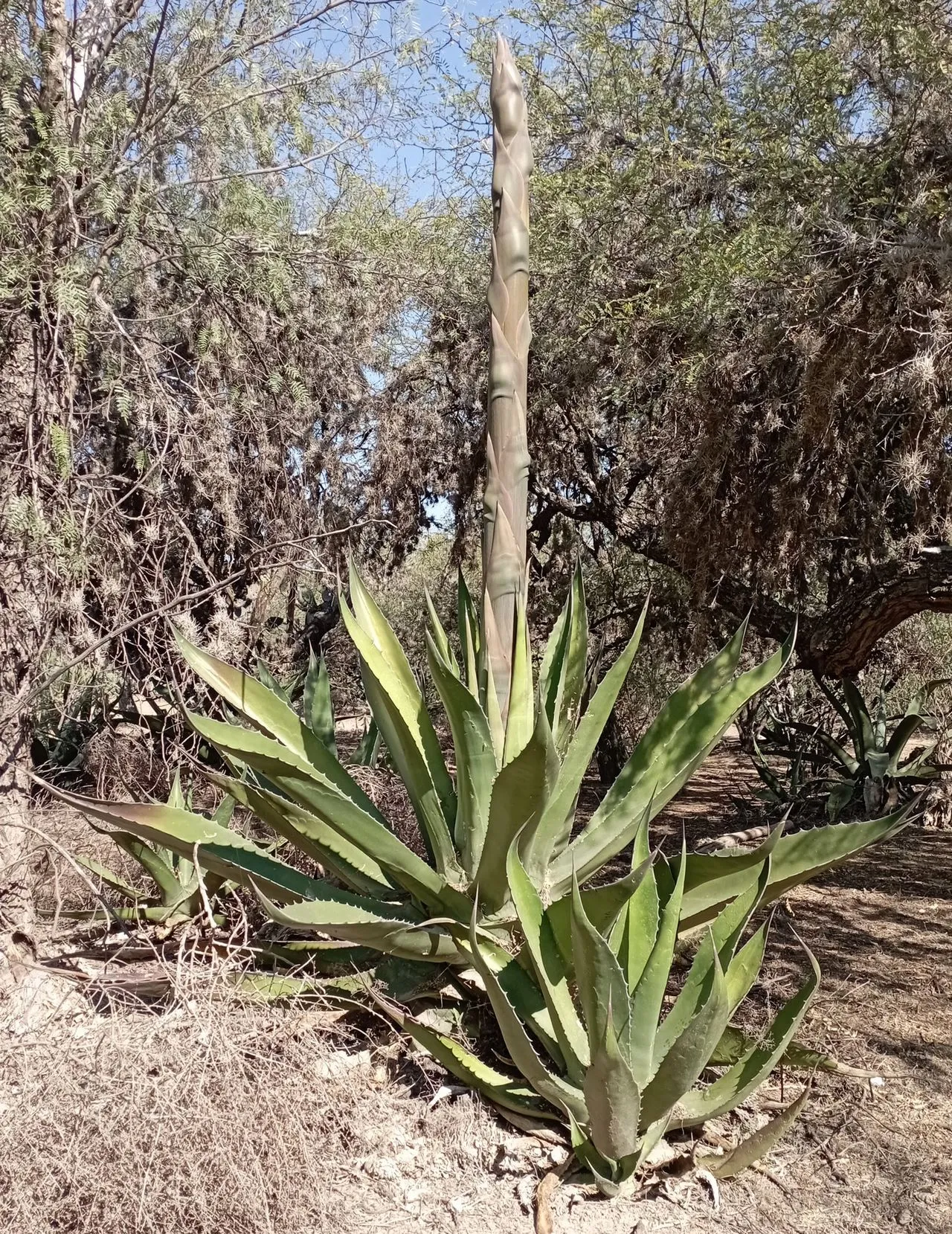
| How large does Agave salmiana grow? | Mature rosettes are usually 1.5 m to 2 m wide and 1 m to 2 m tall, with flower panicles 6 m to 9 m high. |
| How cold-hardy is Agave salmiana? | A dry, settled plant can survive brief drops to about −8 °C. |
| How do you propagate Agave salmiana? | Use seed for genetic diversity or rooted offsets for faster clones. |
Agave salmiana Otto ex Salm-Dyck, the pulque agave or maguey pulquero, was formally described in 1859 by Antoine François Eugène Otto ex Joseph Franz Maria Anton Hubert Ignatz Fürst und Altgraf zu Salm-Reifferscheidt-Dyck, usually shortened in horticulture to Salm-Dyck. The species is native to central and northern Mexico, especially Guanajuato, Hidalgo, San Luis Potosí, and Zacatecas, where it grows around 1,400-2,500 m on calcareous soils. A mature rosette is massive, usually 1.5-2 m wide and 1-2 m tall, with blue-grey leaves, strong marginal teeth, and a long terminal spine.
In habitat, A. salmiana belongs to high Mexican plateaus and limestone-derived slopes rather than low desert flats. Rain arrives seasonally, air movement is strong, and nights can be cool at altitude. The plant's size, waxy leaf surface, and deep carbohydrate storage all make sense in that setting: it can build a large reserve during favourable months, then endure dry, exposed periods without losing the crown. The species is listed as Least Concern in broad conservation assessments, but local cultivated forms, landraces, and field populations deserve more respect than a single status label suggests.
Part of the Complete Agave Guide.
Identification
A. salmiana is not a small patio agave. Even a young plant has a broad, heavy posture, and older specimens can dominate a courtyard or raised bed. The rosette is usually upright rather than flat, with leaves rising from the centre and then arching outward. In open ground, the plant often looks like a blue-grey fountain with armed edges. In a container, it becomes heavy before it becomes old, so pot choice and placement matter early.
Leaves are broad, thick, and deeply channelled, often 60-100 cm long on mature plants. Colour varies from grey-green to glaucous blue-grey depending on clone, light, and nutrition. The upper surface often shows strong impressions from neighbouring teeth while the leaf was folded in the central spear. Marginal teeth are bold, brown to grey-brown, and set on pronounced leaf margins. The terminal spine is long, rigid, and capable of puncturing skin or light footwear.
Flowering is monocarpic. A rosette grows for roughly 12-25 years, sometimes longer in containers or cool climates, then sends up a branched panicle that can reach 6-9 m. The flowering stem is not a decorative spike in the modest sense; it is a structural event. Once the panicle has exhausted the plant, the flowering rosette dies. Offsets around the base may continue if the clone produces them, but a solitary rosette should be treated as a long-lived individual rather than a renewable shrub.
The two main subspecies are useful to know. A. salmiana subsp. salmiana is the wild form, while A. salmiana subsp. crassispina is the cultivated pulque form most strongly associated with maguey fields. Subsp. crassispina tends to have especially robust leaves and spination, selected through long human use rather than nursery fashion.
The common lookalikes are Agave tequilana and Agave americana. A. tequilana, Weber's Blue agave, is the tequila plant. It has a narrower, more upright, more lance-shaped leaf, and the rosette is generally smaller and more uniform in plantation culture. A. salmiana is broader, heavier, and more basin-like at the crown. A. americana can match it in scale, especially in old gardens, but the growth pattern and teeth are different: A. americana often forms a looser, more spreading rosette with leaves that read flatter and more swordlike, while A. salmiana carries a fuller, more massive centre and a pulque-agave profile that looks built around storage.
Cultivation
Give A. salmiana more space than you think it needs. Outdoors, site it where a 2 m rosette will not block a path, catch clothing, or shade smaller plants. The terminal spines are at leg and eye height on a mature specimen. If you grow it in a container, a young plant can start in a 20-25 cm terracotta pot, but a serious specimen soon needs a broad, heavy 40-60 cm container or an open-ground position.
Light should be strong. In temperate climates, full sun is appropriate, especially with good air movement. In hot inland gardens, 6 or more hours of sun with some late-afternoon relief keeps the leaves firm without excessive summer scorch. Indoors, this is rarely a good long-term species unless you have a conservatory or greenhouse. A bright south-facing window may keep a young plant alive, but it will not produce the compact, powerful rosette seen under open sky. For newer growers managing light and watering habits across succulents, the broader principles in the beginner's guide still apply, but scale changes the consequences.
The substrate should be mineral, open, and alkaline-tolerant. For containers, use 60-75% mineral material such as pumice, lava rock, coarse grit, expanded shale, or limestone chips, with the remaining fraction as loam-based compost. Avoid peat-heavy mixes that stay wet at the centre of a large pot. A. salmiana has enough stored water in the leaves and stem; what it needs from the root zone is oxygen after watering.
Water deeply during active growth, then let the pot dry well before watering again. In a large terracotta container during warm weather, that may mean every 14-24 days. In open ground, established plants may need no irrigation except during unusually long dry spells. Use the lower third of the pot as your cue, not the dry top crust. If a moisture probe still reads wet near the base, wait. In winter, especially below 7 °C, keep the root zone dry.
Dry cold tolerance is respectable. A settled plant can survive brief drops to about -8 °C when the root ball is bone-dry and the crown is not holding water. Wet cold is the danger. Saturated compost plus frost damages roots, slows repair, and gives rot a route into the stem. In winter-rain climates, keep container plants under glass, beneath a roof edge, or in an unheated bright shelter. Open-ground plants need a slope, raised bed, or gravel mound rather than a flat planting hole.
Feed lightly. A low-nitrogen fertiliser at one-quarter to one-half strength, once in spring and once in early summer, is enough for container plants. Heavy feeding produces softer leaves and a faster, less resilient rosette. This species has been selected and used for stored sugars, but that does not mean it benefits from constant soluble nitrogen in a pot.
Propagation
Seed is the cleanest method for maintaining species-level diversity. Fresh seed germinates in 10-21 days at 22-28 °C on a fine mineral medium with light coverage. Seedlings begin as narrow green straps and only gradually build the heavy pulque-agave character. Expect several years before a seedling fills a 15 cm pot, and much longer before it has landscape presence.
Offsets are faster when the clone produces them. Remove pups during warm active growth, once they have their own roots and are at least 10-15 cm across. Cut the connecting tissue cleanly, let the wound dry for 5-10 days in shade, then pot into dry mineral mix. Wait another week before watering. A rooted offset may resume growth within 4-8 weeks in warm weather, but a large wound kept damp can rot before roots re-establish.
Do not core a garden plant for propagation unless you are deliberately managing it as a pulque crop or rescuing damaged material. Removing the centre changes the plant's physiology and usually sacrifices the rosette form. For ornamental cultivation, offsets and seed are safer, cleaner, and more respectful of the plant's architecture.
Notes / History
A. salmiana is one of the great cultural agaves of Mexico. For millennia, Mesoamerican peoples cultivated maguey not only as a landscape plant, but as a source of drink, fibre, boundary planting, fuel, food, and ritual material. Its association with pulque is the reason this species carries a history deeper than most ornamental agaves on a nursery bench.
Pulque begins with aguamiel, the sweet sap collected from the plant shortly before it would send up its flowering stalk. The grower removes the central bud and cores the cabeza of the rosette, creating a basin where sap accumulates. That act redirects the plant's stored energy away from the future panicle and into harvestable liquid. A productive pulque plant can yield about 4-7 litres of aguamiel per day for several months, and more than 200 litres in total before the exhausted rosette dies. The numbers matter because they explain the plant's scale: a small decorative agave could not support that kind of extraction.
Fresh aguamiel ferments quickly into pulque, a mildly alcoholic drink with deep pre-Hispanic roots and later colonial-era importance around central Mexican haciendas. The cultivated subsp. crassispina is especially tied to this use. It is not the same plant, culturally or botanically, as A. tequilana in tequila production. Tequila depends on cooked piñas of Weber's Blue agave from legally defined production regions; pulque depends on fresh sap drawn from a living, cored maguey before flowering.
In gardens, this history should make us more careful with the name. A plant labelled A. salmiana should have mass, breadth, strong teeth, and a pulque-agave stance. If it is narrow, fast, and plantation-blue, compare it with A. tequilana. If it is huge but looser and more swordlike, compare it with A. americana. Accurate naming is not academic fussiness here. It connects the plant in front of you to a region, a use, and a long chain of selection.
Pests are the usual large-agave problems. Agave snout weevil is the serious one in regions where it occurs, especially because a large soft-cored plant can collapse rapidly once larvae are inside. Sudden loosening of the rosette, sour smell, or centre collapse should be treated as urgent. Scale insects and mealybugs can shelter at the leaf bases, but they are secondary compared with basal rot and weevil damage.
Sap can irritate skin, and the spines are not minor hazards. Wear eye protection when repotting, and keep the plant away from narrow paths. For a broader genus-level frame on cold, drainage, flowering, and propagation, use the Complete Agave Guide.
See also
- Complete Agave Guide - genus-level cultivation, flowering, hardiness, and propagation.
- Agave tequilana, the narrower Weber's Blue agave used for tequila rather than pulque.
- Agave americana, a similarly large landscape agave often confused with pulque agave.
- Agave snout weevil — the main pest risk for large landscape rosettes like salmiana in warmer regions.
Frequently Asked Questions
What is Agave salmiana used for?
It is a major pulque agave. Aguamiel is collected from the cored rosette before flowering and ferments into pulque.
How large does Agave salmiana grow?
Mature rosettes are usually 1.5 m to 2 m wide and 1 m to 2 m tall, with flower panicles 6 m to 9 m high.
How cold-hardy is Agave salmiana?
A dry, settled plant can survive brief drops to about −8 °C. Saturated compost plus frost is the main winter risk.
How do you propagate Agave salmiana?
Use seed for genetic diversity or rooted offsets for faster clones. Pup wounds should dry for 5 to 10 days before potting.