| Question | Short Answer |
|---|---|
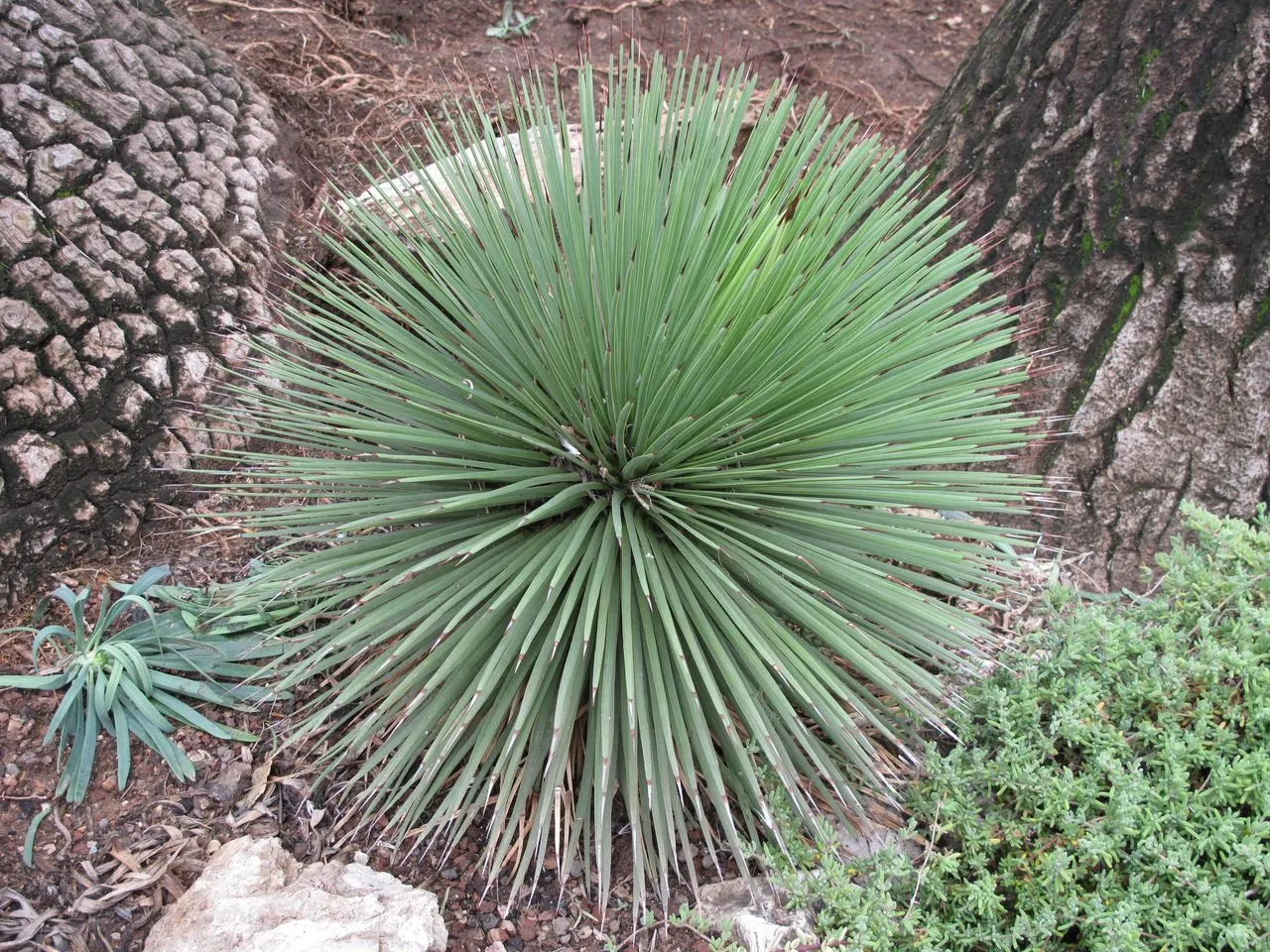
| Why is Agave stricta called hedgehog agave? | A mature rosette carries 100 to 200 narrow leaves with sharp dark terminal spines, producing a ball of points. |
| How big does Agave stricta get? | Typical rosettes are 50 cm to 70 cm wide, often forming clumps as offsets press around the base. |
| How cold-hardy is Agave stricta? | A dry, settled plant survives brief drops to about −5 °C. |
| How do you propagate Agave stricta? | Offsets are practical because the species suckers freely. |
Agave stricta Salm-Dyck, the hedgehog agave, was formally described in 1859 by Joseph Franz Maria Anton Hubert Ignatz Fürst und Altgraf zu Salm-Reifferscheidt-Dyck, usually shortened in horticulture to Salm-Dyck. The species is endemic to Puebla and Oaxaca in southern Mexico, where rosettes grow on limestone slopes between roughly 1,300 and 2,400 m. The defining feature is a dense globular rosette of 100-200 thin, stiff, dark green to grey-green leaves, each ending in a sharp brown-black spine that gives the plant its hedgehog silhouette.
In the field, A. stricta belongs to seasonally dry slopes, cliff edges, and limestone scree where the soil is shallow, alkaline, and freely drained. The species is listed as Least Concern by the IUCN, but populations are localised and sit alongside several rarer relatives in the same montane scrub. It rarely forms continuous stands. Instead you see clumps where one rosette has thrown a ring of offsets, often anchored into a fissure or above a rock shelf. That microhabitat matters more than the elevation number alone. The plant tolerates wide swings between night and day temperatures because the rock zone drains and warms quickly, not because it has unlimited cold tolerance.
Part of the Complete Agave Guide.
Identification
A mature A. stricta forms a tight globular rosette, typically 50-70 cm wide, made up of 100-200 narrow leaves radiating from a short central stem. As the plant ages, that central stem often elongates so the rosette appears to sit on a short caudex. Older clumps lift their crowns above the substrate by 10-30 cm, with offsets pressing in around the base. Each leaf is 25-50 cm long, only 1-1.5 cm wide, and carries a stiff, almost wiry quality that distinguishes it from the soft straps of larger ornamental agaves.
Leaf colour ranges from dark green to grey-green, sometimes flushing reddish in cold weather or strong sun. The leaves are channelled on the upper surface and lightly keeled below, with very fine, tooth-like serrations along the edges that are easier to feel than to see. The terminal spine is the unmistakable feature: brown to nearly black, 1-2 cm long, sharp, and aligned straight along the leaf axis. On a globular rosette of two hundred leaves, those spines collectively make a ball of points and explain the common name.
Flowering is monocarpic at the rosette level, but the species is one of a small group of agaves that effectively survives the event because it suckers prolifically from the base. After 15-25 years, an individual rosette throws a slender erect panicle to about 2-2.5 m tall, with maroon-red to pink-red flowers densely packed along the upper portion. The flowering rosette dies, but the surrounding clump continues. This habit is unusual enough that recent taxonomic work has proposed segregating A. stricta and a few relatives into a separate genus, Echinoagave; for now, A. stricta remains the accepted name.
Two species are commonly confused with A. stricta in trade. Agave striata is the closest match. It shares the narrow-leaved hedgehog shape but tends to have stiffer, slightly broader leaves, a more reddish or bronze hue, and a less rounded overall outline. A. striata also grows further north and has a different flowering profile. The other common confusion is Agave parviflora, but it is much smaller (rosettes 15-20 cm wide), with broader leaves carrying obvious white margins and curling fibres along the edges. A. parviflora reads as a miniature, decorated agave; A. stricta reads as a pincushion of dark green needles.
Cultivation
Give A. stricta strong light and a substrate that drains within minutes, not hours. Outdoors in temperate climates, full sun is appropriate, and in hot inland gardens the plant tolerates 8 or more hours of direct sun without scorching. Indoors, it needs the brightest position available, ideally an unobstructed south-facing window or a strong grow light. A plant grown in low light loses the dense globular outline, the leaves lengthen and droop, and the rosette opens out. For broader light and watering practice across mineral succulents, the beginner's guide covers the underlying logic.
Use a coarse mineral substrate. A useful container mix is 70-80% mineral material such as pumice, lava rock, coarse limestone grit, or expanded shale, with the remaining 20-30% as a low-peat loam-based compost. Limestone or dolomite chips suit this species particularly well because they buffer the pH upward, matching the alkaline scree the plant evolved on. Avoid peat-heavy mixes; the rosette is dense and hides slow drying at the crown, which leads to basal rot before you notice anything is wrong above.
Water deeply during active growth, then let the pot dry through the lower third before watering again. In a 15-20 cm terracotta pot in warm weather, that may mean every 10-16 days. In cooler or more humid conditions, intervals stretch toward 3-4 weeks. The dense leaf canopy holds humidity at the centre after irrigation, so water at the substrate rather than over the leaves, and prefer morning watering so the crown dries before nightfall. In winter, especially below 8 °C, keep the root zone almost completely dry.
Frost tolerance is moderate. A settled plant with a bone-dry root ball survives brief drops to about -5 °C without lasting damage. Below that, leaf tips brown, the central spear can blacken, and prolonged wet cold is lethal. In winter-rain climates, container plants belong under glass, in an unheated bright shelter, or beneath a deep eave. Open-ground plantings need a south-facing slope, raised mineral bed, or rock crevice where rainwater leaves the crown immediately.
Pot size should stay modest. A. stricta has a small fibrous root system relative to leaf mass, so a tight pot suits it: shift up only when the existing rosette plus offsets fill the surface. Terracotta is helpful in temperate or coastal climates because the porous wall accelerates drying after watering. Feed lightly, with a low-nitrogen fertiliser at one-quarter to one-half label strength, once in spring and once in early summer. Heavier feeding produces longer, weaker leaves and breaks the dense globular form that gives the species its character.
Propagation
Offsets are the practical method for this species. A. stricta suckers freely from the base, often producing pups while the parent rosette is still small. Wait until a pup has its own roots and is at least 5-8 cm across, then sever the connecting stolon cleanly with a sharp blade. Let the wound dry for 4-7 days in shade, pot into dry mineral mix, and wait another 5-10 days before watering. Rooted offsets typically resume growth within 4-6 weeks in warm weather and reach a small recognisable rosette within 12-18 months.
Seed works for maintaining genetic diversity but is slower. Fresh seed germinates in 10-21 days at 22-26 °C on a fine mineral surface with light coverage. Seedlings begin as thin green threads and only gradually take on the bristly hedgehog character; expect 2-3 years before a seedling fills a 9 cm pot, and considerably longer for a presentable specimen. Use seed when you want true species material rather than the trade clones that circulate as offsets, which can drift toward A. striata or hybrid forms.
Detached leaves do not root for this species. Agaves in general do not regenerate from leaf cuttings the way echeverias and many sedums do, so do not waste material trying.
Notes
Despite the high leaf count, A. stricta is not difficult to grow well; it is difficult to grow tightly. The two failures I see most often are pots that are too large with mixes that are too organic, and winter watering that continues out of habit when the plant has stopped using water. Both produce loose rosettes with elongated leaves and, eventually, basal rot.
In trade, the name A. stricta sometimes covers material that is closer to A. striata or to intergrades between the two. If you want a true hedgehog form, look for tight clumps with narrow leaves under 1.5 cm wide and short, dark, near-black terminal spines. Plants whose leaves are 2 cm or wider, with brownish rather than near-black spines, are likely A. striata or hybrid material rather than typical A. stricta.
Pests are mostly secondary. Mealybugs occasionally settle deep in the rosette where the dense leaf base hides them; check the centre by parting a few outer leaves with long tweezers, not fingers, since the spine count is high. Scale appears occasionally on plants kept in still air. The agave snout weevil that damages large landscape agaves rarely targets A. stricta, probably because the rosette mass is small and the central crown is narrow.
The terminal spines are the practical hazard. A globular rosette presents hundreds of points at chest or eye height when the plant sits on a bench. Place the pot accordingly, and wear eye protection during repotting. For genus-level cultivation, hardiness, and propagation context that connects this species to the broader agaves you might grow alongside it, see the Complete Agave Guide.
See also
- Complete Agave Guide - genus-level cultivation, flowering, hardiness, and propagation.
- Agave parviflora - much smaller, with white-margined leaves and curling marginal fibres.
- Agave victoriae-reginae - compact and slow-growing, with bold white leaf markings.
- Agave geminiflora — a filiferous many-narrow-leaf species with a soft tip rather than a sharp terminal spine.
Frequently Asked Questions
Why is Agave stricta called hedgehog agave?
A mature rosette carries 100 to 200 narrow leaves with sharp dark terminal spines, producing a ball of points.
How big does Agave stricta get?
Typical rosettes are 50 cm to 70 cm wide, often forming clumps as offsets press around the base.
How cold-hardy is Agave stricta?
A dry, settled plant survives brief drops to about −5 °C. Prolonged wet cold is lethal.
How do you propagate Agave stricta?
Offsets are practical because the species suckers freely. Rooted pups 5 cm to 8 cm across can be severed, callused, and potted dry.