| Question | Short Answer |
|---|---|
| What is the main identification point? | The Identification section separates Aloe arenicola by plant habit, leaf form, marginal teeth or surface markings, flowers, and lookalikes named in the article. |
| How should this aloe be watered? | Follow the Cultivation section rather than a fixed calendar. |
| How is it propagated? | Use the Propagation section. |
| What should buyers watch for? | Check the Notes and lookalike sections. |
Aloe arenicola Reynolds (sand aloe) is a creeping aloe endemic to the coastal sand dunes and sandy flats of Namaqualand in western South Africa, between roughly Lamberts Bay and the mouth of the Orange River. The epithet arenicola means "sand-dweller" and reflects the species' highly specific habitat of wind-shaped white sand overlying quartzitic substrate.
Part of the Complete Aloe Guide.
Identification
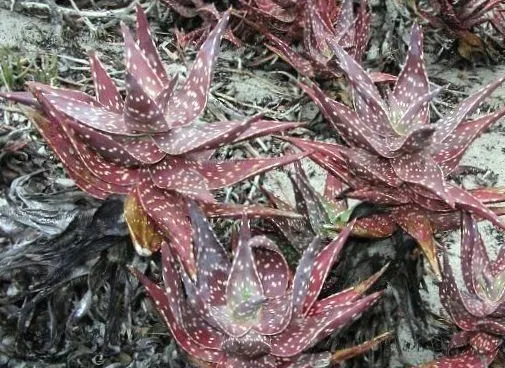
A decumbent to creeping aloe with stems that lie along the substrate and turn upward at the tip, forming small rosettes of 12 to 20 recurved leaves. Stems reach 40 to 80 cm in length over many years, rooting intermittently where they touch the sand. Leaves are 10 to 15 cm long, pale green flushing pink-red under sun and drought stress, and carry conspicuous scattered white spots on both upper and lower surfaces. Leaf margins have small firm teeth.
The creeping habit and heavy white spotting separate A. arenicola from most other South African aloes in the same size class. The closest morphological relative in the field is Aloe khamiesensis, which is more upright and less heavily spotted. Inflorescence is an unbranched raceme 30 to 50 cm tall with coral-pink to dull red tubular flowers, blooming in late spring in habitat.
Cultivation
The natural habitat is a clue to the essential cultivation requirement: A. arenicola demands a very fast-draining mostly sandy substrate. My working mix for this species is 60% coarse sand (3 to 5 mm grit), 20% pumice, 10% loam-based compost, and 10% fine grit. Standard aloe mixes retain too much moisture and predictably rot the creeping stems at their contact points with the substrate.
Full sun is essential for the pink-red leaf flush that is the species' main ornamental feature. Under lower light the leaves revert to a plain pale green and the creeping habit becomes untidy. Frost tolerance is limited: the Namaqualand coast rarely freezes, and in cultivation the species is best kept above 5°C.
The creeping habit means A. arenicola suits wide shallow pans or raised beds rather than deep pots. In a standard upright container the stems eventually arch over the rim and lose contact with substrate, which stalls growth.
Propagation
Stem cuttings are unusually easy for an aloe, taking advantage of the species' natural adventitious rooting along procumbent stems. Cut a 15 to 20 cm stem section, callus for a week, and lay it on sandy mix, pinning in place if needed. Roots form along the buried section within three to four weeks. This mimics the species' natural vegetative spread in habitat and is the preferred propagation route.
Seed is viable between genetically distinct plants, germinates on sandy mix within two to three weeks at 22 to 26°C, and seedlings reach characteristic spotted-leaf morphology by the second year. Basal offsets occasionally form at nodes along older stems and can be separated with adventitious roots intact.
Notes
A. arenicola is listed as Least Concern on the IUCN Red List, but the Namaqualand coastal habitat is fragmented and under pressure from diamond mining and coastal development. Purchase only nursery-propagated material.
The species' creeping habit makes it a useful ground-cover aloe in frost-free xeric plantings, where it fills space efficiently and colours well under sun. It is less suited to conventional windowsill culture than most small aloes because of the substrate requirements and the stem habit that benefits from horizontal space.
A practical growing note: the older stem sections shed their leaves and become bare as the plant extends, which is normal and does not indicate problems. Prune and re-root the growing tips every three to four years to keep specimens compact, using the pruned sections as cuttings.
See also
- Aloe argenticauda
- Aloe albiflora
- Aloe bakeri
- Aloe striata — South African coral aloe with a distinctive toothless margin, contrasting the spotted creeping habit.
Frequently Asked Questions
What is the main identification point?
The Identification section separates Aloe arenicola by plant habit, leaf form, marginal teeth or surface markings, flowers, and lookalikes named in the article.
How should this aloe be watered?
Follow the Cultivation section rather than a fixed calendar. The article gives drying depth, seasonal growth rhythm, and the wet-cold risk for this plant.
How is it propagated?
Use the Propagation section. The article states whether offsets, stem cuttings, or seed are practical, and notes that single-leaf cuttings do not work for aloes.
What should buyers watch for?
Check the Notes and lookalike sections. The article flags trade confusion, hybrid material, or conservation sourcing where those issues apply.